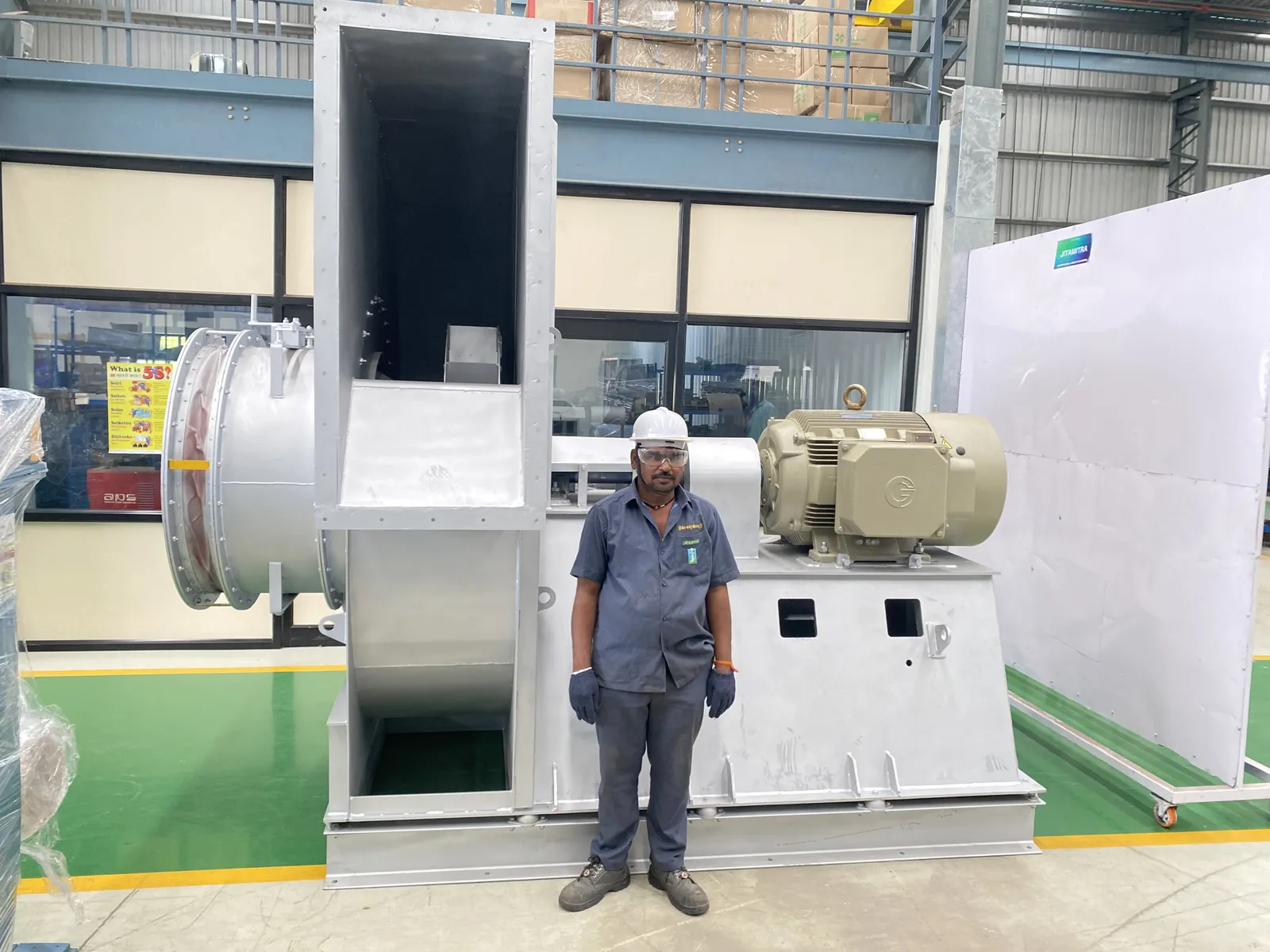
| Who | A boilers & combustion equipment OEM in Maharashtra, also active in furnaces, ovens and heat-treatment |
| Equipment | Jitamitra centrifugal blower, 1200 CMH / 425 mmWC / 5 HP / 30 °C |
| Complaint | Abnormal noise from the blower, reported with five site videos of the running unit |
| Service | Warranty investigation of the drive motor — field triage, motor withdrawal, factory strip-down |
| Response | Motor removed from site and opened at our works; an interim spare motor issued from our own stock so the customer kept running |
| Result | Root cause proved: rotor-to-stator rub inside the bought-out drive motor — not the bearings. Motor sent for repair under warranty, blower re-assembled on the spare. Post-repair noise readings and customer closure are not in our record, and we do not claim them. |
The customer is an OEM in the boilers & combustion space, also building furnaces, ovens and heat-treatment lines. Our blower leaves their works already integrated into their equipment — so it does not serve their plant, it serves their customers' plants, under their name.
The duty is modest on paper: 1200 CMH at 425 mmWC, 5 HP, 30 °C — a compact, high-static combustion-air blower, small volume and hard pressure. What matters is where it sits: the burner's air supply depends on it, and because it is an OEM-supplied component, a noise complaint on one machine is a question mark over every machine the OEM ships with that blower on it.
The stakes were not "a noisy fan". They were an OEM's confidence in a component carrying their brand.
The complaint was one line: noise problem. With it came five phone videos of the blower running.
"Noise" is the least diagnostic word in rotating equipment. It can be aerodynamic (inlet system effect, a badly-fitted flexible connector, duct resonance), mechanical (bearings, coupling, loose fasteners, a fouled impeller), electromagnetic (the motor), or structural (a base that amplifies everything).
Our own first triage went straight to the obvious suspect, and logged itself as a question rather than a finding: "I think this seems bearing noise…?"
Bearings are the obvious suspect because bearings are usually right — and a phone video will happily support that theory, because a video captures only the symptom. Abnormal noise sounds like abnormal noise no matter where in the machine it is born.
This time the obvious suspect was wrong.
We ruled out in the order that costs the customer least.
1. Aerodynamic and system causes. The unit was in normal service at its design duty. No duct modification, damper change or process change coincided with the onset. Nothing pointed to a system-effect or resonance origin.
2. Bearing and fan-side mechanical causes — the leading hypothesis. Here we made a deliberate call: a noise you cannot localise in the field does not get diagnosed in the field. Distinguishing a rub from a bearing from an electromagnetic hum, standing next to a running burner set, is guesswork with a clipboard. So we withdrew the drive motor and brought it back to our works.
3. Factory strip-down — where the answer was. With the motor opened on the bench, the fault was unambiguous: the rotor was contacting the stator. The rub was inside the motor air-gap. The fan bearings — prime suspect all week — were not the source at all.
That is a bought-out component fault, and we treated it as one: the motor was covered under warranty and went for repair. Meanwhile we did the thing that decides whether a warranty case becomes a relationship problem — we issued a spare motor from our own stock, so the blower could be re-assembled and returned to service instead of waiting on the repair cycle.
Why the abnormal noise? Metal-to-metal rubbing inside the machine. Why rubbing? The motor rotor was contacting the stator. Why contact? The rotor–stator air-gap was not being held — a build, tolerance or fit issue inside the drive motor. Why did it reach a running plant? A rotor-stator rub is invisible from outside the motor and does not always announce itself at first run. Why was it not caught before dispatch? Because a bought-out motor was screened by function — "it runs" — not by an air-gap check and a no-load run-and-listen on the motor as a component.
The reusable lesson: A fan is not one machine. It is an aerodynamic machine bolted to an electrical machine. When the symptom is noise, the electrical machine is a first-class suspect — not a footnote after the bearings. And a symptom you cannot localise in the field is a symptom you take to a bench.
What our record proves, and what it does not:
We would rather publish a case that ends with an honest full stop than one that ends with a compliment we cannot evidence.
Don't stop at the first plausible label. "Bearing noise" is the default hypothesis on any noisy fan because it is usually right — which is exactly what makes it dangerous. Two rules fall out:
If you have a fan or blower making a noise nobody can explain — vibration you cannot trend, a bearing that keeps getting blamed, a motor nobody has opened — we will come and look at it properly. We service centrifugal fans and blowers of any make, not only our own. Balancing to ISO 21940; vibration assessed against ISO 14694 (rigid BV-3: 4.5 mm/s accept, 7.1 alarm, 9.0 shutdown; flexible 6.3 / 11.8 / 12.5); performance tested to IS 4894 / ISO 5801 / AMCA 210 method.
— Jitamitra Electro Engineering · Technical Services
Engineered for Every Application.
Not necessarily. Bearings are the obvious suspect because bearings are usually right, and a phone video will happily support that theory, because a video captures only the symptom. On this 1200 CMH combustion-air blower the noise was a rotor-to-stator rub inside the drive motor. The fan bearings, prime suspect all week, were not the source at all.
Not reliably. Abnormal noise sounds like abnormal noise no matter where in the machine it is born. A noise you cannot localise in the field does not get diagnosed in the field — distinguishing a rub from a bearing from an electromagnetic hum, standing next to a running burner set, is guesswork with a clipboard.
By ruling out in the order that costs the customer least — aerodynamic and system causes first, then fan-side mechanical — and then opening the machine. With the motor withdrawn and opened on the bench at our works, the fault was unambiguous: the rotor was contacting the stator, and the rub was inside the motor air-gap.
Yes. On this job the fault sat in the bought-out drive motor and was treated as a bought-out component fault: the motor was covered under warranty and went for repair.
Not if it can be avoided. Here an interim spare motor was issued from our own stock, so the blower could be re-assembled and returned to service instead of waiting on the repair cycle.
No. Post-repair noise readings and customer closure are not in our record, and we do not claim them.
Flow, static, gas temperature, application — or attach a spec, GA drawing or a multi-fan schedule. Engineer to engineer.
ISO 9001:2015 quality system · performance-tested to IS 4894 / ISO 5801 / AMCA 210 method · witnessed FAT on request.
*For our standard range. ATEX and special projects need 5 to 7 working days.
This site sets no cookies of its own. Google Analytics loads only if you accept. It sets two cookies, so we can see which fan topics people actually read. Decline and no analytics loads — the site works exactly the same. What we collect →