Is your paint-booth fan ATEX-rated, and for which zone?
Yes. Spray-paint booths are Zone 2 gas atmospheres by directive interpretation, because solvent vapour is present during application and flash-off. Our standard paint-booth fan is configured Ex II 3G for Zone 2 — aluminium non-sparking impeller, bronze rub rings, bonded earthing, anti-static coatings and a T3 temperature class (max surface 200 °C). To be precise, this is an ATEX self-declaration of conformity under Module A per 2014/34/EU, not a third-party certification. For powder-coat booths we add Ex II 3D for the Zone 22 dust. Zone 1 (Cat 2G) is available on application via a Notified Body.
How do you stop paint overspray building up on the impeller?
Three measures, specified to your paint chemistry. A radial-tipped self-cleaning impeller geometry that sheds film rather than trapping it; PTFE-based anti-stick coatings on the impeller and casing interior; and gasketed, bolted access doors at the volute throat and on the wheel-cover so the rotor can be washed down in place — typically on a weekly schedule. Backward-curved efficient wheels are used only on the cleanest after-filter (post-activated-carbon) configurations where overspray is minimal.
How does the fan hold booth velocity as the filters fill?
Booth capture depends on a fixed face velocity — typically 0.3-0.6 m/s for solvent paint and 0.5-1.0 m/s for powder coat. As the paint stops, cardboard and carbon load, system resistance climbs. We size the fan to deliver rated velocity at 100% filter loading, not just clean, and fit VFD speed control as standard on new installations so the fan ramps up as the filters fill instead of coasting down and letting overspray drift onto the operator.
What materials do you use, and what changes for water-wash-down booths?
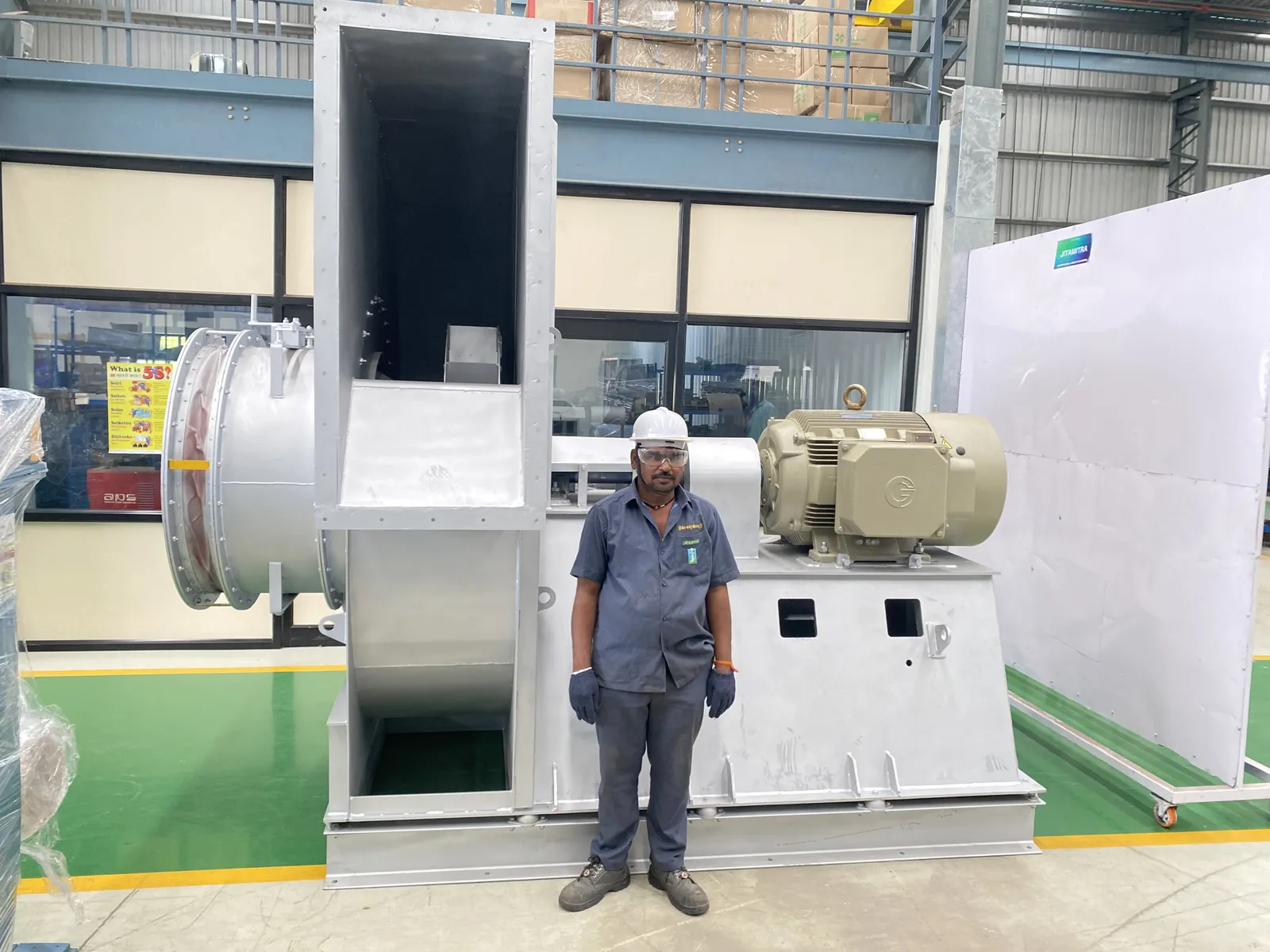
An aluminium non-sparking impeller for ATEX compliance, specified case-by-case per booth chemistry and ATEX class. Casing is 304 SS with an epoxy-paint exterior for solvent-only service. For water-wash-down booths we move to 316L SS, because the frequent cleaning chemistry attacks lesser grades. PTFE / anti-stick coatings go on the impeller and casing interior to minimise paint adhesion. The metallurgy is matched to your booth, not a default.
We run a powder-coat line, not solvent. What is different?
Powder-coat booths are Zone 22 combustible-dust atmospheres, sometimes with Zone 2 gas too if a solvent-based topcoat is used. We keep the same aluminium-impeller, bronze-rub-ring base, tighten the anti-static coating resistivity to below 10^8 ohm-sq for the dust-cloud risk, and add Ex II 3D marking on top of Ex II 3G where solvent is also present. Booth face velocity is also higher, typically 0.5-1.0 m/s, and the fan is sized for that.
Can you supply the filter bank with the fan, or just the fan?
We deliver the fan with a mounting flange and a transition to your paint-booth filter bank as standard, so it lands onto your existing booth exhaust train. Where you prefer an integrated supply — fan plus filter bank as one package — we offer that on application through a partnered booth-OEM channel. Tell us the filter configuration (paint stop / cardboard / activated carbon) and we quote the scope to match.
How loud is the fan beside the operator station?
Paint booths sit next to operators, so our standard sound limit is below 80 dB(A) at 1 m. Where the booth needs it quieter, we supply a full acoustic enclosure to bring it below 75 dB(A) on application. Tell us the limit at the operator position and we engineer the fan and enclosure to meet it.
What is the lead time, and do you performance-test before dispatch?
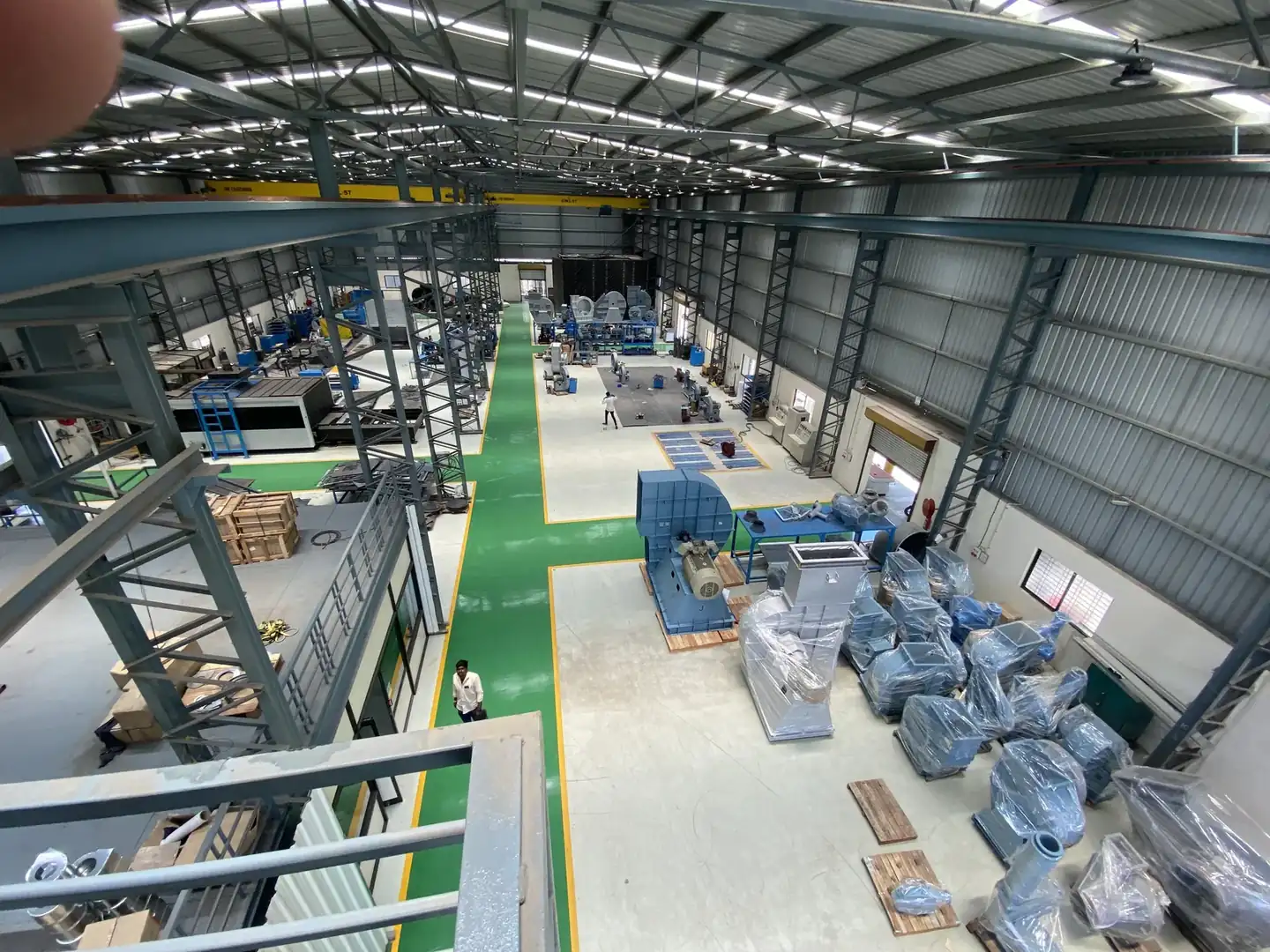
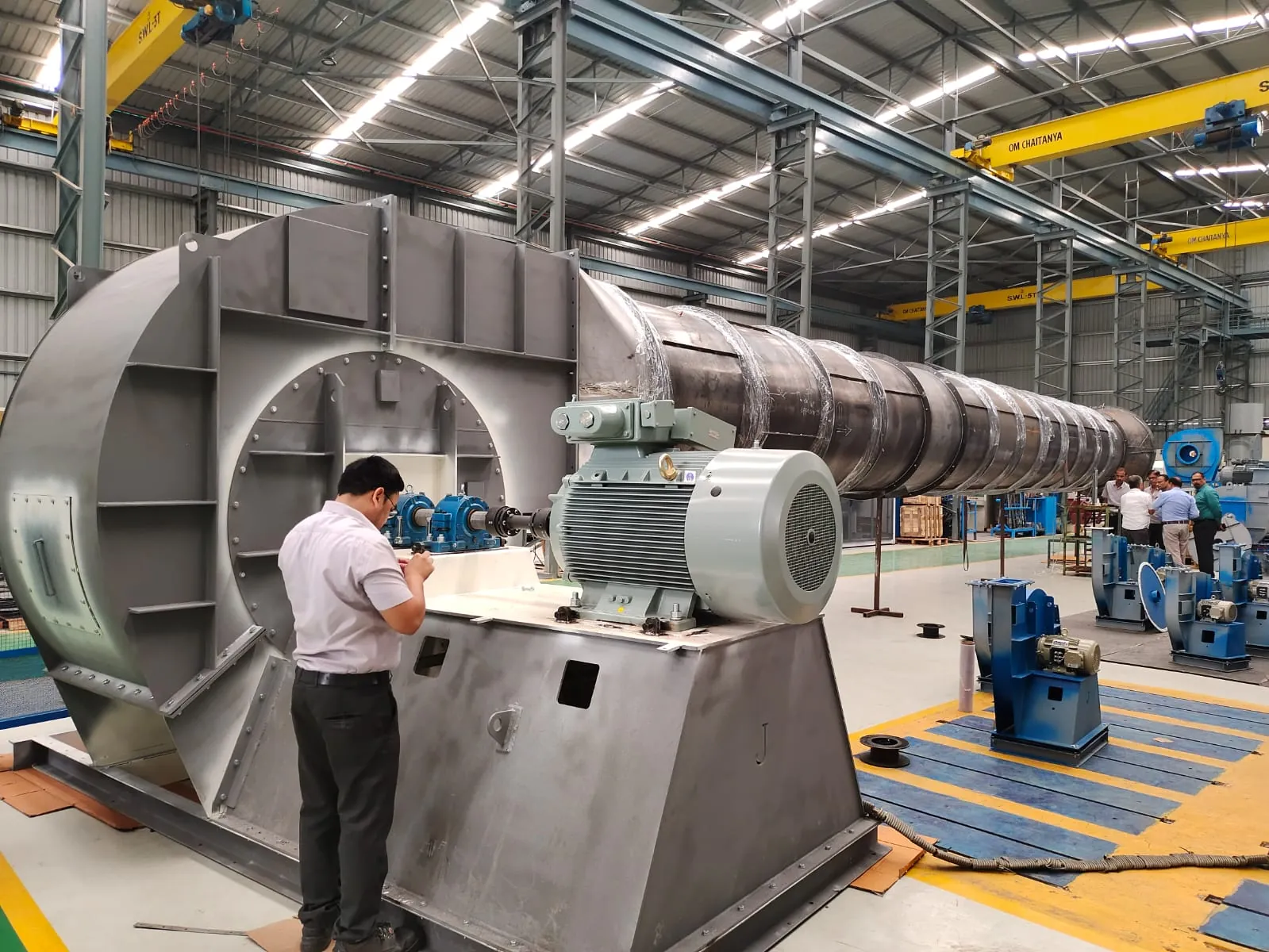
Offer turnaround is 5 working days for standard duty (7-10 for high-spec or multi-zone). A standard paint-booth fan runs roughly 9-13 weeks order-to-dispatch — GA approval 2-3 weeks, manufacture, balance and paint 6-9 weeks, test and FAT 1 week. Every fan is performance-tested in-house to the AMCA 210 / ISO 5801 method on our 200 HP VFD test rig and dynamically balanced to ISO 21940 G6.3 (G2.5 / G1.0 on application). You see the curve and the balance report before it leaves the floor.