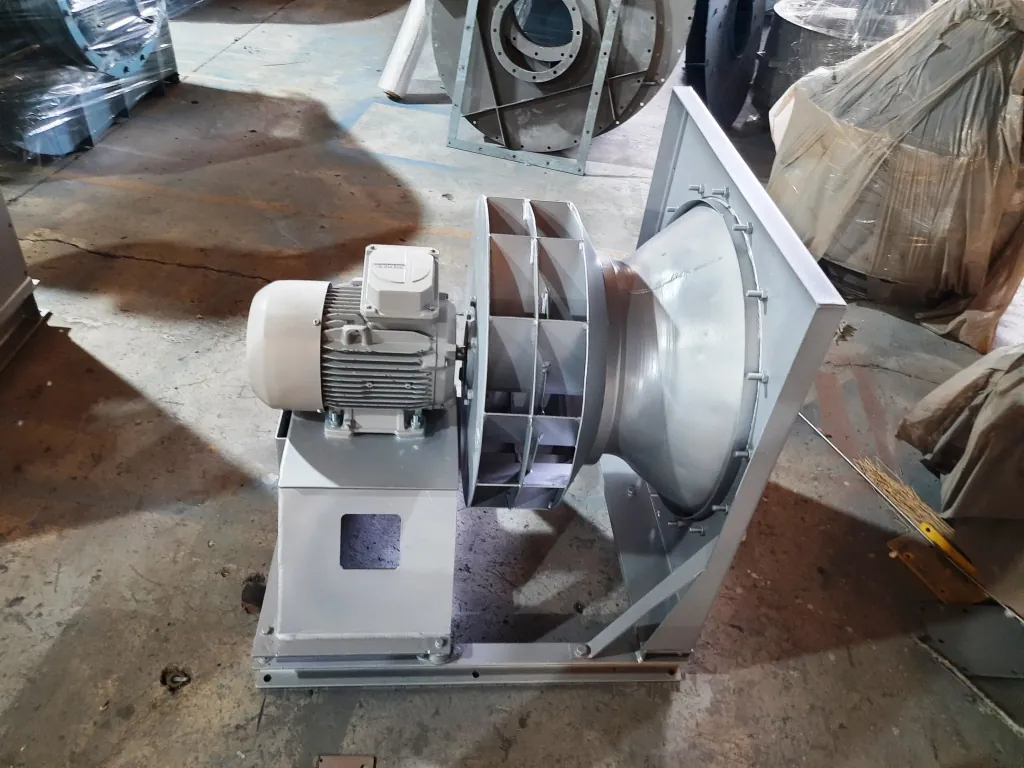
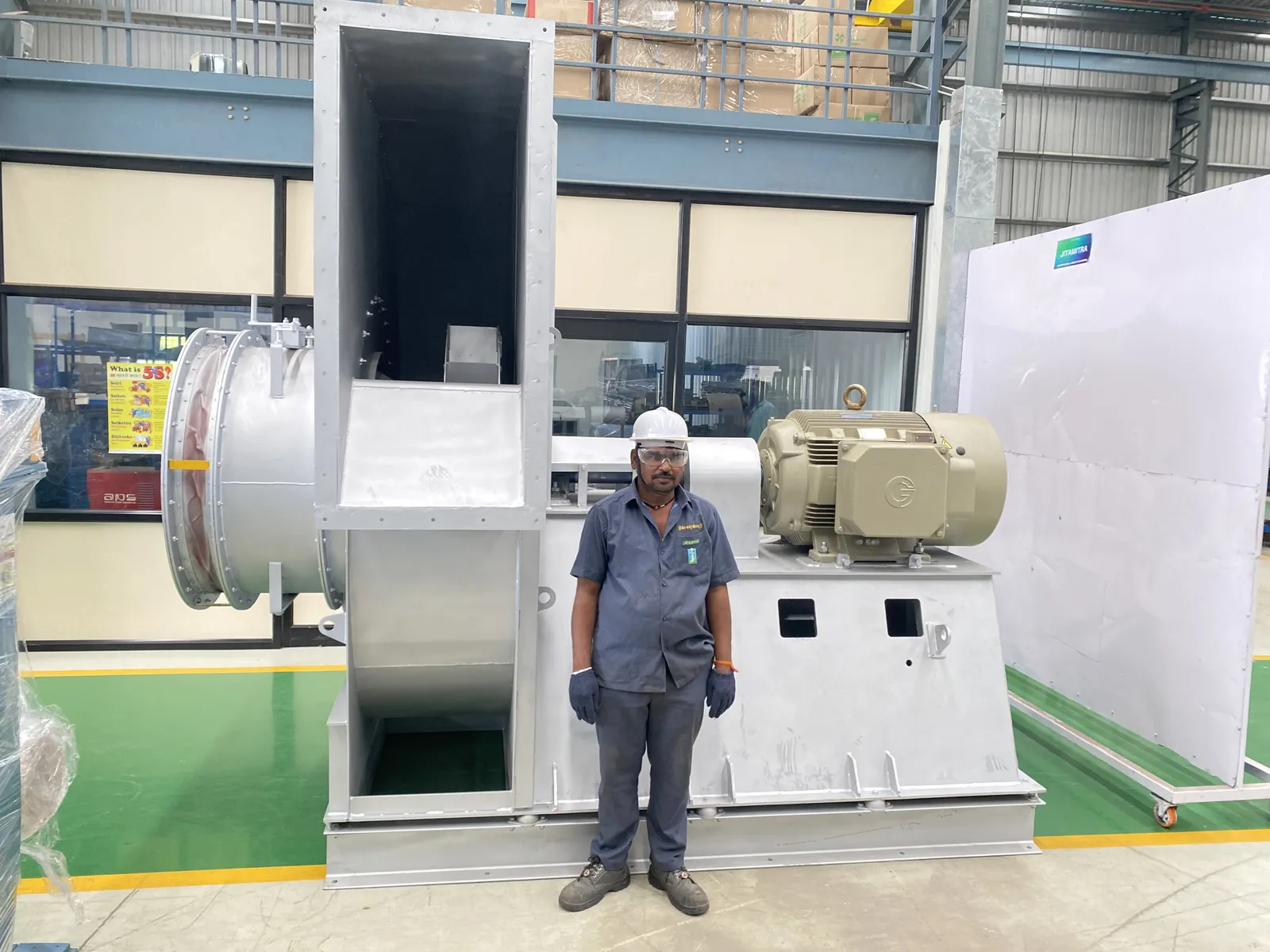
Radial-tip centrifugal fan impeller on the Jitamitra shop floor — curved-root, straight-tip blades
Home  /  Products  /  Jitamitra Radial-Tip
Products

Radial-Tip fans — the moderate-dust middle ground, where backward erodes and a full radial wastes power.

The Jitamitra Radial-Tip wheel curves at the root and finishes straight (radial) at the tip: dust-tolerant and self-cleaning where a backward blade would erode, yet far more efficient than a full paddle radial. It is the family for gas carrying moderate dust — too much for a backward fan, below the heavy abrasive load of a radial — at medium-to-high pressure. Cement and raw-mill vent, dust-laden drying, sludge handling. Engineered to your duty across the envelope below, on a Class 4–5 build and proven on the rig.

moderatedust tolerance
shared on enquirypeak static eff.
medium–highpressure class
to dutyengineered, not stocked
15,000+
fans built since 2011
200 HP
VFD test rig · IS 4894 / AMCA 210
99%
on-time delivery
3
working days to quote — always
CURVED ROOT · STRAIGHT (RADIAL) TIP · SELF-CLEANING · CLASS 4–5 · 150 m/s TIP SPEED
What the geometry does

A radial-tip wheel does three things at once — it is the deliberate middle of the range.

The blade is curved near the hub and straightens to radial at the outer tip. That single geometric choice splits the difference between the efficient backward families and the rugged paddle radial — and it is why the family exists.

  • 01
    Tolerate dust

    The straight, radial tip is self-cleaning and shrugs off particulate that would erode and clog a backward blade — the moderate-dust middle of the range.

  • 02
    Hold efficiency

    The curved root keeps the inflow clean, so peak static efficiency lands well above a pure paddle radial's — the reward for not over-building for the dust.

  • 03
    Make pressure

    A higher tip speed (150 m/s, Class 4–5 build) develops medium-to-high static — enough for mill-vent and dust-laden draught duty.

GENERAL ARRANGEMENT to scale from our design drawings IMPELLER · RADIAL-TIP BLADE wheel schematic DISCHARGE ORIENTATIONS · ENGINEERED TO ORDER 45° 90° 135° 180° 225° 270°
Fig. 1General arrangement, impeller and 7 discharge orientations. Drawn to scale from our in-house design drawings; every fan engineered to your duty.
Why you pick this wheel

Three drivers send a duty to the radial-tip — and each carries a trade-off.

The radial-tip is chosen when the gas is dusty enough to erode a backward fan but not abrasive enough to justify a full radial. Pick it for the right reasons and you keep efficiency the radial would have cost you; pick it for the wrong gas and you under- or over-build. Once the abrasive load runs beyond moderate, this is the wrong family — step to the radial.

01 — DUST

Moderate dust that erodes backward blades

Cement / raw-mill vent and dust-laden drying gas carry particulate a smoothly-profiled backward or aerofoil blade cannot survive — the thin profile erodes and the build-up clogs the passages.

How we engineer it out

The straight radial tip is self-cleaning across the family's moderate-dust range; leading-edge hardfacing and bolt-in replaceable scroll liners are specified to the wear mode, with impeller-overlay refurbishment for the wear life.

02 — PRESSURE

Medium-high pressure at the dusty duty

Mill-vent and draught duties need real static, but a dust-tolerant wheel run faster carries blade-root and tip-speed stress that fails a fan built on hope.

How we engineer it out

A Class 4–5 build — thicker plate, FEA on the higher-stress wheels, fine balancing — runs the 150 m/s tip safely to medium-to-high static rather than a fabricated wheel spun up and trusted.

03 — EFFICIENCY

Running cost the radial would waste

Reaching for a full paddle radial on merely-moderate dust throws away efficiency — and on a fan running thousands of hours a year that is real electricity cost.

How we engineer it out

The curved root holds peak static efficiency noticeably above a pure radial's; we reserve the Radial family for genuinely heavy abrasive loads, not moderate dust.

How we build it

Every choice is documented on the GA drawing you sign off — before we cut metal.

We don't sell a catalogue near-fit. The wheel is sized to your flow, pressure, dust load and temperature, then engineered for the wear mode and the tip-speed stress.

  • Blade form & wheel geometry — Radial-tipped wheel — curved at the root for clean inflow, straight (radial) at the tip for self-cleaning and dust tolerance; sized near best efficiency on the selected wheel, with FEA on the higher-stress builds at the 150 m/s tip.
  • Materials & wear protection — MS standard; wear-plated (WP) recommended on abrasive duty — leading-edge hardfacing (qualified WPS) and bolt-in replaceable scroll liners; SS304 / 316, Corten or duplex on the airstream for corrosive gas; FRP (F) where the chemistry calls for it.
  • Construction suffixesHT high-temperature (refractory-grade construction + shaft cooling disc) for hot mill-vent gas; SR spark-resistant (AMCA 99 Type A/B/C, ATEX self-declared) for combustible-dust zones; F FRP; WP wear-plated. SWSI is standard for this family.
  • Drive & control — Belt or direct drive; inlet / outlet damper or in-cone IGV for capacity control; VFD with shaft-earthing ring for variable duty; split SNL plummer-block bearings for maintainability; shaft cooling disc above ~150 °C.
Engineered to your duty point

We size the wheel where its curve crosses your system — then prove it on the rig.

No catalogue fan forced onto your spec. Your operating point is engineered onto the best-efficiency region of the selected radial-tip wheel — then verified on the 200 HP VFD test rig to the AMCA 210 / ISO 5801 method before dispatch.

avoid: unstable 0 40,000 80,000 1,20,000 1,60,000 2,00,000 VOLUME FLOW RATE  [ CMH ] 0 500 1000 1500 2000 STATIC PRESSURE  [ mmWC ] 0 25 50 75 100 STATIC EFFICIENCY  [ % ] Fan static pressure System resistance Static efficiency BEP 82% DUTY POINT 1,20,000 CMH · 450 mmWC Fan static pressure System resistance Static efficiency
Fig. 2Representative radial-tip characteristic — fan static pressure, system resistance and static efficiency vs. flow, with the duty point engineered onto the best-efficiency region. Illustrative; every fan is sized to its own duty.
Capability envelope — radial-tip service

What we can supply, and where it stretches on application.

ParameterStandardOn application
Volume flowup to 2,00,000 CMHhigher on enquiry
Static pressureup to 2,000 mmWCto the envelope; per wheel + class
Inlet dust loadingmoderate — more than a backward family should seeheavier abrasive load → step to the radial family
Continuous gas temperatureup to 600 °C with HT constructionhot-duty build confirmed on enquiry
Peak static efficiency (family character)well above a paddle radial; below the backward familiesduty-point efficiency engineered onto best-efficiency region
Drive powerup to 400 HPhigher with custom motor sourcing
Balance qualityISO 21940 G6.3 standardG2.5 fine balance for the 150 m/s tip
Bearing life (design target)L10h ≥ 40,000 h continuouslonger L10 on application

The envelope above is our published ceiling; the radial-tip family's own character sits inside it — a self-cleaning straight tip for moderate dust, peak static efficiency well above a paddle radial's (exact figures shared with your enquiry), on a Class 4–5 / 150 m/s build. Where the dust runs heavier or more abrasive, the rugged radial family is the right answer; where the gas is clean, a backward family is more efficient. We will tell you which.

How a Jitamitra Radial-Tip fan is specified

Specified, not picked from a shelf.

The same engineering language carries from your enquiry to the GA drawing to the nameplate — expressed in the standard AMCA conventions, with the radial-tip family options spelled out.

Specification fieldOptions
Arrangement (AMCA 99)Arr. 1 (overhung, fan bearings) / Arr. 4 (direct, motor on base) / Arr. 8 (overhung on common base) / Arr. 9 (overhung, motor side) / Arr. 10 (overhung, motor inside base) — selected by drive, access and temperature.
Width / inletSWSI (single width, single inlet) — standard for radial-tip duty; the family is built single-inlet for the pressure and the wear-protected wheel.
Wheel typeRadial-tipped (curved root, straight radial tip) — self-cleaning, moderate-dust, medium-high-pressure; the deliberate middle between backward (efficiency) and full radial (ruggedness).
Class (by pressure / outlet velocity)Class 4–5 build for the 150 m/s tip — thicker plate, FEA on the higher-stress wheels, fine balancing; class selected from the duty point on the pressure-vs-outlet-velocity limits.
Materials of constructionMS (standard) / wear-plated WP with leading-edge hardfacing + bolt-in replaceable scroll liners for abrasive duty / SS304, SS316, Corten or duplex on the airstream for corrosion / FRP (F) for chemical service.
Construction & high-temp suffixesHT (high-temperature / refractory-grade construction + shaft cooling disc above ~150 °C) / SR (spark-resistant, AMCA 99 Type A/B/C + ATEX self-declared) / F (FRP) / WP (wear-plated) — combined as the duty requires.
DriveDirect-coupled / V-belt / VFD with shaft-earthing ring for variable duty. Drive up to 400 HP across the envelope; capacity trim by inlet / outlet damper or in-cone IGV.
Discharge & rotation (AMCA orientation)Rotation CW or CCW (viewed from drive side) with discharge angle per AMCA — e.g. TH/BH/UB/DB — set to match your duct take-off and installed footprint.
The proof, not the promise

We test before we ship — and you're welcome to witness it.

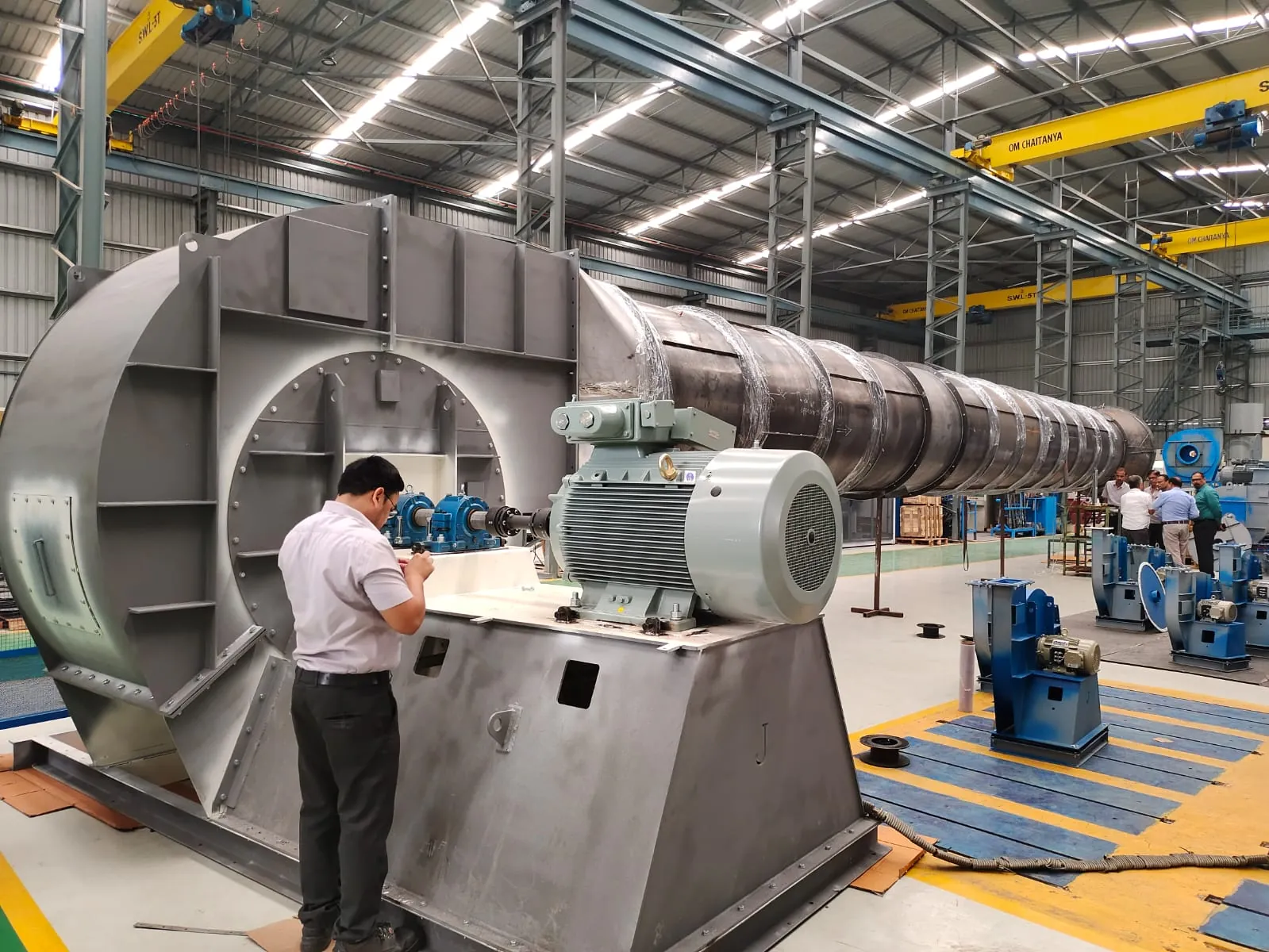
Every job's performance is verified at our works on the 200 HP VFD test rig, to the AMCA 210 / ISO 5801 method, before dispatch.

  • Customer-witnessed FAT on request — at no extra cost
  • Rotors balanced to ISO 21940 G6.3 as standard (G2.5 / G1.0 on application) before they leave the floor
  • Full NDT in-house — DP, MPI, UT, RT — to what the duty demands
30+ INDUSTRIES · 45 APPLICATION / DUTY TYPES
Where our radial-tip fans run

Proven where the gas is dusty but not yet abrasive.

Cement & Lime

Cement-mill and raw-mill vent, moderate-dust process draught.

Foundry & Casting

Dust-laden process and sand-handling vent at medium-high pressure.

Pharmaceuticals

Dust-collection draught and AHU duty where moderate particulate rules out an aerofoil.

Food & Beverage

Spray / fluid-bed / flash drying on dust-laden product gas.

Mining & Minerals

Ore and mineral dust collection at moderate loadings.

Pollution Control / APC OEM

Mill-vent and dust-handling fans built to an APC builder's package spec.

Water & Wastewater

Sludge drying and handling exhaust on dust-laden gas.

Your duty

Moderate-dust, medium-high-pressure work. Tell us your gas and operating point.

Standards & conformity

Stated precisely — because procurement checks.

What our marks mean, in the words that survive an audit.

Performance

Tested to the AMCA 210 / ISO 5801 method, in-house on our 200 HP VFD rig. Tested-to-method — not AMCA-certified.

Quality system

ISO 9001:2015 — third-party certified. Our only third-party certification.

CE conformity

Self-declared per 2006/42/EC + 2014/35/EU (Module A). A self-declaration, not a notified-body certificate.

ATEX conformity

Self-declared, Zone 2/22, Category 3, per 2014/34/EU, where the area classification calls for it.

Oil & gas duty

Designed and built to API 673 as project-specific scope.

Welding

ASME Sec IX qualified welders + WPS for every joint.

Balance

ISO 21940 — G6.3 minimum, G2.5 / G1.0 on application.

Vibration

ISO 20816 evaluation; ISO 14694 for fan-specific limits.

Lead time & process

From enquiry to a tested fan on your dock.

StageStandard dutyAPI-673 / engineered
Offer / quotation3 working days — always7–10 working days
GA drawing for approval2–3 weeks from PO3–4 weeks from PO
Manufacture + balance + paint6–10 weeks10–14 weeks
Performance test + witnessed FAT~1 week1–2 weeks
Order-to-dispatch (total)9–14 weeks14–20 weeks

Shutdown-driven replacements: we have shipped fans within 6 weeks of a clean PO. Tell us your shutdown window and we commit to a dated plan.

Questions engineers ask

The eight we hear most before a PO.

How is a radial-tip fan different from a radial (paddle) fan?
The blade. A radial-tip blade curves at the root and straightens to radial only at the outer tip; a full radial (paddle) blade is straight all the way from the hub. The curved root gives the radial-tip noticeably better peak efficiency than a paddle radial, while the straight tip stays self-cleaning. The radial-tip is sized for moderate dust; the Radial family is the wear-plated family for the heaviest abrasive loads in the range. We use the radial-tip when the dust is moderate so you do not pay the radial's efficiency penalty for dust you do not have.
How much dust can a radial-tip fan handle before I should move to a radial?
Moderate dust is the radial-tip's gate — more than a trace, but short of a genuinely heavy abrasive load. Below that, a backward family is more efficient on cleaner air; above it, or where the dust is heavy / abrasive / sticky, the rugged Radial family — wear-plated for the heaviest loads in the range — is the right family. Tell us the dust loading in g/m³ and whether it is abrasive, and we will place you on the family that survives the wear and runs at the best efficiency for that gas (the exact family limits are shared with your enquiry).
Will the wheel wear out in dusty gas, and can wear parts be replaced on site?
Wear is engineered for, not left to chance. On abrasive duty we specify leading-edge hardfacing to a qualified WPS and bolt-in replaceable scroll liners, sized to the wear mode, with access for in-place replacement. We also offer an impeller-overlay refurbishment service that keeps the wheel in service through its wear life rather than scrapping it. The wear parts are a planned, replaceable system — so wear is managed and budgeted, not a surprise failure.
What pressure and flow can a radial-tip fan reach?
The radial-tip is a medium-to-high-pressure family — the Class 4–5 build runs a 150 m/s tip to make real static. Across the envelope we engineer up to 2,00,000 CMH and 2,000 mmWC, with the wheel and pressure class selected from your duty point. The fan is built for your stated flow and static together — a flow figure alone cannot size a fan — not to a generic catalogue rating.
Can a radial-tip fan run hot — cement-mill or drying gas?
With high-temperature (HT) construction we engineer to 600 °C across the envelope, with a shaft cooling disc fitted above about 150 °C. We confirm hot duty on enquiry against your stated gas temperature and excursion case rather than quoting a generic ceiling. The construction follows the temperature you give us.
Why not just buy a cheaper full radial for our dusty mill-vent duty?
For genuinely heavy abrasive loads we would put you on the Radial family — that is exactly what it is for. But for moderate dust the radial-tip gives you noticeably better peak efficiency than a paddle radial, and on a fan running thousands of hours a year that efficiency is real electricity cost. We match the family to your actual dust loading so you neither erode a backward fan nor over-pay in running cost on a radial you did not need.
Do you performance-test before dispatch, and can we witness it?
Yes. Every fan is performance-tested in-house to the AMCA 210 / ISO 5801 method on our 200 HP VFD test rig, and dynamically balanced to ISO 21940 G6.3 as standard, with G2.5 fine balance for the 150 m/s tip on critical duty. The test and FAT take about a week and are customer-witnessed on request. You see the curve and the balance report before the fan leaves the floor.
What about API 673, CE and ATEX requirements?
We design and build to API 673 for oil and gas duty as project-specific scope (allow 7–10 working days for the offer). CE is self-declared per 2006/42/EC and 2014/35/EU, and ATEX Zone 2/22 is self-declared per 2014/34/EU (Category 3) with spark-resistant (SR) construction where the area classification calls for it. To be precise: those are self-declarations of conformity, not third-party certifications; our only third-party certification is ISO 9001:2015.

Across the range

Where the radial-tip sits — the duties it serves, the industries it runs in, and the families on either side of it.

The same engineering, viewed three ways — by fan family, by duty, and by industry. Follow the cross-references.

Take it further

Specs an engineer can use — not a brochure.

Engineer to engineer

Send us the duty point.
We'll quote in 3 working days — always.

No model numbers needed. Give us the operating conditions — flow, static, gas temperature, composition, particulate, and any tender standard — and our application engineers size the fan and quote it. Attach a spec or GA if you have one.

+91 90110 09155  ·  mihir.jitamitra@gmail.com