My dust is combustible. Are your fans ATEX-rated for it?
Yes. ATEX Zone 22 is self-declared per 2014/34/EU Module A, Category 3D, and it is our default scope for pharma, food, wood, biomass and metallic-dust duty. The build uses an aluminium-alloy or bronze rub ring to prevent ferrous-on-ferrous contact, bonded earthing throughout, anti-static surface coatings and T-class bearing-temperature control. To be precise, that is a self-declaration of conformity, not a third-party certification; our only third-party certification is ISO 9001:2015.
How do you stop abrasive dust from eating the impeller and casing?
Three measures, specified to your dust loading. Hard-faced chrome-carbide blades or a 4140 chrome-carbide wheel for severe abrasion like foundry sand; AR400 bolted-in wear plates at the volute throat and outlet with hinged access doors for in-place replacement; and rejection geometry — radial-tipped wheels that don't trap dust in the blade root. Cement dust, foundry sand and fly ash all get the wear package sized to their loading, and the wear parts are replaceable in place, not welded in.
Our dust is sticky and builds up on the blades. What do you do about it?
Sticky organic dust from food, biomass and wood redistributes mass on the wheel and drives vibration until it trips protection or breaks the shaft. We default to a radial-tipped self-cleaning impeller with sloped blade faces that encourage shedding, and where the dust composition allows we provide in-place water-wash cycles. We size the geometry to your specific dust, not a generic wheel.
Should the fan sit on the clean side or the dirty side of the filter?
Clean side is most common and easier on the fan — inlet loading is low downstream of the filter, so wear is minimal. Dirty side is harder duty, with much heavier inlet loading, and it gets the full abrasion package: hard-faced wheel and AR400 wear plates. Tell us where the fan sits and we build the wear protection to match; on a dirty-side duty we assume the worst of your loading data, not the average.
How do you size for a filter whose pressure drop keeps climbing between pulse cycles?
Filter media loads with dust between pulse-clean cycles, so the pressure drop climbs and the operating point shifts up the curve. We size the fan to span both the clean-filter point and the fully-loaded point without running at a control limit — minimum 20% flow margin at the clean condition, with the fan curve extending through the loaded condition. VFD control is our default so the fan tracks demand smoothly across the cycle.
The dust collector sits next to operators. How quiet can you make the fan?
Standard build is under 85 dB(A) at 1 m. For noise-sensitive lines — packaging, food plants — we add an inlet silencer, an outlet silencer and acoustic-lagged casing and design down to under 75 dB(A). Tell us the limit your area has to meet and we specify the acoustic package to hit it.
We're a pollution-control OEM. Can you supply just the fan as a sub-package?
Yes. We supply fans separately to bag-filter manufacturers, cartridge-filter OEMs, scrubber integrators and ESP project houses. You specify the duty and the integration interface — flange dimensions, mounting orientation, electrical interface and control protocol — and we document it up front and deliver the fan ready to mate. The engineering is identical to a direct-buyer fan; only the integration interface and who buys it differ.
Do you performance-test before dispatch, and what standards apply?
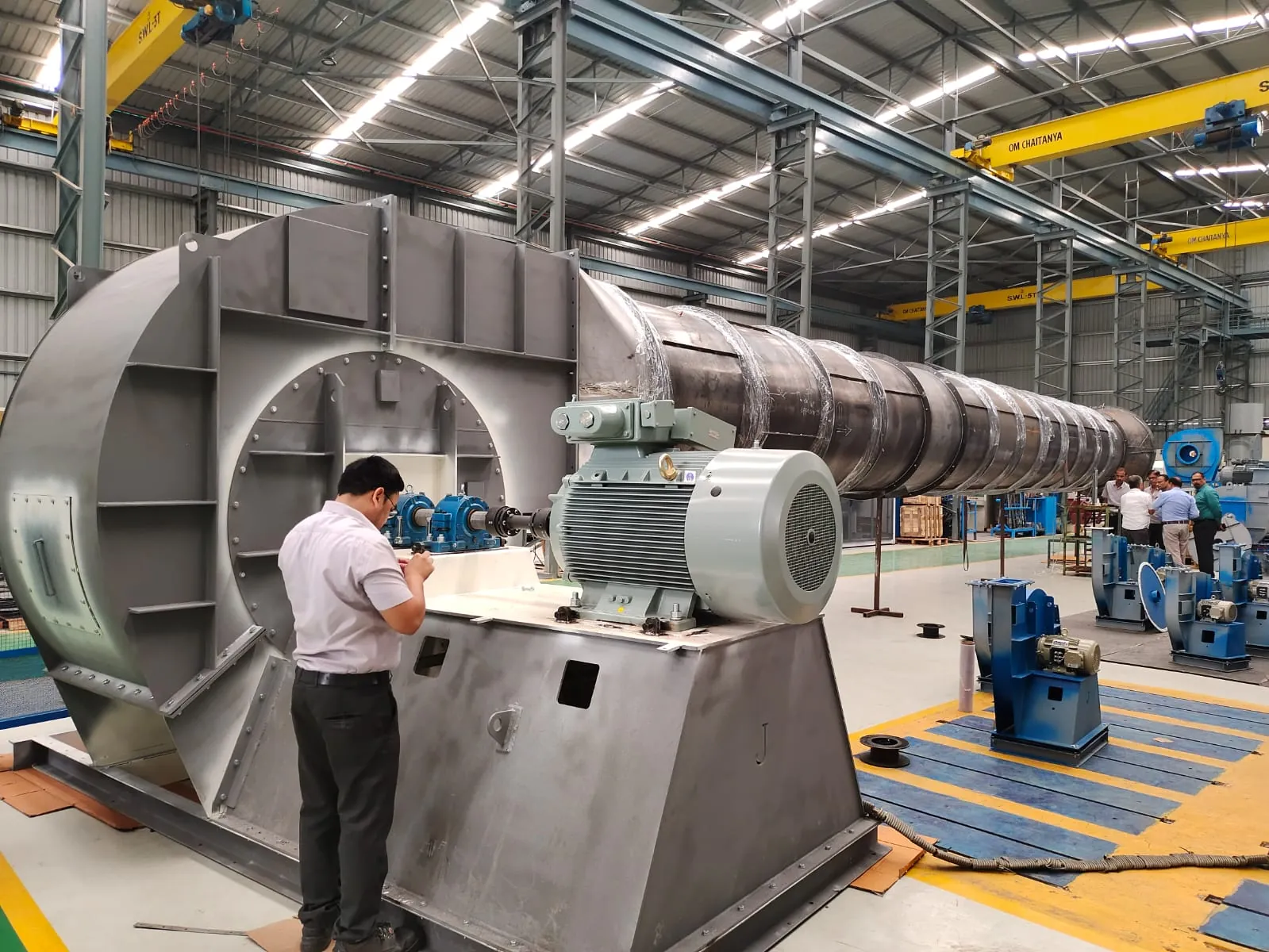
Yes. Every fan is performance-tested in-house to the IS 4894 / ISO 5801 / AMCA 210 method on our 200 HP VFD test rig, and dynamically balanced to ISO 21940 G6.3 as standard (G2.5 / G1.0 on application). For a standard dust fan the offer turns around in 3-5 working days and order-to-dispatch runs roughly 9-14 weeks; an ATEX or high-spec build adds ATEX file prep and runs about 12-16 weeks. The test and FAT take about a week and are customer-witnessed on request.