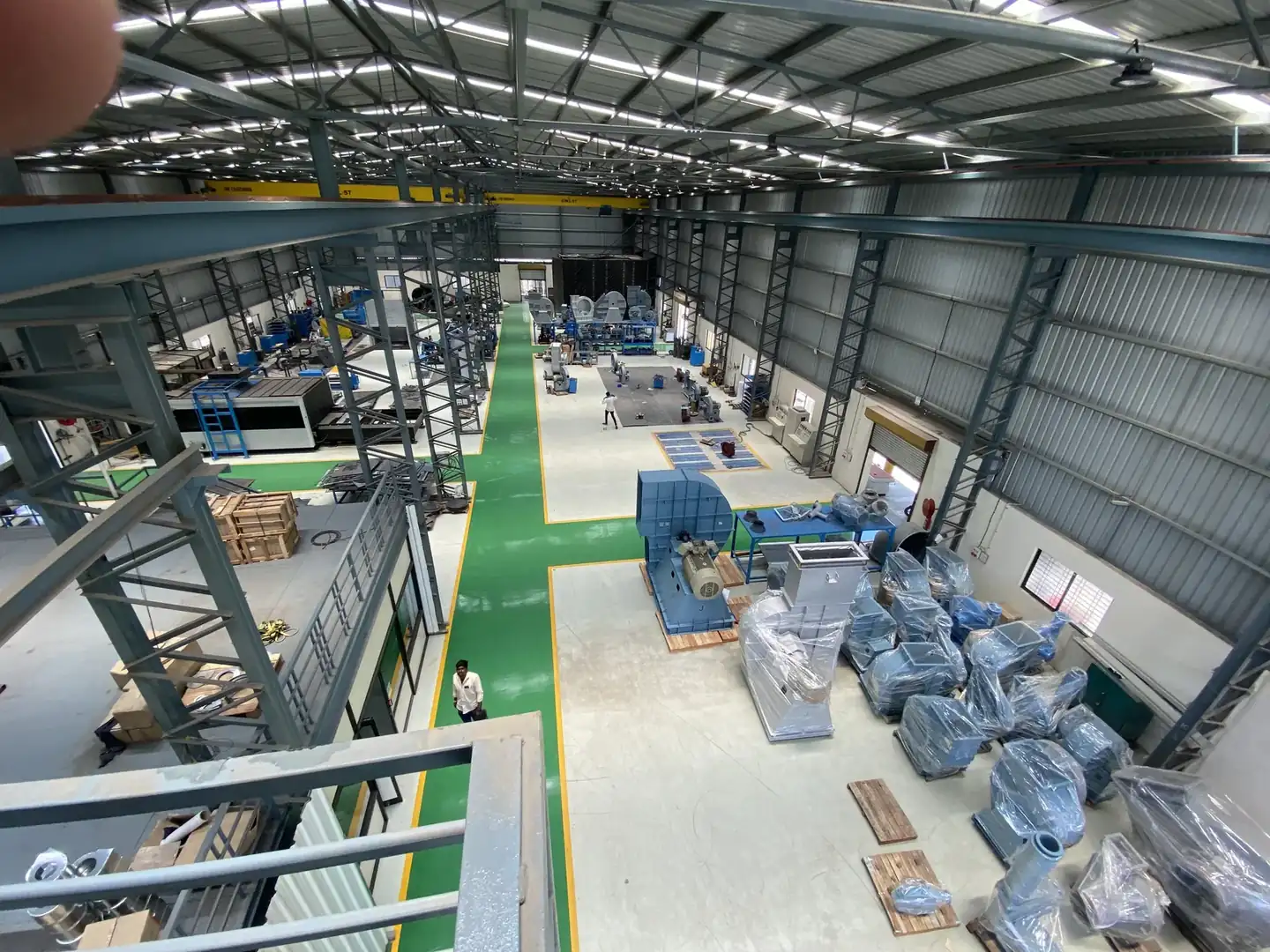
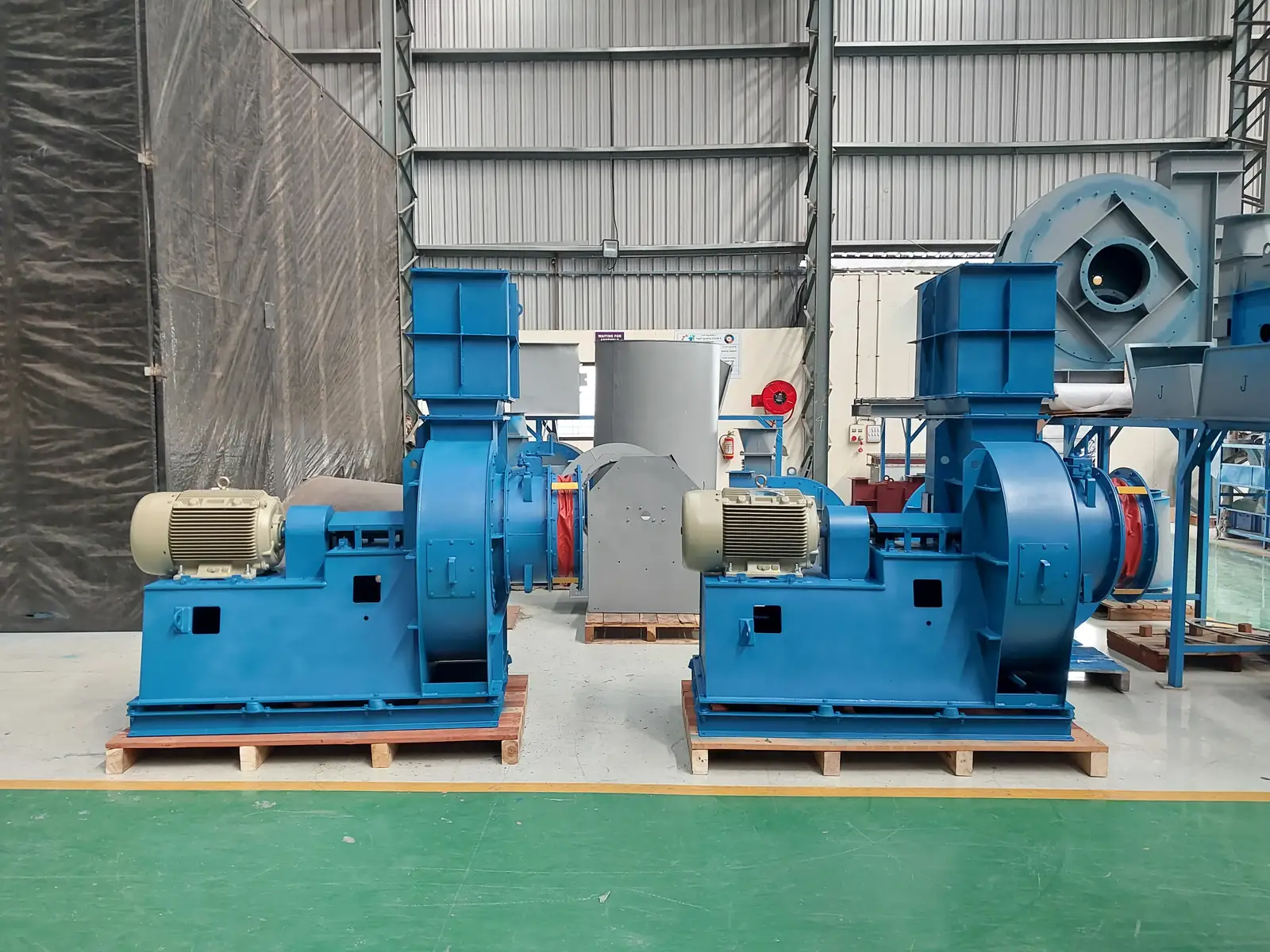
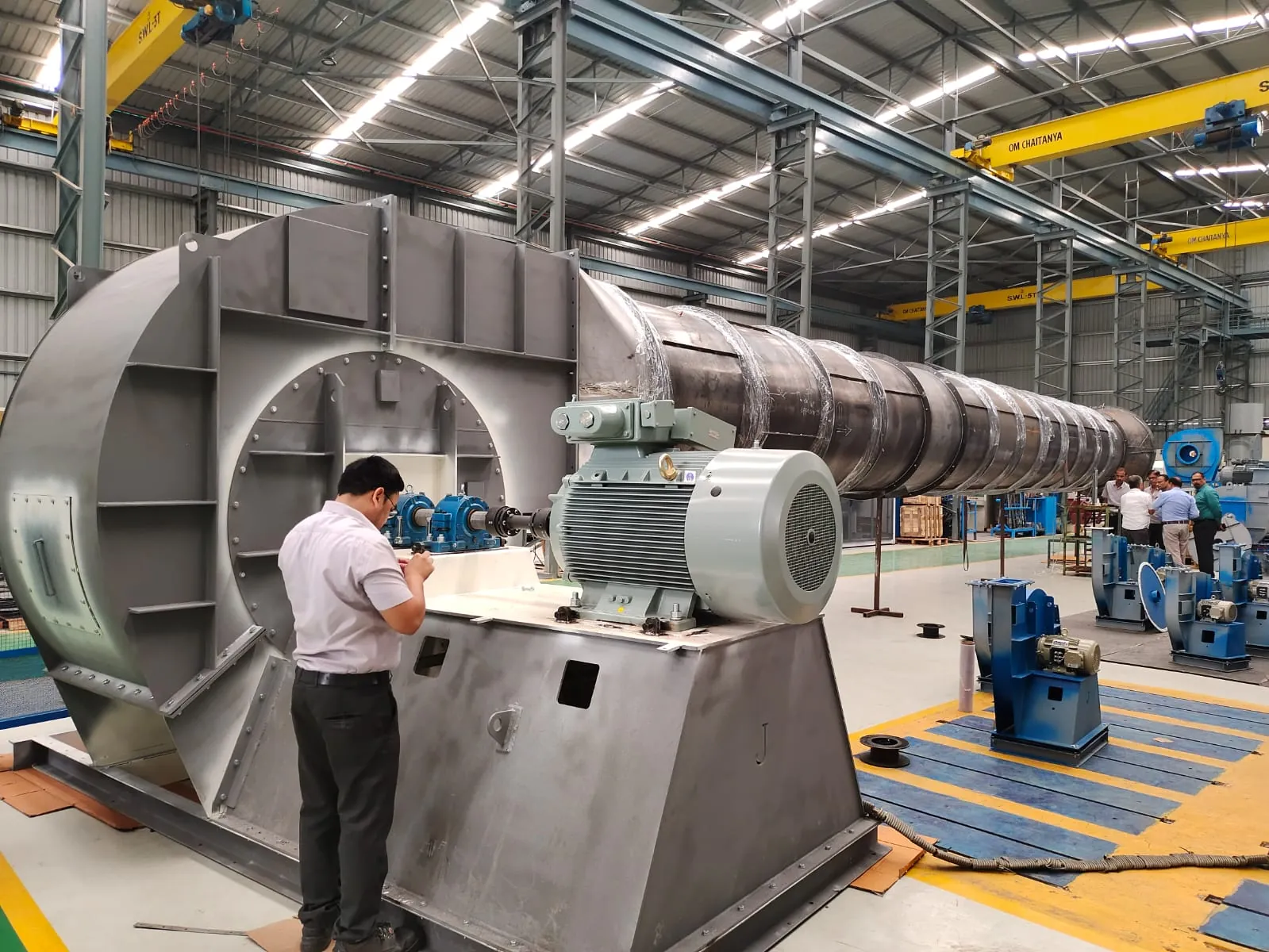
Large backward-flat-plate centrifugal fan rotor on the Jitamitra shop floor
Home  /  Products  /  Jitamitra Backward-Flat Plate
Products

Backward-Flat Plate fans — high flow at medium-high pressure, built around a robust large wheel.

The Backward-Flat Plate family is the high-flow specialist: flat steel plate blades set backward-inclined make a strong, large-diameter wheel that moves big volumes of air while still developing medium-to-high pressure. We build Backward-Flat Plate fans for large industrial ventilation, flue and process-gas handling, drying, deep-tank aeration and digester/biogas duty across chemicals, pharma, food, water & wastewater and biogas plants — single-width up to the large double-width rotor, across the full envelope below.

High flowthe family's job
Highstatic efficiency class
Light dustdust tolerance
to dutyengineered, not boxed
15,000+
fans built since 2011
200 HP
VFD test rig · IS 4894 / AMCA 210
99%
on-time delivery
3
working days to quote — always
FLAT BACKWARD-INCLINED PLATE · NON-OVERLOADING · HIGH FLOW · MEDIUM-HIGH PRESSURE · LARGE ROBUST WHEEL
What it is

A flat-plate backward wheel — built for volume, not for the last point of efficiency.

Backward-Flat Plate wheels use flat (laminar) plate blades that lean backward — straight plates rather than the shaped curve of the Backward-Curved Plate family. The flat plate makes a strong, large-diameter rotor that handles big airflows; the backward lean keeps the power curve non-overloading. It trades a little efficiency for size and high-volume capability.

  • 01
    Move volume

    High airflow is the driver. The large double-width wheel reaches the biggest flows in the range — engineered to ~2,00,000 CMH within our publishable envelope, larger on enquiry.

  • 02
    Hold pressure

    Medium-to-high static at that volume — per-model up to ~1,400 mmWC on the plate wheels, so the fan covers flue/process-gas and large drying duty other backward fans cannot reach at size.

  • 03
    Stay protectable

    Light dust within the family's design gate, and a flat-plate blade that is straightforward to wear-protect, repair and field-service on a large rotor — not a thin shaped blade that erodes.

GENERAL ARRANGEMENT to scale from our design drawings IMPELLER · BACKWARD-FLAT PLATE BLADE wheel schematic DISCHARGE ORIENTATIONS · ENGINEERED TO ORDER 45° 90° 135° 180° 225° 270°
Fig. 1General arrangement, impeller and 7 discharge orientations. Drawn to scale from our in-house design drawings; every fan engineered to your duty.
Why you pick it

Three drivers decide Backward-Flat Plate over a curved-plate or a radial fan.

The Backward-Flat Plate family sits in a deliberate spot in the range: more volume than the Backward-Curved Plate workhorse, more efficiency than a radial. Pick it for the three reasons below — and accept the matching trade-offs honestly, rather than forcing the wrong wheel onto a large duty.

01 — VOLUME

High flow at size

Large ventilation, flue-gas and drying duties need big volumes of air — beyond what a compact curved-plate wheel moves without over-speeding or over-sizing.

How we engineer it out

A flat-plate large-diameter rotor — single-width on the plate wheels, the large double-width wheel for the largest flows — sized on the best-efficiency region for the volume, not the nearest box.

02 — PRESSURE

Medium-high static, kept honest

The duty still needs real pressure — flue/process gas and deep drying systems — but inflated catalogue pressure points fail a basic motor-power check.

How we engineer it out

The plate wheels run a 140 m/s Class 3-4 plate build to ~1,400 mmWC per model; the figure is the software-validated structural ceiling, sanity-checked against absorbed power — not a brochure number.

03 — HEAT & HANDLING

Hot gas and a 3 m rotor

High-volume drying and flue-gas duty runs hot, and a large rotor has to be balanced, transported and serviced — where reliability is actually won or lost.

How we engineer it out

Highest served gas temperature in the backward range (a 500 °C job), shaft cooling above ~150 °C, and split/sectioned casing with a rotor-handling SOP and witnessed run-test on large wheels.

How it is built

Every wheel, suffix and drive choice is fixed on the GA drawing you sign off — before we cut metal.

We don't sell a catalogue near-fit. The fan is engineered to your flow, pressure, gas temperature, dust load and operating point — and the large rotor is designed for how it will be balanced, shipped and serviced.

  • Blade form & wheels — flat (laminar) backward-inclined plate blades on five wheels — four single-width plate wheels and the large double-width rotor — matched to the volume-and-pressure duty; 140 m/s tip on the single-width plate build, 120 m/s on the large double-width rotor.
  • Materials of construction — MS standard; SS304 / SS316 full or airstream-only; F (FRP) and Corten / duplex for corrosive flue-gas and drying duty; WP wear-plated leading edges and replaceable liners where light dust creeps toward the family's design gate.
  • Construction suffixesHT high-temperature build (refractory/heat scope + shaft cooling disc) for hot drying and flue gas; SR spark-resistant (AMCA 99 Type A/B/C, ATEX self-declared) for solvent and combustible-dust zones; F FRP airstream; WP wear protection; SWSI on most single-width plate wheels, DWDI on the largest plate wheel and the double-width rotor for high volume.
  • Drive & large-rotor handling — belt or direct drive; VFD with shaft-earthing ring for variable-volume duty; split SNL plummer-block bearings for maintainability; split/sectioned casing and a rotor-handling SOP where the wheel exceeds container or transport limits — designed in, not improvised on site.
Engineered to your duty point

We size the wheel where its curve crosses your system — then prove it on the rig.

No catalogue fan forced onto your spec. Your high-flow operating point is engineered onto the best-efficiency region of the selected wheel — then verified on the 200 HP VFD test rig (AMCA 210 / ISO 5801 method) and dynamically balanced before dispatch. On a large rotor, the stated balance grade and a witnessed run-test are exactly where reliability is won.

avoid: unstable 0 40,000 80,000 1,20,000 1,60,000 2,00,000 VOLUME FLOW RATE  [ CMH ] 0 500 1000 1500 2000 STATIC PRESSURE  [ mmWC ] 0 25 50 75 100 STATIC EFFICIENCY  [ % ] Fan static pressure System resistance Static efficiency BEP 82% DUTY POINT 1,20,000 CMH · 450 mmWC Fan static pressure System resistance Static efficiency
Fig. 2Representative Backward-Flat Plate characteristic — fan static pressure, system resistance and static efficiency vs. flow, with the high-flow duty point engineered onto the best-efficiency region. Illustrative; every fan is sized to its own duty.
Capability envelope — Backward-Flat Plate service

What we can supply, and where it stretches on application.

ParameterStandardOn application
Volume flowup to 2,00,000 CMHlarger on enquiry (the double-width rotor scales further)
Static pressureup to ~1,400 mmWC per modelhigher on enquiry
Gas / air temperatureup to 600 °C with HT constructionserved to 500 °C — confirmed on enquiry
Dust toleranceLight dust only (design gate)heavier abrasive dust → step to the Radial family
Drive powerup to 400 HPhigher with custom motor sourcing
Static efficiencyHigh for the flow class (exact figures shared with your enquiry)wheel selected near best efficiency for the duty
Balance qualityISO 21940 G6.3G2.5 / G1.0 on application (large rotors)
Bearing life (design target)L10h ≥ 40,000 h continuouslonger L10 on application

The envelope above sits inside Jitamitra's publishable ceiling (2,00,000 CMH / 2,000 mmWC / 400 HP / 600 °C); the Backward-Flat Plate family is the high-flow family within it, peaking on static around ~1,400 mmWC per model rather than the very top of the pressure range. Dust tolerance is the design gate — light dust only; once the dust becomes more than light, the Radial family is the right family. For duty outside the envelope we engineer to spec and quote on enquiry.

How a Jitamitra BFP fan is specified

Specified, not picked from a shelf.

The same engineering language carries from your enquiry to the GA drawing to the nameplate — expressed in the standard AMCA conventions, so the build is unambiguous.

Specification fieldOptions
Arrangement (AMCA 99)Arr. 1 (overhung, fan bearings) / Arr. 3 (between bearings, common on large DWDI rotors) / Arr. 8 (overhung on common base) / Arr. 9 (overhung, motor side) — selected by drive, rotor size, access and temperature.
Width / inletSWSI (single width, single inlet) on most single-width plate wheels; DWDI (double width, double inlet) on the largest plate wheel and the large double-width rotor for high volume in a compact height.
Wheel typeFlat (laminar) backward-inclined plate — four single-width plate wheels and a large double-width flat-blade wheel for the highest flows. Backward lean = non-overloading characteristic.
Class (by pressure / outlet velocity)Class 3-4 plate build (single-width, 140 m/s tip) / large low-stress build (double-width, 120 m/s tip), selected from the duty point on the pressure-vs-outlet-velocity limits; higher class = heavier construction for higher pressure and tip speed.
Materials of constructionMS (standard) / SS304 / SS316 full or airstream / Corten or duplex for corrosive flue-gas and drying duty / FRP (F) for corrosive light-duty air / wear-plated (WP) leading edges and replaceable liners for light-dust service.
Construction suffixHT (high-temperature: heat scope + shaft cooling disc) / SR (spark-resistant: AMCA 99 Type A/B/C, ATEX self-declared) / F (FRP airstream) / WP (wear-plated). Combined per duty — e.g. HT for hot drying gas, SR for solvent / combustible-dust exhaust.
DriveDirect-coupled / V-belt / VFD with shaft-earthing ring (default for variable-volume control). Drive up to 400 HP across the envelope; split SNL plummer-block bearings on large rotors for maintainability.
Accessories & large-rotor scopeInlet box and inlet/outlet dampers; in-cone IGV; flexible connectors and AV mounts; inlet/outlet silencers; shaft cooling disc above ~150 °C; wear protection and replaceable liners; spark-resistant build where the zone requires it; split/sectioned casing and a rotor-handling SOP for fans that exceed container or transport limits.
The proof, not the promise

We test before we ship — and you're welcome to witness it.

Every job's performance is verified at our works on the 200 HP VFD test rig, to the AMCA 210 / ISO 5801 method, before dispatch.

  • Customer-witnessed FAT on request — at no extra cost
  • Rotors balanced to ISO 21940 G6.3 as standard (G2.5 / G1.0 on application) before they leave the floor
  • Full NDT in-house — DP, MPI, UT, RT — to what the duty demands
30+ INDUSTRIES · 45 APPLICATION / DUTY TYPES
Where our Backward-Flat Plate fans run

Proven where the volume is large and the gas runs hot.

Chemicals & Petrochem

Flue and process-gas handling, large drying systems, corrosive-airstream ventilation.

Pharmaceuticals

Large cleanroom / pharma AHU, spray and fluid-bed drying exhaust.

Food & Beverage

Spray-drier and flash-drying air, large process and building ventilation.

Water & Wastewater

Deep-tank aeration, sludge drying and handling exhaust.

Biogas / Biomass

Digester / biogas booster and process-gas handling.

Furnaces & Heat Treatment

Hot drying and flue-gas duty — the family's highest served temperature.

Thermal Power (clean side)

High-flow process and ventilation air on power-adjacent plants.

Your process

339 Backward-Flat Plate builds delivered. Tell us your duty.

Standards & conformity

Stated precisely — because procurement checks.

What our marks mean, in the words that survive an audit.

Performance

Tested to the AMCA 210 / ISO 5801 method, in-house on our 200 HP VFD rig. Tested-to-method — not AMCA-certified.

Quality system

ISO 9001:2015 — third-party certified. Our only third-party certification.

CE conformity

Self-declared per 2006/42/EC + 2014/35/EU (Module A). A self-declaration, not a notified-body certificate.

ATEX conformity

Self-declared, Zone 2/22, Category 3, per 2014/34/EU, where the area classification calls for it.

Oil & gas duty

Designed and built to API 673 as project-specific scope.

Welding

ASME Sec IX qualified welders + WPS for every joint.

Balance

ISO 21940 — G6.3 minimum, G2.5 / G1.0 on application.

Vibration

ISO 20816 evaluation; ISO 14694 for fan-specific limits.

Lead time & process

From enquiry to a tested fan on your dock.

StageStandard dutyAPI-673 / engineered
Offer / quotation3 working days — always7–10 working days
GA drawing for approval2–3 weeks from PO3–4 weeks from PO
Manufacture + balance + paint6–10 weeks10–14 weeks
Performance test + witnessed FAT~1 week1–2 weeks
Order-to-dispatch (total)9–14 weeks14–20 weeks

Shutdown-driven replacements: we have shipped fans within 6 weeks of a clean PO. Tell us your shutdown window and we commit to a dated plan.

Questions engineers ask

The eight we hear most before a PO.

When do I pick the Backward-Flat Plate over the Backward-Curved Plate?
When the airflow VOLUME is the driver. The Backward-Curved Plate family gives you more pressure for a given size — it is the medium-to-high-pressure workhorse. The Backward-Flat Plate family gives you high flow at medium-to-high pressure on a larger, robust flat-plate wheel, including the double-width rotor for the biggest volumes. If the duty is high static at a small size, the Backward-Curved Plate family (or a radial family) is the better pick; if the duty is large volume, the Backward-Flat Plate family is the one.
What is the biggest airflow you can build?
Within our publishable envelope, up to 2,00,000 CMH. The large double-width wheel scales further on our proprietary fan-selection software — toward roughly 2.3 million CMH at a ~3 m rotor — which is engineered-to-order territory: large fans are designed with rotor handling, crane access, large-rotor balancing and transport built in from the start. Give us the flow and static together and we size the wheel to sit near best efficiency.
How hot can the Backward-Flat Plate fan run?
It carries the highest served gas temperature in our backward range — a delivered 500 °C job — and is engineered to 600 °C with high-temperature (HT) construction. Above about 150 °C we fit a shaft cooling disc, and we add the HT heat scope and matched expansion joints for hot drying and flue-gas duty. The fan is built for your stated gas temperature and excursion case, not a generic rating.
How much dust can it handle?
Light dust only. The flat-plate blade is straightforward to wear-protect (WP leading edges and replaceable liners) where the dust creeps toward the design gate, but it is not an abrasive-duty wheel. For heavy or abrasive dust we move you to the Radial family, which is wear-plated for the heaviest, most product-laden dust in our range and self-cleaning. We will tell you honestly when the Backward-Flat Plate family is the wrong wheel for your dust.
What materials can you build it in for corrosive flue gas or drying duty?
MS as standard; SS304 or SS316 full or airstream-only; Corten or duplex where the flue gas calls for it; and FRP (F suffix) for corrosive light-duty air. Below the acid dew point we hold the casing above dew point and select corrosion-grade metallurgy for the gas. The right answer depends on your gas analysis and moisture, so we size the material to your duty, not a default.
Who balances and ships a 3 m rotor properly?
We do, and we design for it. We state the balance grade (ISO 21940 G6.3 standard, G2.5 premium), dynamically balance the rotor, and ship a FAT with a recorded run-test — on a large wheel that is exactly where reliability is won or lost. Where the rotor exceeds container or transport limits we design the casing split/sectioned and supply a rotor-handling SOP with crane and large-machining scope engineered in.
Do you performance-test before dispatch, and can we witness it?
Yes. Every fan is performance-tested in-house to the AMCA 210 / ISO 5801 method on our 200 HP VFD test rig, and dynamically balanced to ISO 21940 G6.3 as standard (G2.5 / G1.0 on application). The test and FAT take about a week and are customer-witnessed on request. You see the curve and the balance report before the fan leaves the floor. To be precise: this is tested to the AMCA 210 / ISO 5801 method in-house — not AMCA-certified.
What about API 673, CE and ATEX requirements?
We design and build to API 673 for petroleum / chemical / gas service as project-specific scope (allow 7-10 working days for the offer). CE is self-declared per 2006/42/EC, and ATEX spark-resistant construction (AMCA 99 Type A/B/C) is self-declared per 2014/34/EU where the area classification calls for it. To be precise: those are self-declarations of conformity, not third-party certifications; our only third-party certification is ISO 9001:2015.

Across the range

Where the high-flow Backward-Flat Plate fits — the duties, industries and sibling wheels around it.

The same engineering, viewed three ways — by fan family, by duty, and by industry. Follow the cross-references.

Take it further

Specs an engineer can use — not a brochure.

Engineer to engineer

Send us the duty point.
We'll quote in 3 working days — always.

No model numbers needed. Give us the operating conditions — flow, static, gas temperature, composition, particulate, and any tender standard — and our application engineers size the fan and quote it. Attach a spec or GA if you have one.

+91 90110 09155  ·  mihir.jitamitra@gmail.com