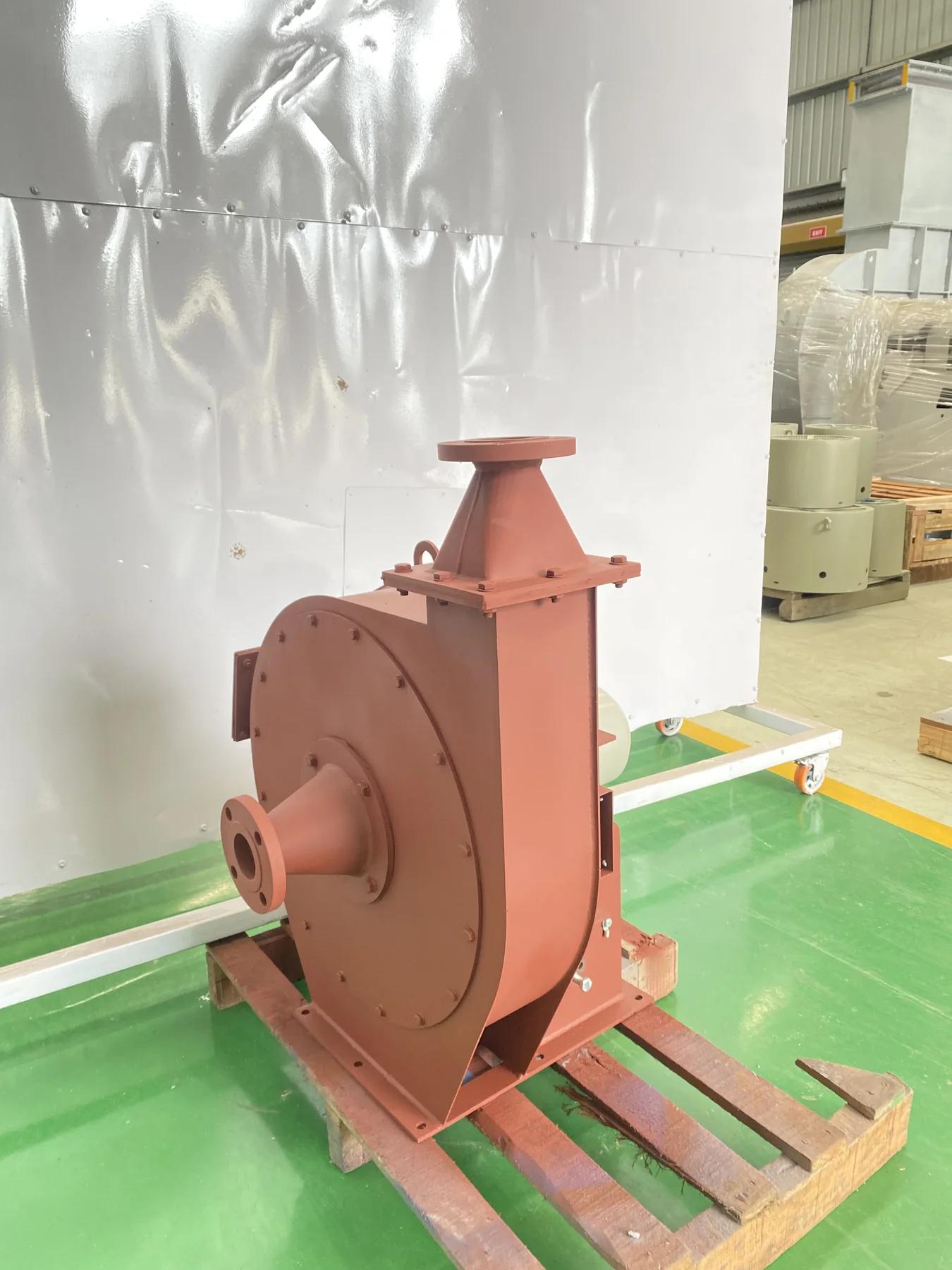
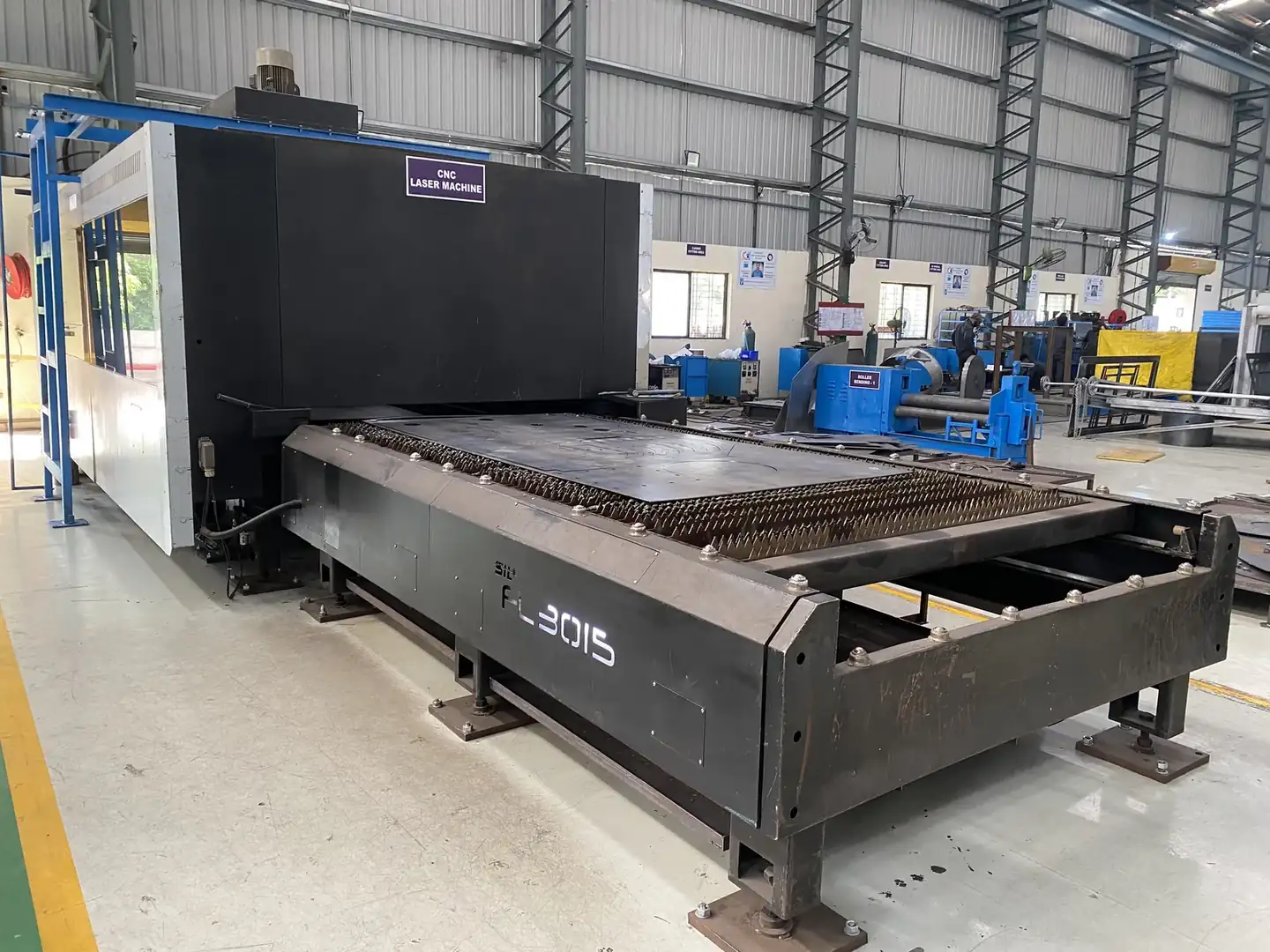
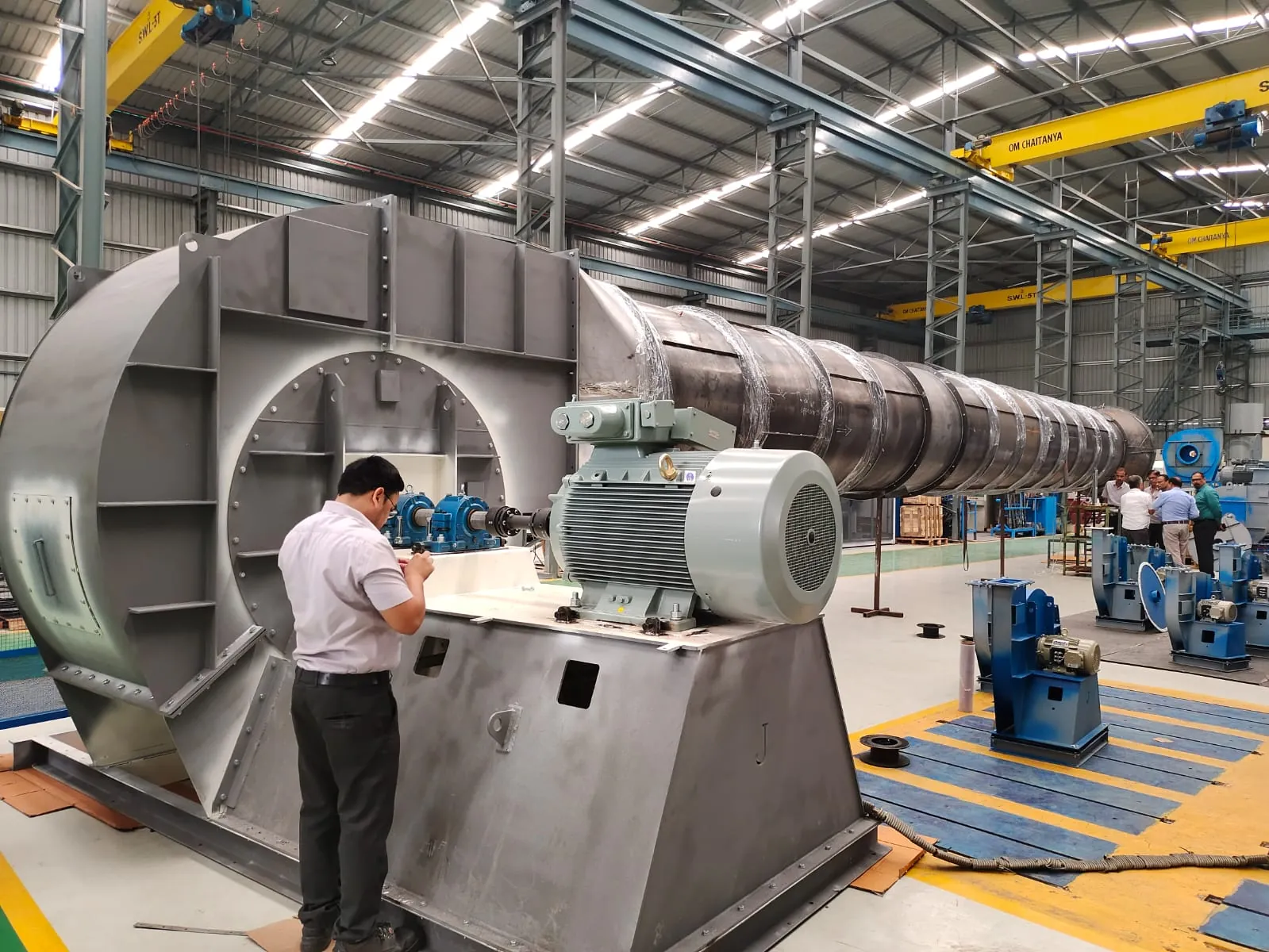
High-pressure centrifugal conveying blower on the Jitamitra shop floor
Home  /  Applications  /  Pneumatic conveying (dilute)
Applications

Pneumatic-conveying blowers — high-pressure, abrasion-resistant, ATEX where it matters.

Moving cement, fly ash, polymer pellets, flour or pharma intermediates through pipework needs pressure rise that ordinary fans cannot reach. Conveying duty pushes into the 1,000–2,000 mmWC band — roughly twice typical ID/FD pressure — with abrasive solids in the gas stream and, often, combustible-dust classification. We build positive-pressure (push) and negative-pressure (vacuum) conveying blowers across the full envelope below.

1,00,000CMH max flow
2,000mmWC single-stage
Zone 22ATEX self-declared
400 HPdrive power
15,000+
fans built since 2011
200 HP
VFD test rig · IS 4894 / AMCA 210
99%
on-time delivery
3
working days to quote — always
FROM THE PICK-UP POINT · THROUGH THE CONVEYING LINE · LIFT & BENDS · TO THE RECEIVING SILO
What it does

A conveying blower does three jobs at once — and the pressure is unforgiving.

A pneumatic-conveying blower is the prime mover of the line: developing the pressure rise that carries the solid, sustaining it against pipe, lift and bend losses, and surviving the abrasive material riding in the air stream.

  • 01
    Lift

    Develop the pressure rise the line needs — typically 1,000–2,000 mmWC, well past the ~500 mmWC ceiling of an ordinary centrifugal fan.

  • 02
    Sustain

    Against the whole line resistance — pipe friction, vertical lift, bends and the receiving filter — across loadings from 5 to 100+ kg/kg air.

  • 03
    Survive

    The conveyed material itself — cement, fly ash or pellets at heavy solids loading — and, where the dust is combustible, an ATEX Zone 22 atmosphere.

INDUCED-DRAFT CENTRIFUGAL FAN Single-width single-inlet — scroll cut away to reveal the impeller inlet expansion joint MOTOR IE3 / VFD GAS IN GAS OUT n 1 2 3 4 5 6 7 8 9 10 1 Inlet cone (bell-mouth) 2 Backward-curved / radial-tipped impeller 3 Spiral volute casing 4 Replaceable AR wear plates (volute throat) 5 Shaft 6 Plummer-block bearings (L10 ≥ 40,000 h) 7 Shaft cooling disc (>400 °C duty) 8 Pedestal / base frame 9 Drive — motor + coupling 10 Outlet flange + duct take-off
Fig. 1Pneumatic-conveying blower — high-pressure centrifugal stage, scroll cut away to reveal the impeller. Numbered components keyed below the drawing.
Why it is hard

Three forces decide whether a conveying blower holds duty or chokes.

High pressure rise, abrasive solids in the stream, and combustible-dust risk drive the design. Get them right and the blower holds its duty point across a full conveying cycle. Size it like an ordinary fan and it stalls when the line empties, wears through in 12–24 months, or sits outside its ATEX classification.

01 — PRESSURE

Pressure rise beyond a fan

Standard centrifugal fans tap out near 500 mmWC. Conveying needs 1,000–2,000 mmWC, occasionally higher — out of reach for a single ordinary wheel.

How we engineer it out

Two impellers in series in one casing, or a high-speed single stage at 2,950 RPM and above on a carefully balanced rotor — sized to the line, not pushed past its curve.

02 — ABRASION

Abrasion from the material

Cement, fly ash and pellets each scour the wheel and volute in their own way, throwing the rotor out of balance.

How we engineer it out

Hard-faced (chrome-carbide) impeller leading edges, AR400 wear plates on the high-velocity volute zones, and replaceable inlet cones — wear parts changed in place, not welded in.

03 — COMBUSTIBLE DUST

Combustible-dust ATEX

Flour, sugar, biomass, polymer and aluminium powders form an explosive dust atmosphere — a Zone 22, sometimes Zone 21, classification the fan must sit inside.

How we engineer it out

Self-declared Zone 22 (Cat 3D) per 2014/34/EU: non-sparking impeller, bronze rub ring, bonded earthing, anti-static coatings and a defined T-class. Not a third-party certification.

How we design for it

Every choice is documented on the GA drawing you sign off — before we cut metal.

We don't sell a catalogue near-fit. The blower is engineered to your material, conveying mode, loading and required pressure rise.

  • Stage configuration — single-stage high-pressure impeller to ~1,500 mmWC; two impellers in series in one casing with an interstage seal for 2,000+ mmWC — compact against two fans manifolded.
  • Wheel geometry — backward-curved efficient profile for clean-dust service; radial-tipped self-cleaning profile when the material is sticky or accumulates on the blade.
  • Wear & materialsMS + AR400 with hard-faced wheel for cement / fly ash; 304 SS food-grade for flour and sugar; 316L or Hastelloy for pharma and corrosive intermediates; aluminium wheel for combustible biomass.
  • Sealing & control — labyrinth shaft seal for clean service, mechanical-contact seal + gas purge for hazardous duty, pressure-rated bolted access — holding to ~250 mbar gauge; VFD control standard so the operating point holds as the line empties or chokes.
Engineered to your duty point

We size the blower where its curve crosses your line — then prove it on the rig.

No catalogue fan forced onto your spec. Your operating point is engineered onto the best-efficiency region of the selected stage — wide enough to ride through an empty line and a choked line without stalling — then verified on the 200 HP VFD test rig before dispatch.

avoid: unstable 0 40,000 80,000 1,20,000 1,60,000 2,00,000 VOLUME FLOW RATE  [ CMH ] 0 500 1000 1500 2000 STATIC PRESSURE  [ mmWC ] 0 25 50 75 100 STATIC EFFICIENCY  [ % ] Fan static pressure System resistance Static efficiency BEP 82% DUTY POINT 1,20,000 CMH · 450 mmWC Fan static pressure System resistance Static efficiency
Fig. 2Representative conveying-blower characteristic — fan static pressure, line resistance and static efficiency vs. flow, with the duty point engineered onto the best-efficiency region. Illustrative; every blower is sized to its own line.
Capability envelope — conveying service

What we can supply, and where it stretches on application.

ParameterStandardOn application
Volume flowup to 1,00,000 CMH (conveying duty is typically lower flow than ID/FD)higher on enquiry
Static pressureup to 2,000 mmWC single-stage; higher with two-stage3,000+ mmWC with custom multi-stage
Operating temperatureambient to 80 °C (typical conveying air)up to 200 °C for hot-process material conveying
Material loadingdilute up to 15 kg/kg; dense 15–100 kg/kghigher dense-phase on enquiry
ATEXZone 22 (Cat 3D) self-declared for combustible materialsZone 21 (Cat 2D) via Notified-Body partner
Drive powerup to 400 HPhigher with custom motor sourcing
Speed600–1,800 RPM typical; high-pressure single-stage to 2,950 RPM+per duty + sound limits
Balance qualityISO 21940 G6.3G2.5 / G1.0 on application

Bearing life is a L10h ≥ 40,000 h continuous design target, with pressurized oil lubrication on application for the largest dense-phase blowers. The envelope above covers the great majority of conveying duty; for pressure or loading beyond it, we engineer to spec and quote on enquiry. Material loading is mode-dependent — dilute phase runs 5–15 kg/kg at 18–30 m/s; dense phase runs 15–100+ kg/kg at 1–8 m/s.

How a Jitamitra PD fan is specified

Specified, not picked from a shelf.

The same engineering language carries from your enquiry to the GA drawing to the nameplate — expressed in the standard AMCA conventions.

Specification fieldOptions
Arrangement (AMCA 99)Arr. 1 (overhung, fan bearings) / Arr. 4 (direct, motor on base) / Arr. 8 (overhung on common base) / Arr. 9 (overhung, motor side) / Arr. 10 (overhung, motor inside base) — selected by drive, access and pressure class.
Stage / inletSingle-stage SWSI (single width, single inlet) to ~1,500 mmWC; two-stage in series in one casing for 2,000+ mmWC dense-phase duty.
Wheel typeBackward-curved (default, best efficiency, clean-dust) / radial-tipped self-cleaning (sticky or accumulating material) / high-speed single-stage (maximum pressure rise).
Class (by pressure / outlet velocity)Class II / III selected from the duty point on the pressure-vs-outlet-velocity limits; conveying duty sits high on the pressure axis, so heavier construction is the norm.
Materials of constructionMS + AR400 with hard-faced wheel (cement / fly ash) / 304 SS food-grade (flour, sugar, spices) / 316L or Hastelloy (pharma, corrosive intermediates) / aluminium wheel with anti-static (combustible biomass and powders).
DriveDirect-coupled / V-belt / VFD (default, so the operating point holds through an empty or choked line). Drive up to 400 HP; coupling service factor 1.5 minimum for the high-torque high-pressure load.
Discharge & rotation (AMCA orientation)Rotation CW or CCW (viewed from drive side) with discharge angle per AMCA — e.g. TH/BH/UB/DB — set to match your conveying-line take-off and installed footprint.
Accessories & ATEX scopeInlet/outlet silencers (high-pressure conveying runs noisier than FD duty); labyrinth or mechanical-contact + gas-purge shaft seal; bolted-and-gasketed pressure-rated access doors and inlet cone; AR400 wear plates; ATEX package — non-sparking impeller, bronze rub ring, bonded earthing, anti-static coating, T-class — where the dust is combustible.
The proof, not the promise

We test before we ship — and you're welcome to witness it.

Every job's performance is verified at our works on the 200 HP VFD test rig, to the AMCA 210 / ISO 5801 method, before dispatch.

  • Customer-witnessed FAT on request — at no extra cost
  • Rotors balanced to ISO 21940 G6.3 as standard (G2.5 / G1.0 on application) before they leave the floor
  • Full NDT in-house — DP, MPI, UT, RT — to what the duty demands
30+ INDUSTRIES · 45 APPLICATION / DUTY TYPES
Where our conveying blowers run

Proven where the material is abrasive and the pressure is highest.

Cement

Cement, fly ash, raw meal and clinker dust to silo and through transfer lines.

Power Generation

Fly ash to silo, bottom ash, and fly ash to disposal.

Food Processing

Flour, sugar, salt, spices, milk powder, infant formula and cocoa — food-grade, ATEX.

Pharmaceuticals

APIs, excipients, granulation feed and dispensing-line transport — sanitary, CIP-ready, ATEX.

Polymers

Pellets, regrind, powder feedstock and masterbatch — pellet impact and attrition control.

Chemicals

Pigments, dyes, fertiliser intermediates and polymer powders — corrosion plus abrasion.

Metallurgy

Aluminium powder, slag dust and refractory fines — severe combustible-dust risk.

Your material

45 application/duty types engineered, across 30+ industries. Tell us yours.

Standards & conformity

Stated precisely — because procurement checks.

What our marks mean, in the words that survive an audit.

Performance

Tested to the AMCA 210 / ISO 5801 method, in-house on our 200 HP VFD rig. Tested-to-method — not AMCA-certified.

Quality system

ISO 9001:2015 — third-party certified. Our only third-party certification.

CE conformity

Self-declared per 2006/42/EC + 2014/35/EU (Module A). A self-declaration, not a notified-body certificate.

ATEX conformity

Self-declared, Zone 2/22, Category 3, per 2014/34/EU, where the area classification calls for it.

Oil & gas duty

Designed and built to API 673 as project-specific scope.

Welding

ASME Sec IX qualified welders + WPS for every joint.

Balance

ISO 21940 — G6.3 minimum, G2.5 / G1.0 on application.

Vibration

ISO 20816 evaluation; ISO 14694 for fan-specific limits.

Lead time & process

From enquiry to a tested fan on your dock.

StageStandard dutyAPI-673 / engineered
Offer / quotation3 working days — always7–10 working days
GA drawing for approval2–3 weeks from PO3–4 weeks from PO
Manufacture + balance + paint6–10 weeks10–14 weeks
Performance test + witnessed FAT~1 week1–2 weeks
Order-to-dispatch (total)9–14 weeks14–20 weeks

Shutdown-driven replacements: we have shipped fans within 6 weeks of a clean PO. Tell us your shutdown window and we commit to a dated plan.

Questions engineers ask

The eight we hear most before a PO.

What pressure rise can your pneumatic-conveying blowers deliver?
Up to 2,000 mmWC from a single high-pressure stage, and 2,000+ mmWC with two impellers in series in one casing. Beyond that we quote a custom multi-stage build reaching 3,000+ mmWC on enquiry. A standard centrifugal fan stops near 500 mmWC, so conveying duty needs either a high-speed single stage running at 2,950 RPM and above on a carefully balanced rotor, or the two-stage configuration. We size the stages to your line, not push one wheel past its curve.
What is the difference between dilute-phase and dense-phase, and which fan do I need?
Dilute-phase runs high air velocity (18-30 m/s) and low loading (5-15 kg material per kg air) with the material suspended as a cloud, at 500-1,500 mmWC — forgiving on the blower but air-hungry. Dense-phase runs low velocity (1-8 m/s) and high loading (15-100+ kg/kg) with the material moving as a slug, often 1,500-2,000+ mmWC — gentler on fragile material but the blower works harder. We supply both; the duty point and the conveying mode together drive the engineering. Tell us the material, line length, lift and target loading and we recommend the mode.
How do you protect the impeller against abrasive material like cement and fly ash?
Three measures, specified to your material and loading. Hard-faced (chrome-carbide) leading edges or a hardened wheel on abrasive duty; AR400 wear plates on the high-velocity volute zones; and replaceable inlet cones. Cement and fly ash carry a high dust load, so the wear scope is matched to the actual loading. The wear parts are bolted in and changed in place, not welded in.
We convey combustible dust — flour, sugar, biomass or aluminium powder. Is the blower ATEX?
Yes, as default for any combustible-material duty. We self-declare Zone 22 (Category 3D) under 2014/34/EU with a non-sparking impeller, bronze rub ring, bonded earthing, anti-static coating and a defined T-class; Zone 21 (Category 2D) is available via a Notified-Body partner where continuous material loading calls for it. To be precise: Zone 22 is a self-declaration of conformity, not a third-party certification. Our only third-party certification is ISO 9001:2015.
How do you seal the blower against material leakage under pressure?
Conveying duty operates against a real pressure differential, typically up to 250 mbar gauge, so the shaft seal, the inlet/outlet flanges and the access doors all have to hold it. We supply labyrinth shaft seals for clean service, mechanical-contact seals with gas purge for hazardous service, and pressure-rated bolted-and-gasketed access points throughout. The seal is selected to the material and the area classification, not a single default.
What materials of construction do you offer for food and pharma conveying?
Food-grade 304 SS casing and wheel for flour, sugar, salt, spices and milk powder, with ATEX where the dust is combustible. For pharma intermediates, APIs and excipients we build in 316L SS, sanitary and CIP-ready, with the ATEX package. For corrosive chemical intermediates we move to 316L or Hastelloy. Each material is matched to the conveyed solid on the GA drawing you sign off.
How does the blower hold its operating point when the line empties or chokes?
The blower curve is engineered wide enough to ride through both extremes without stalling. When the conveying line empties between batches the resistance drops; when it chokes the resistance climbs. VFD control is standard on new installations so speed tracks the duty, and we offer speed switching with mechanical bypass on legacy retrofits. We size the curve to your two operating extremes, not just the nominal point.
What is your lead time and offer turnaround for a conveying blower?
A quotation lands in 3 working days for standard duty; a fully engineered conveying offer runs 5-7 working days single-stage and 7-10 working days for two-stage or ATEX scope. Order-to-dispatch is roughly 11-17 weeks single-stage (GA approval 2-3 weeks, manufacture, balance and paint 8-12 weeks, test and FAT 1-2 weeks) and 15-20 weeks for two-stage or ATEX builds. The dates are committed against your project schedule, not placeholders.

Across the range

Where pneumatic-conveying fans fit — the fans that run them, related duties, and the industries served.

The same engineering, viewed three ways — by fan family, by duty, and by industry. Follow the cross-references.

Take it further

Specs an engineer can use — not a brochure.

Engineer to engineer

Send us the duty point.
We'll quote in 3 working days — always.

No model numbers needed. Give us the operating conditions — flow, static, gas temperature, composition, particulate, and any tender standard — and our application engineers size the fan and quote it. Attach a spec or GA if you have one.

+91 90110 09155  ·  mihir.jitamitra@gmail.com