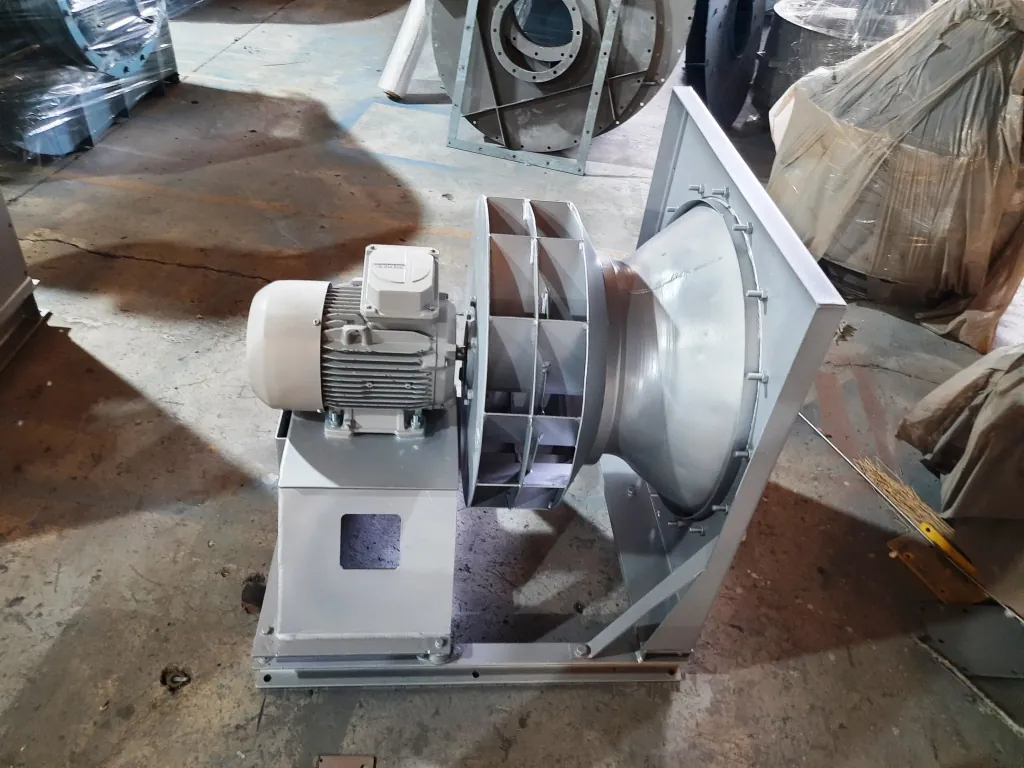
Low-noise plenum supply fan for a pharmaceutical cleanroom AHU on the Jitamitra shop floor
Home  /  Industries  /  Pharmaceuticals
Industries

Fans for the pharmaceutical plant — cleanroom supply to solvent exhaust.

A pharma plant runs two opposite fan worlds under one roof: GMP-clean supply air into cleanrooms and AHUs that has to be quiet, efficient and contamination-free, and hazardous solvent, fume-hood and dust exhaust that is often ATEX and corrosive. One side must never shed a particle; the other must never spark. We build fans across both — supply and exhaust, clean and hazardous — not one duty off a shelf: 73 executed pharmaceutical duties, across the full envelope below — up to 2,00,000 CMH, 2,000 mmWC, 400 HP and 600 °C.

73executed pharmaceutical duties
ATEX Zone 2/22solvent exhaust, self-declared
≤ 75 dB(A)quiet cleanroom supply
316Lwash-down wetted parts
15,000+
fans built since 2011
200 HP
VFD test rig · IS 4894 / AMCA 210
99%
on-time delivery
3
working days to quote — always
CLEANROOM AHU · FUME-HOOD EXHAUST · SOLVENT / ATEX · DUST COLLECTION · DRYER AIR
Where the fans sit

One plant, two opposite jobs — clean quiet supply and hazardous solvent exhaust.

Across a pharma plant the fans do two jobs that pull in opposite directions: they push clean, tempered, quiet air into cleanrooms and AHUs to hold room grade and pressure cascade, and they pull solvent vapour, fume-hood, dust and dryer air safely out — much of it ATEX and corrosive. The supply side must run efficiently and silently in validated space; the exhaust side must run without a source of ignition. Both are engineered here.

The duties we run in a pharma plant

The fan duties across a pharmaceutical plant — and the role each one plays.

A single plant needs clean supply fans, hazardous exhaust fans and process-air fans on the same site. We have executed 73 pharmaceutical duties across this list — each engineered to its own cleanliness, area classification and gas, not adapted from a catalogue near-fit.

The fans we deploy here

Three fan types cover the pharma plant — matched to cleanliness and pressure.

The wheel is chosen by cleanliness and the pressure it has to make: an aerofoil wheel for the quietest, most efficient clean supply and AHU duty, a backward-curved plate wheel for the higher-pressure dust and dryer circuits, and a backward-curved wheel for the mid-pressure exhaust and ventilation duty. All three build across the same envelope — to 2,00,000 CMH, 2,000 mmWC, 400 HP and 600 °C.

Why pharma fan duty is hard

Three things in a pharma plant decide whether the fan passes validation or fails it.

A pharma plant asks a fan to be two contradictory things — spotless and silent on the supply side, spark-safe and corrosion-proof on the exhaust side. Engineer for both and the fan runs the plant's 24×7 validated life without a contamination or safety finding. Engineer for the duty point alone and it fails a GMP audit, an ATEX assessment or a noise limit before the plant is even qualified.

01 — CLEANLINESS

GMP cleanliness & wash-down

On the supply side the fan can shed nothing — no shed particles, no rust bloom, no dirt-trapping crevices — and it has to survive periodic wash-down and sanitisation. A mild-steel wheel that flakes or corrodes contaminates the room and fails a GMP audit.

How we engineer it out

Smooth, crevice-free, cleanable construction; 304 / 316L stainless on the wetted and wash-down surfaces; sealed bearings kept out of the airstream; and coatings selected so nothing sheds into HEPA-filtered supply air.

02 — IGNITION

ATEX solvent & combustible dust

The exhaust side carries flammable solvent vapour and combustible API powder — classified Zone 2/22 — where a spark from rubbing metal or static is an ignition source. A standard fan in that stream is an explosion risk.

How we engineer it out

ATEX Zone 2/22 self-declared per 2014/34/EU (Category 3): non-sparking construction with a spark-resistant impeller/casing pairing, controlled tip-to-casing clearance, earthing/bonding across the assembly and antistatic belts where fitted.

03 — QUIET & EFFICIENT

Low noise in validated space

Supply fans run 24×7 beside occupied cleanrooms and offices, so a noisy or inefficient wheel breaks the site noise limit and burns energy for the plant's whole life — and a re-selected fan means re-validating the room.

How we engineer it out

A high-efficiency aerofoil wheel at its best-efficiency point; balancing to ISO 21940 G2.5 for smooth, low-vibration running; and the duty engineered onto the quiet part of the curve so the fan meets the noise limit without an add-on silencer.

How we design for the plant

Every cleanliness, area-classification and metallurgy choice is documented on the GA drawing you sign off — before we cut metal.

We don't sell a catalogue near-fit onto a pharma plant. Each fan is engineered to its own duty — the cleanroom supply fan to its noise and cleanliness, the solvent exhaust to its area classification, the dryer fan to its pressure — at your operating point.

  • GMP-clean, cleanable build — Smooth, crevice-free construction that survives wash-down and sanitisation; 304 or 316L stainless on the wetted and cleaned surfaces; sealed bearings kept out of the airstream and coatings selected so nothing sheds into HEPA-filtered supply air.
  • ATEX & non-sparking scopeATEX Zone 2/22 self-declared per 2014/34/EU (Category 3) for solvent and combustible-dust exhaust — spark-resistant impeller/casing pairing, controlled clearances, full earthing and bonding, and antistatic belts where the classification calls for it.
  • Low noise & high efficiency — A high-efficiency aerofoil wheel at its best-efficiency point for the 24×7 supply duty, balanced to ISO 21940 G2.5 for smooth running, with the duty engineered onto the quiet part of the curve to meet the site noise limit without an add-on silencer.
  • Single source across the plant — One engineering partner for both sides of the plant — cleanroom and AHU supply, fume-hood and solvent exhaust, dust collection and dryer air — with 73 executed pharmaceutical duties, so the clean-side and hazardous-side fans carry one convention across the site.
Standards & conformity

Stated precisely — because procurement checks.

What our marks mean, in the words that survive an audit.

Performance

Tested to the AMCA 210 / ISO 5801 method, in-house on our 200 HP VFD rig. Tested-to-method — not AMCA-certified.

Quality system

ISO 9001:2015 — third-party certified. Our only third-party certification.

CE conformity

Self-declared per 2006/42/EC + 2014/35/EU (Module A). A self-declaration, not a notified-body certificate.

ATEX conformity

Self-declared, Zone 2/22, Category 3, per 2014/34/EU, where the area classification calls for it.

Oil & gas duty

Designed and built to API 673 as project-specific scope.

Welding

ASME Sec IX qualified welders + WPS for every joint.

Balance

ISO 21940 — G6.3 minimum, G2.5 / G1.0 on application.

Vibration

ISO 20816 evaluation; ISO 14694 for fan-specific limits.

Questions engineers ask

Pharmaceutical fan questions, answered straight.

Can you supply the fans across the whole pharma plant, or only one duty?
Across the whole plant, on both sides. We have executed 73 pharmaceutical duties spanning cleanroom and pharma AHU supply, AHU supply and return, lab and fume-hood exhaust, corrosive solvent and scrubber-vent exhaust, dirty-side dust collection, spray/fluid-bed/flash dryer process air, and general and dilution ventilation. The clean quiet supply fan and the ATEX solvent exhaust fan are different machines built to opposite requirements — but they come from one partner, on one engineering convention across the site.
How do you keep a supply fan GMP-clean and cleanable?
We build the supply-side fan to shed nothing and to survive wash-down. Smooth, crevice-free construction with no dirt traps; 304 or 316L stainless on the wetted and cleaned surfaces; sealed bearings kept out of the airstream; and coatings chosen so the wheel and casing do not flake, rust-bloom or shed particles into HEPA-filtered supply air. The finish and material are specified to your cleanliness grade and sanitisation regime, not a default, so the fan does not become a contamination finding.
Our solvent exhaust and dust collectors are classified areas. Do you build ATEX fans?
Yes. Where the area classification calls for it we build the exhaust or dust-collection fan as ATEX Zone 2/22 self-declared per 2014/34/EU (Category 3): a spark-resistant impeller and casing pairing, controlled tip-to-casing clearance so metal cannot rub, full earthing and bonding to bleed static, and antistatic belts where fitted. Solvent vapour is typically a Zone 2 gas risk and combustible API or excipient powder on the collector a Zone 22 dust risk; on corrosive or wet-scrubbed streams we also step the wetted metallurgy up to 316L or higher. To be precise, that is a self-declaration of conformity, not a third-party certification. Tell us the zone, the gas or dust group and the temperature class and we build the fan to it.
The supply fans sit next to cleanrooms and offices. How do you keep them quiet and efficient?
We select a high-efficiency aerofoil wheel and engineer your duty onto its best-efficiency point, which is also its quietest region, so the fan meets the site noise limit — typically 75 dB(A) or below — without bolting on a silencer. The wheel is balanced to ISO 21940 G2.5 for smooth, low-vibration running, which matters for a fan that runs 24x7 for the validated life of the room. Getting the selection right the first time also avoids re-selecting a fan later, which would mean re-validating the room.
Can you build a replacement to match our existing pharma fan's duty and footprint?
Yes. We reverse-engineer to the existing duty point (flow, static pressure, temperature, density and any dust or solvent load), bearing centres, inlet/outlet orientation and foundation bolt pattern so the unit drops onto the existing base and ducting — whether it is a cleanroom supply fan, a fume-hood exhaust, a dust-collection fan or a dryer fan. Made to your installation, not a nearest-catalogue substitute, so you avoid disturbing a qualified AHU or duct run. Send the old GA, the nameplate and a curve if you have one, and we match it.
Do you performance-test the fans, and what about AMCA, CE, ATEX and quality certification?
Every fan is performance-tested in-house to the AMCA 210 / ISO 5801 method on our 200 HP VFD test rig, and dynamically balanced to ISO 21940 G6.3 as standard (G2.5 / G1.0 on application, which is what the quiet supply duty gets). To be precise: that in-house testing is to the AMCA 210 / ISO 5801 method, not AMCA-certified; CE is self-declared per 2006/42/EC and 2014/35/EU, and ATEX Zone 2/22 is self-declared per 2014/34/EU (Category 3) where the area classification calls for it — those are self-declarations of conformity, not third-party certifications. Our only third-party certification is ISO 9001:2015.

Across the range

Where Pharmaceuticals fits — the fans we deploy, the duties we run, and adjacent industries.

The same engineering, viewed three ways — by fan family, by duty, and by industry. Follow the cross-references.

Take it further

Specs an engineer can use — not a brochure.

Engineer to engineer

Send us the duty point.
We'll quote in 3 working days — always.

No model numbers needed. Give us the operating conditions — flow, static, gas temperature, composition, particulate, and any tender standard — and our application engineers size the fan and quote it. Attach a spec or GA if you have one.

+91 90110 09155  ·  mihir.jitamitra@gmail.com