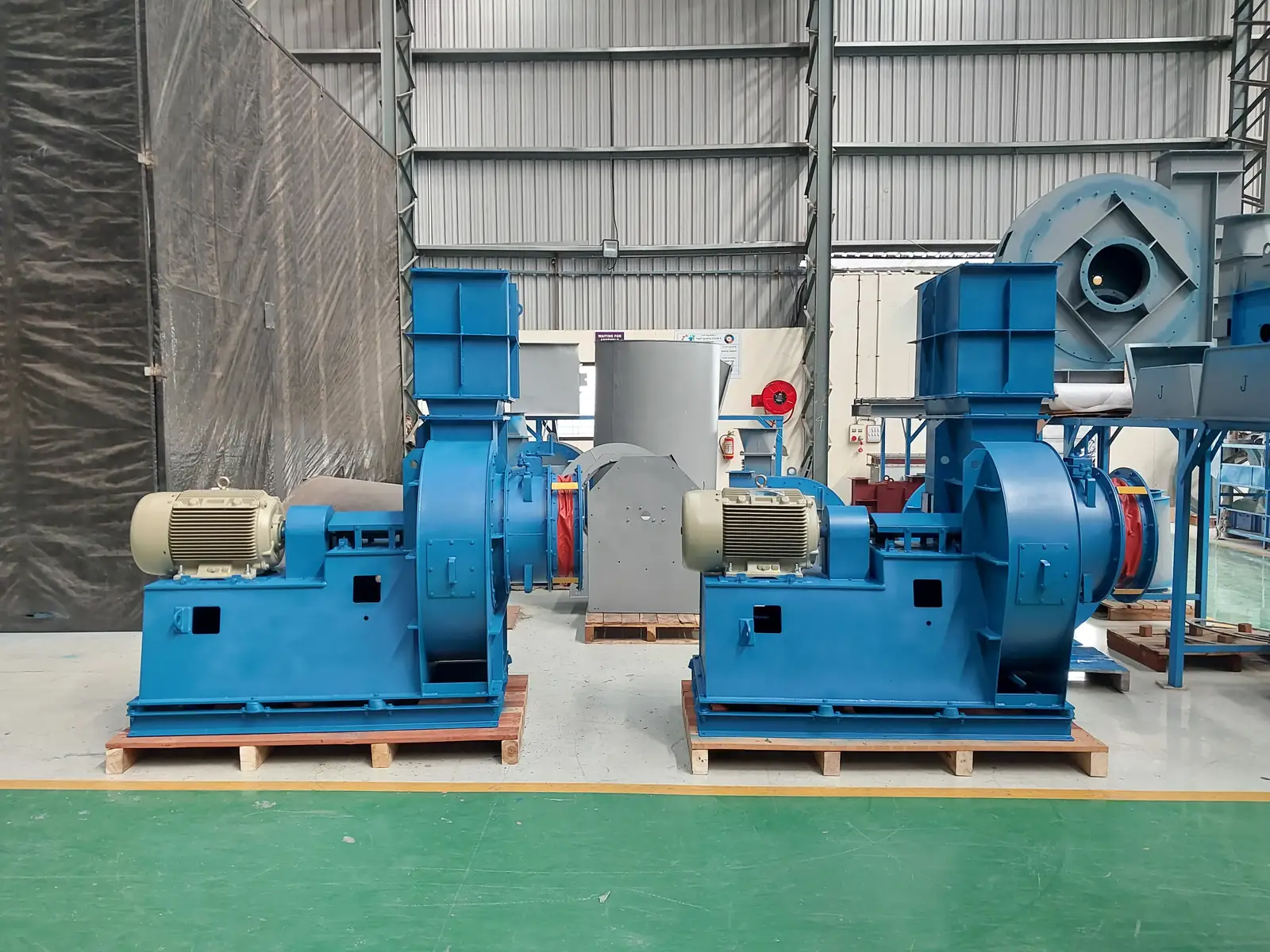
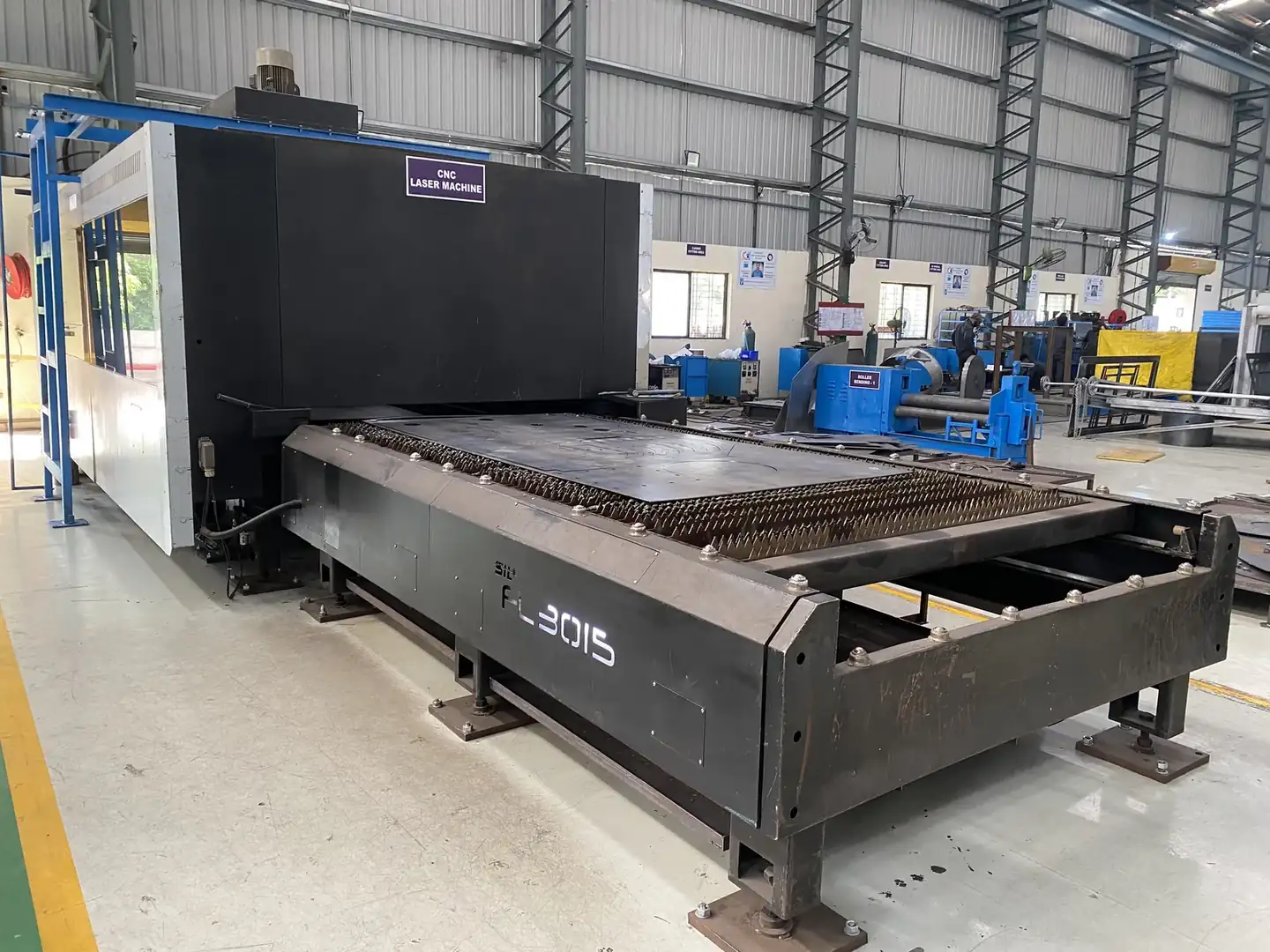
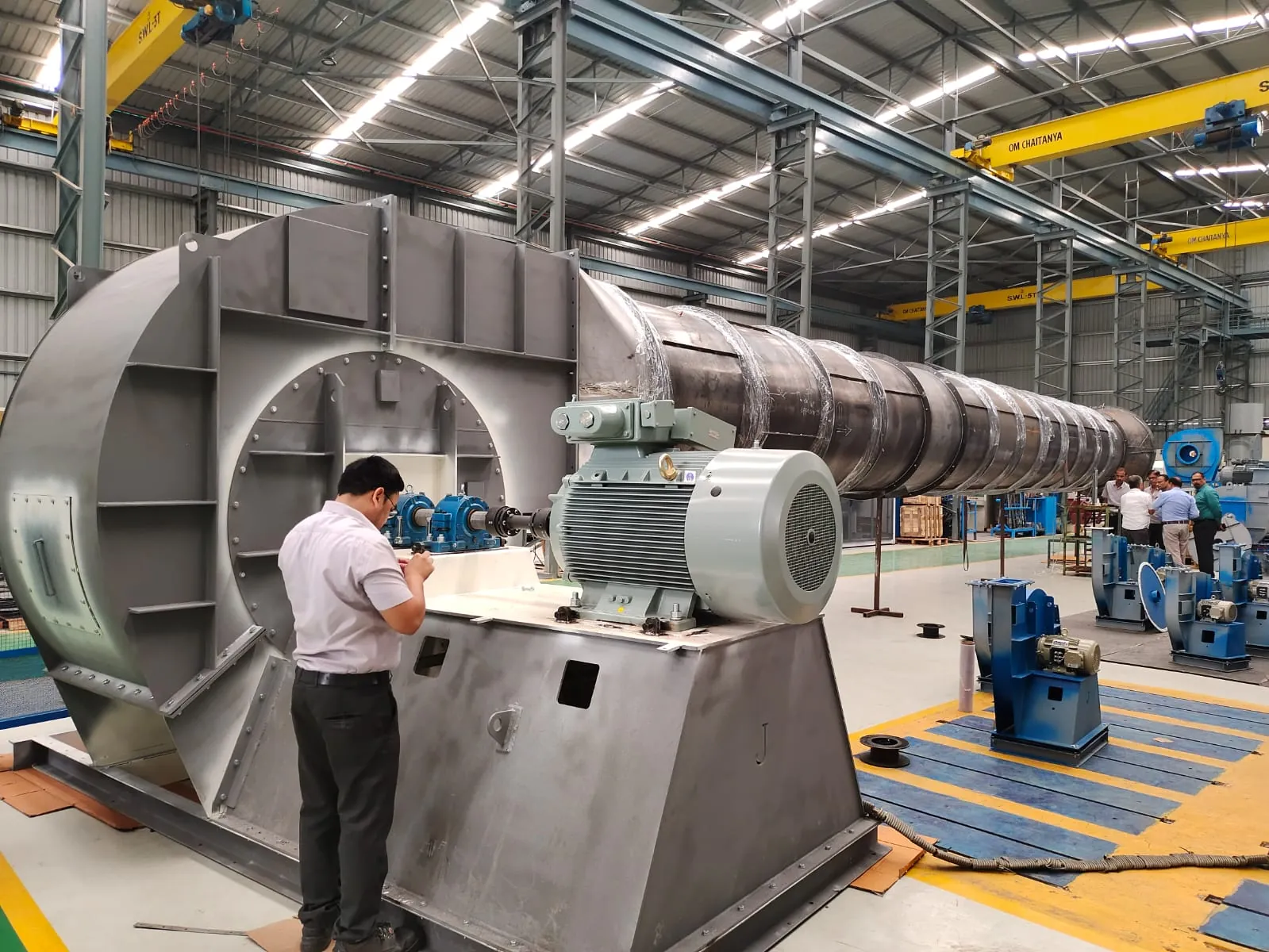
Backward-curved plate centrifugal fan impeller on the Jitamitra shop floor
Home  /  Products  /  Jitamitra Backward-Curved Plate
Products

Backward-Curved Plate fans — the process-air workhorse, built for pressure with light dust.

The Backward-Curved Plate family is the one we build most. Flat steel-plate blades set on a backward-curved pitch give you medium-to-high pressure and good efficiency, with the robustness to take light dust an aerofoil wheel would never survive. It is the default first pick for forced-draft, primary and secondary air, combustion and process air, bag-filter draught and light-dust ID across process and power plants — engineered to your duty point, not selected from a fixed catalogue.

~1,562mmWC family static
highstatic efficiency
light dusttolerance
to dutyengineered, not shelved
15,000+
fans built since 2011
200 HP
VFD test rig · IS 4894 / AMCA 210
99%
on-time delivery
3
working days to quote — always
BACKWARD-CURVED PLATE BLADE · NON-OVERLOADING · MEDIUM-TO-HIGH PRESSURE · LIGHT-DUST TOLERANT
What the wheel does

A backward-curved plate wheel buys you pressure and ruggedness without giving up much efficiency.

The blades are flat steel plates set on a backward-curved pitch — simpler and tougher to fabricate than a shaped aerofoil, and run at a higher tip speed (140 m/s, Class 3–4 build). That combination is the practical middle of the range: it holds good efficiency while generating more pressure for a given size than a curved-blade fan, and it still leans backward, so the power curve cannot overload the motor.

  • 01
    Pressurise

    The plate blade at 140 m/s tip develops medium-to-high static — more pressure per unit size than a curved-blade wheel, and family-served to 2,000 mmWC on the smallest wheels.

  • 02
    Stay efficient

    Backward-leaning plate keeps static efficiency high — close behind the aerofoil and curved-blade wheels — so the running-cost penalty over an aerofoil is small while the pressure and dust headroom are large.

  • 03
    Take the dust

    The solid plate blade tolerates light dust — bag-filter draught, process air and light-dust ID — where a thin aerofoil blade would erode in weeks.

GENERAL ARRANGEMENT to scale from our design drawings IMPELLER · BACKWARD-CURVED PLATE BLADE wheel schematic DISCHARGE ORIENTATIONS · ENGINEERED TO ORDER 45° 90° 135° 180° 225° 270°
Fig. 1General arrangement, impeller and 7 discharge orientations. Drawn to scale from our in-house design drawings; every fan engineered to your duty.
Why this family is chosen

Three design drivers put the plate wheel between the aerofoil and the radial.

Every wheel form is a trade-off between efficiency, pressure and dust tolerance — you cannot maximise all three at once. The backward-curved plate is chosen when you need two of the three at once: pressure and light-dust ruggedness, with efficiency given up only at the margin. Push past its limits and the right answer is a different family — and we will tell you which.

01 — PRESSURE

Medium-to-high pressure

Forced-draft, combustion-air and primary-air duty often needs more static than a clean curved-blade wheel can give at a sensible size — but not the extreme pressure of a heavy radial.

How we engineer it out

The plate blade runs a 140 m/s Class 3–4 tip — more pressure per unit diameter than the curved Backward-Curved family, and a served record to 2,000 mmWC on the smallest high-pressure wheel.

02 — DUST

Light-dust ruggedness

Bag-filter draught, process air and light-dust ID carry enough particulate to erode a thin hollow aerofoil blade — but not enough to justify the efficiency penalty of a full radial.

How we engineer it out

Solid steel-plate blades tolerate light dust, and the flat plate is straightforward to wear-protect with leading-edge hardfacing and replaceable scroll liners when dust creeps toward the family's gate.

03 — EFFICIENCY

Efficiency you do not throw away

Reaching pressure and dust tolerance by jumping straight to a radial wheel costs you efficiency — and on a fan running thousands of hours a year, that is real electricity.

How we engineer it out

Backward-leaning plate holds peak static efficiency close to the curved-blade family's, so you keep most of the running-cost benefit while gaining the pressure and dust headroom.

How we build it

Blade form, metallurgy and construction are set on the GA drawing you sign off — before we cut metal.

We don't sell a catalogue near-fit. The wheel is selected near best efficiency for your flow, pressure, temperature and dust, and the construction is specified to your gas and area classification.

  • Blade form & wheel range — Backward-curved plate — flat steel plate on a backward-curved pitch, 140 m/s Class 3–4 tip. Seven wheel sizes, so the wheel is matched to your duty, not over-sized to the nearest box.
  • Materials of construction — MS standard; SS304 / SS316 full or airstream for corrosive process air; FRP variant (F suffix) for wet corrosive gas; Corten / duplex per duty; wear-plated (WP) leading edges and replaceable liners when dust approaches the family's gate.
  • Construction suffixesHT (high-temp construction + shaft cooling disc for hot process air); SR (spark-resistant, AMCA 99 Type A/B/C + ATEX self-declared) for solvent and combustible-dust zones; F (FRP airstream); WP (wear-plated) for light-dust duty.
  • Width & drive — SWSI standard across most wheels; DWDI on the high-flow wheel for higher flow. Direct-coupled, V-belt or VFD — VFD with shaft-earthing ring for variable process-air duty; shaft cooler fitted above ~150 °C.
Engineered to your duty point

We size the wheel where its curve crosses your system — then prove it on the rig.

No catalogue fan forced onto your spec. With seven wheels to choose from, your operating point is engineered onto the best-efficiency region of the closest-matched plate wheel — then verified on the 200 HP VFD test rig to the AMCA 210 / ISO 5801 method before dispatch.

avoid: unstable 0 40,000 80,000 1,20,000 1,60,000 2,00,000 VOLUME FLOW RATE  [ CMH ] 0 500 1000 1500 2000 STATIC PRESSURE  [ mmWC ] 0 25 50 75 100 STATIC EFFICIENCY  [ % ] Fan static pressure System resistance Static efficiency BEP 82% DUTY POINT 1,20,000 CMH · 450 mmWC Fan static pressure System resistance Static efficiency
Fig. 2Representative backward-curved plate characteristic — fan static pressure, system resistance and static efficiency vs. flow, with the duty point engineered onto the best-efficiency region and the non-overloading power curve shown. Illustrative; every fan is sized to its own duty.
Capability envelope — BCP service

What we can supply, and where it stretches on application.

ParameterStandardOn application
Volume flowup to 2,00,000 CMHhigher on enquiry
Static pressurefamily to ~1,562 mmWCserved to 2,000 mmWC (small-wheel high-pressure build)
Continuous gas/air temperatureup to 600 °C with HT constructionshaft cooling disc above ~150 °C; metallurgy to duty
Inlet dust loadinglight dust — bag-filter draught, process air, light-dust IDwear-plating + liners near the gate; heavier dust → radial-tip / radial family
Peak static efficiency (family)high for the range (exact figure shared with your enquiry)duty-dependent; wheel selected near BEP
Drive powerup to 400 HPhigher with custom motor sourcing
Balance qualityISO 21940 G6.3G2.5 / G1.0 on application
Bearing life (design target)L10h ≥ 40,000 h continuouslonger L10 on application

The envelope above sits inside Jitamitra's company-wide publishable ceiling (2,00,000 CMH / 2,000 mmWC / 400 HP / 600 °C). The family's own character — a ~1,562 mmWC software static ceiling with high static efficiency — is from the internal range study; the 2,000 mmWC point is a genuine served-above-software record (three small-wheel high-pressure units, 2022, motor-power checked), not a catalogue claim. Once dust becomes more than light this is the wrong duty for this wheel — we move you to the radial-tip or radial family so the fan lasts.

How a Jitamitra BCP fan is specified

Specified, not picked from a shelf.

The same engineering language carries from your enquiry to the GA drawing to the nameplate — expressed in the standard AMCA conventions.

Specification fieldOptions
Arrangement (AMCA 99)Arr. 1 (overhung, fan bearings) / Arr. 4 (direct, motor on base) / Arr. 8 (overhung on common base) / Arr. 9 (overhung, motor side) / Arr. 10 (overhung, motor inside base) — selected by drive, access and temperature.
Width / inletSWSI (single width, single inlet) standard across most wheels for pressure; DWDI (double width, double inlet) on the high-flow wheel for high flow at moderate pressure.
Wheel typeBackward-curved plate (flat steel plate on a backward-curved pitch) — the medium-to-high-pressure, light-dust workhorse; one step up in pressure and dust headroom from a curved/aerofoil wheel, one step down in dust tolerance from a radial.
Class (by pressure / outlet velocity)Class I / II / III selected from the duty point on the pressure-vs-outlet-velocity limits; the plate blade runs a Class 3–4 (140 m/s) tip, so higher class = heavier construction for higher pressure and tip speed.
Materials of constructionMS (standard) / SS304 or SS316 full or airstream for corrosive process air / FRP (F suffix) for wet corrosive gas / Corten or duplex per duty / wear-plated (WP) leading edges and replaceable scroll liners for light-dust service.
Construction suffixHT (high-temperature construction + shaft cooling disc for hot process air) / SR (spark-resistant, AMCA 99 Type A/B/C + self-declared ATEX, for solvent and combustible-dust zones) / F (FRP airstream) / WP (wear-plated for light dust).
DriveDirect-coupled / V-belt / VFD (default for variable process-air duty, with shaft-earthing ring). Drive up to 400 HP across the envelope; shaft cooler fitted above ~150 °C.
Discharge & rotation (AMCA orientation)Rotation CW or CCW (viewed from drive side) with discharge angle per AMCA — e.g. TH/BH/UB/DB — set to match your duct take-off and installed footprint.
The proof, not the promise

We test before we ship — and you're welcome to witness it.

Every job's performance is verified at our works on the 200 HP VFD test rig, to the AMCA 210 / ISO 5801 method, before dispatch.

  • Customer-witnessed FAT on request — at no extra cost
  • Rotors balanced to ISO 21940 G6.3 as standard (G2.5 / G1.0 on application) before they leave the floor
  • Full NDT in-house — DP, MPI, UT, RT — to what the duty demands
30+ INDUSTRIES · 45 APPLICATION / DUTY TYPES
Where our plate fans run

The backbone fan of process and power plants.

Thermal Power

Forced-draft (FD), primary air (PA) and secondary / overfire air (SA) on the boiler fan suite.

Cement & Lime

Coal-mill primary air and clean-side process-air duty.

Iron & Steel / Metals

Blast-furnace combustion air and high-pressure process-air blowers.

Chemicals & Petrochem

Process and combustion air; API 673 process fans for oil & gas service.

Pharmaceuticals

Solvent and paint-booth exhaust on spark-resistant (SR) construction; process air.

Food & Beverage

Spray / fluid-bed / flash drying and process ventilation.

Pulp & Paper

Recovery-boiler and general process-air fans.

Your process

7 plate wheels, sized to your duty. Tell us yours.

Standards & conformity

Stated precisely — because procurement checks.

What our marks mean, in the words that survive an audit.

Performance

Tested to the AMCA 210 / ISO 5801 method, in-house on our 200 HP VFD rig. Tested-to-method — not AMCA-certified.

Quality system

ISO 9001:2015 — third-party certified. Our only third-party certification.

CE conformity

Self-declared per 2006/42/EC + 2014/35/EU (Module A). A self-declaration, not a notified-body certificate.

ATEX conformity

Self-declared, Zone 2/22, Category 3, per 2014/34/EU, where the area classification calls for it.

Oil & gas duty

Designed and built to API 673 as project-specific scope.

Welding

ASME Sec IX qualified welders + WPS for every joint.

Balance

ISO 21940 — G6.3 minimum, G2.5 / G1.0 on application.

Vibration

ISO 20816 evaluation; ISO 14694 for fan-specific limits.

Lead time & process

From enquiry to a tested fan on your dock.

StageStandard dutyAPI-673 / engineered
Offer / quotation3 working days — always7–10 working days
GA drawing for approval2–3 weeks from PO3–4 weeks from PO
Manufacture + balance + paint6–10 weeks10–14 weeks
Performance test + witnessed FAT~1 week1–2 weeks
Order-to-dispatch (total)9–14 weeks14–20 weeks

Shutdown-driven replacements: we have shipped fans within 6 weeks of a clean PO. Tell us your shutdown window and we commit to a dated plan.

Questions engineers ask

The eight we hear most before a PO.

Why is the Backward-Curved Plate called your workhorse family?
It is the family we build and sell most. The flat steel-plate blade on a backward-curved pitch is the practical middle of the range — good efficiency, medium-to-high pressure, light-dust tolerance, and a robust, repairable wheel. That combination covers the bulk of everyday process-plant duty: forced-draft, primary and secondary air, combustion and process air, bag-filter draught and light-dust ID. For most industrial process-air enquiries it is the default first pick.
What is the highest pressure you have actually delivered with this family?
2,000 mmWC — three small-wheel high-pressure units built in 2022, with the motor power checked against the duty. That is a genuine served-above-software record, supported by a 1,524–1,700 mmWC band across five customers from 2022 to 2025 — not a catalogue claim. The family software ceiling is ~1,562 mmWC on the smallest wheel; above that is engineered-to-order, and we will only quote a pressure we can stand behind on a motor-power check.
How much dust can the plate wheel take, and what happens above that?
Light dust — bag-filter and pulse-jet draught, process air and light-dust ID. The solid plate blade is far more robust than a hollow aerofoil and is straightforward to wear-protect with leading-edge hardfacing and replaceable scroll liners as dust creeps toward the gate. Once dust becomes more than light this is the wrong wheel — we move you to the radial-tip family for moderate dust, or to the radial family, the toughest in our range, for dirty, abrasive, product-laden gas — so the fan lasts rather than erodes. The exact loading gates are shared with your enquiry.
Will the motor overload if the system resistance drops?
No. The backward-curved plate is a non-overloading wheel — power rises with flow, peaks, then falls, so if the duct opens up the motor cannot be driven past its rating. That makes drive sizing safer than a forward-curved wheel, which can overload off-design. We still size the motor to the verified absorbed power across your operating range, not to a rule-of-thumb margin.
Can you run this family hot, or in a hazardous area?
Yes to both, as specified construction. For hot process air we use HT (high-temperature) construction, attested to 600 °C, with a shaft cooling disc fitted above about 150 °C. For solvent, paint-booth and combustible-dust zones we build SR (spark-resistant) construction to AMCA 99 Type A/B/C with ATEX conformity. To be precise: ATEX is self-declared per 2014/34/EU (Category 3) where the area classification calls for it — a self-declaration of conformity, not a third-party certification.
How do I choose between this family and your other backward fans?
Match the wheel to what you most need. Backward-Curved Plate when you need medium-to-high pressure with light dust — the FD/process-air default. Step down to the curved Backward-Curved family for low-pressure clean ventilation where it may be cheaper, or up to the Aerofoil family for maximum efficiency on perfectly clean air. For high flow at medium-high pressure on a large fan, the Backward-Flat Plate family. Once dust goes beyond light loading, the Radial-Tip family. We size the duty first, then pick the family — we will tell you when this is the wrong one.
Do you performance-test before dispatch, and can we witness it?
Yes. Every fan is performance-tested in-house to the AMCA 210 / ISO 5801 method on our 200 HP VFD test rig, and dynamically balanced to ISO 21940 G6.3 as standard (G2.5 / G1.0 on application). The test and FAT take about a week and are customer-witnessed on request. You see the curve and the balance report before the fan leaves the floor. To be precise, that is testing to the AMCA 210 / ISO 5801 method in-house — not AMCA certification.
What about API 673, CE and ATEX requirements?
We design and build to API 673 for oil and gas process-fan duty as project-specific scope (allow 7–10 working days for the offer) — rotor balance to ISO 1940-1, vibration-transducer provisions, NACE materials where specified. CE is self-declared per 2006/42/EC and 2014/35/EU, and ATEX Zone 2/22 is self-declared per 2014/34/EU (Category 3) where the area classification calls for it. To be precise: those are self-declarations of conformity, not third-party certifications; our only third-party certification is ISO 9001:2015.

Across the range

The duties, industries and sibling families around the Backward-Curved Plate.

The same engineering, viewed three ways — by fan family, by duty, and by industry. Follow the cross-references.

Take it further

Specs an engineer can use — not a brochure.

Engineer to engineer

Send us the duty point.
We'll quote in 3 working days — always.

No model numbers needed. Give us the operating conditions — flow, static, gas temperature, composition, particulate, and any tender standard — and our application engineers size the fan and quote it. Attach a spec or GA if you have one.

+91 90110 09155  ·  mihir.jitamitra@gmail.com