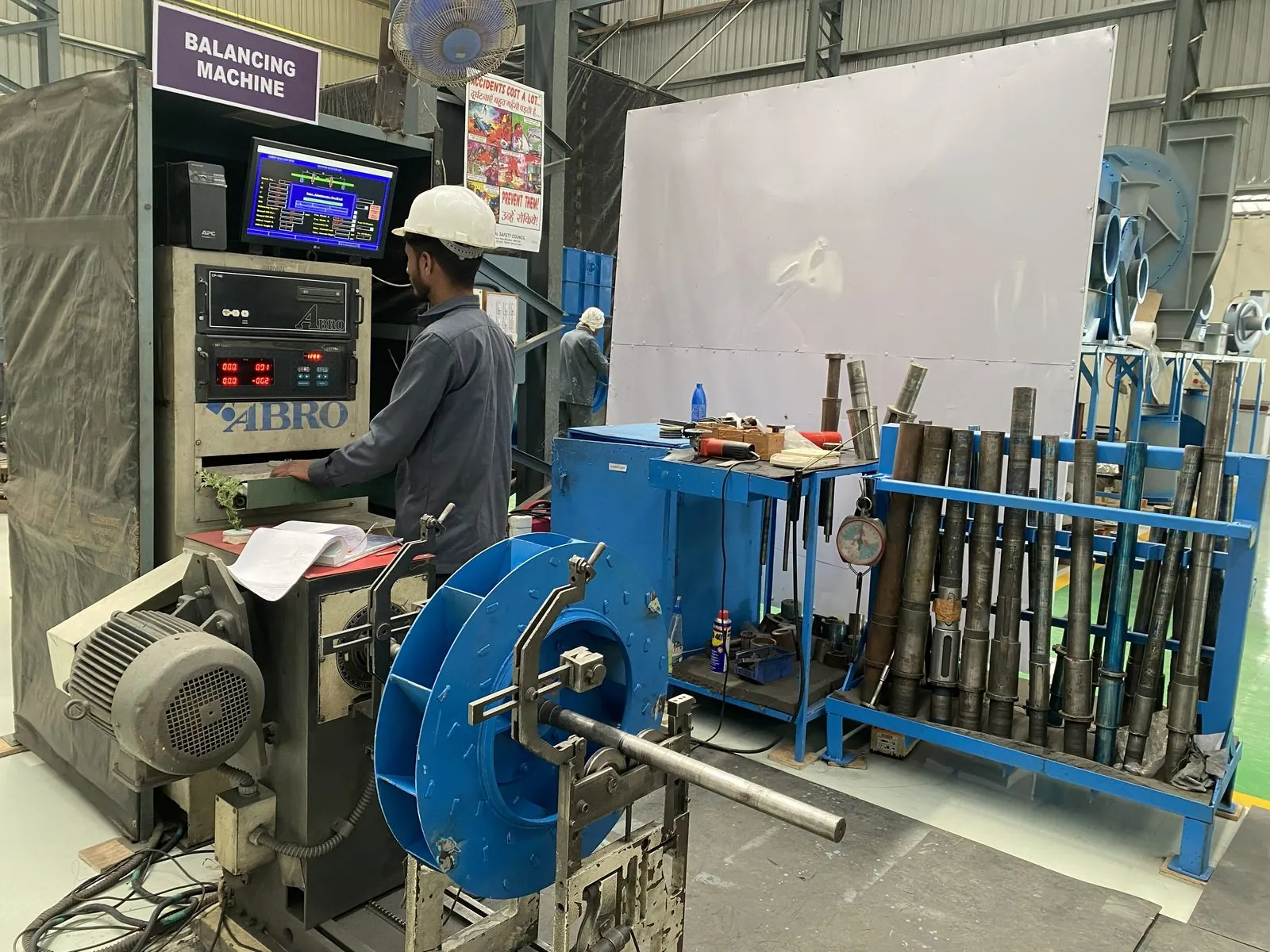
Balancing, alignment, vibration diagnosis, repair, retrofit and turnkey installation — field and workshop services for centrifugal fans and blowers of any manufacturer, not just ours.
Yes. The field and workshop service covers centrifugal fans and blowers of any make, not only ours: on-site and workshop dynamic balancing, vibration diagnosis, alignment, bearing and shaft replacement, impeller repair and rebuild, retrofit, installation supervision and breakdown attendance. Jitamitra runs an ABRO two-plane balancing machine for rotors to 1,500 kg and 1,500 mm diameter, and portable balancing and vibration analysis on site.
839 service events over 12 years.
Field and workshop support across the fan's whole life: balance it, align it, diagnose it, repair it, re-rate it. Regardless of who built the fan.
On the fans we build: what the warranty covers, and what is chargeable.
Any-make repair, overhaul, hardfacing, impeller replacement, re-rate & spares.
Service areaOn-site balancing, vibration diagnostics, alignment, installation & commissioning.
Service areaField & lab performance testing, NDT/PMI, specialty mechanical testing, docs.
Service areaRetrofits, energy audits, FEA/CFD, duct-system studies & application consulting.
Service areaReplacing a belt-driven or AC plug fan in an existing AHU — the eight checks we make on site before we quote.
Service areaTiered AMCs, preventive programmes, 24/7 breakdown response & training.
Keep any manufacturer's centrifugal fan running: in-situ balancing, vibration and root-cause diagnostics, laser alignment, condition monitoring and breakdown response — delivered at your plant to recognised ISO acceptance limits with minimum downtime, whoever built the fan.
Related reading: Reading a fan's vibration signature · Balancing grades G2.5 & API 673
Balance your installed impeller in place — single- or two-plane — using portable tri-axial sensors and an FFT field analyser, trimming correction weights until vibration falls within an accepted grade, with no dismantling or transport. We work to ISO 21940 grades (G6.3 general, G2.5 for API 673 / critical service) and hand back a documented before/after balance report. Any manufacturer's centrifugal fan.
Capture vibration in three axes at the bearing housings and resolve it into an FFT spectrum, reading each fault at its characteristic frequency — imbalance, misalignment, bearing defects, looseness, resonance or electrical causes — and trend it across visits to warn before failure. Assessed against ISO 14694 BV-3 acceptance limits and its causes-of-vibration framework, you get a documented diagnosis with the spectrum and the correct corrective path. Any make of centrifugal fan.
Align the fan-to-motor coupling with laser/detector heads, correcting soft-foot first, then shimming and shifting the motor until both parallel offset and angular misalignment sit within tolerance. We verify the result against ISO 14694 in-situ acceptance (BV-3) and hand over an alignment report with the final offset and angle figures. Any make of direct-coupled or belt-driven fan set.
A capability under development: high-speed camera capture with motion-amplification processing that makes a running fan's sub-visible movement visible, exposing looseness and structural resonance across the whole structure that single-point sensors miss — a visual layer over conventional vibration diagnostics. Offered on enquiry as a roadmap item; today the same looseness and resonance faults are pinpointed by our delivered vibration-analysis and troubleshooting services.
Find the root cause of airflow shortfall, noise, vibration or repeat failures using structured field-diagnostic trees that separate mechanical, aerodynamic and electrical causes, plus operating-point analysis where the fan curve meets your system curve. We reference ISO 14694 / ISO 14695 for vibration and ISO 21940 for re-balance, back high-stakes failures with frequency testing and FEA (deep CFD/modal on enquiry), and deliver a documented root cause with a costed fix path. Any make of centrifugal fan.
Diagnose your fan remotely — over a video call where your technician measures on camera, an app-based ticket or a phone line — working the same structured checks as an on-site visit: rotation, damper position, deposit imbalance, bearing temperature, vibration and surge signatures. We resolve what can be resolved live (wrong rotation, damper, belt slip) and pre-scope the parts and visit for anything that can't, closing out a logged ticket with the diagnosis and recommended action. Any make of centrifugal fan.
Mount wireless vibration and temperature sensors on the bearing housings and casing to stream continuous data to a cloud dashboard, with alert thresholds set from real fan engineering — bearing-temperature limits and ISO 14694 BV-3 vibration bands — so a drifting reading flags a developing fault weeks early. Offered as a subscription and delivered with a specialist sensor/cloud partner, it turns an emergency breakdown into a planned, cheaper repair. Any make of centrifugal fan.
Respond to a breakdown by mobilising a crew to site, root-causing the failure with the same structured field-diagnostic method as our troubleshooting service, then removing, repairing and reinstalling the fan — shafts, bearings, impeller — and re-balancing to ISO 21940 (G6.3 general, G2.5 critical) before restart. We respect critical-stop indicators such as a cracked impeller or a bearing over 110 °C, and commit only to a response time we can actually meet. Any make of centrifugal fan.
See the service and retrofit work we have done →
From rigging a fan onto its foundation to the controlled first start, we own the on-site scope that decides whether your fan reaches rated duty — on any make, not just ours.
Related reading: The first-hour commissioning checklist
We rig, level, anchor and grout the fan to its foundation, fit the drive and anti-vibration mounts, and tie it into your inlet and discharge ducting — preserving the straight inlet run that protects rated performance. First-run coupling alignment and vibration are verified to ISO 14694 acceptance (BV-3). You receive a documented installation and handover record, on any make of centrifugal fan.
We station our engineer at your crew's critical hold points — foundation and levelling, rotor and impeller-to-cone clearances, coupling alignment, soft-foot and duct tie-in — and witness and sign off every bolt torque. Checks apply AMCA 201 system-effect practice and ISO 14694 first-run acceptance (BV-3). You keep the cost advantage of your own labour and get a signed hold-point checklist, on any make of fan.
We run the pre-start checklist — rotation, clearances, torques, lubrication, damper position — then start the fan correctly for its type, holding high-inertia and hot-gas wheels against a closed or 10–20% open damper to avoid surge and cold-start trip. First-run vibration and bearing temperatures are taken, the fan is tuned to its duty point, and acceptance is confirmed to ISO 14694 (BV-3). You receive a documented commissioning checklist and first-run report, on any make of fan.
We survey and re-engineer the whole airside path — ducting, dust collector and stack — measuring flow, static pressure (mmWC) and absorbed power at duct test points to find where the system is robbing the fan of duty. Targeting AMCA 201 system-effect losses such as inlet elbows within ~3 duct diameters and drop-box inlets, we specify turning vanes, added straight run or flexible bellows and deliver a measured before/after report. This capability is engineered to your system on request, on any make of fan and duct.
We can own the full fan scope of a plant shutdown end to end — inspection against wear criteria, impeller replacement, hardfacing, bearing and shaft renewal, balancing to ISO 21940 (G6.3 / G2.5), laser alignment and re-commissioning — sequenced to fit the outage window. A staged plan-execute-verify-report method with pre-staged spares gives you one accountable party and a post-outage record. The constituent repairs are delivered services today; the turnkey wrapper is engineered to your shutdown on request, across any make in the fleet.
Documented, standards-referenced proof of what your fan actually delivers — field performance testing, witnessed works tests, NDT crack checks and audit-ready documentation. Most tracks run on any make, not only the fans we build.
Related reading: Balancing grades & API 673 · Field static vs design: the system curve
Measure actual flow, static pressure and absorbed power on the installed fan with portable instruments (Pitot traverse, suction/discharge tappings, motor power), correct to standard air for temperature, altitude and density, and plot against the design duty point using the AMCA 203 / ISO 5802 field method. We separate a genuine fan shortfall from system-effect losses in your ducting — this is field, portable-instrument testing, not an accredited-lab test — and hand over a documented field performance report on any make of fan.
Rig-test air performance, sound and balance to IS 4894 / ISO 5801 / AMCA 210 — a full flow, pressure, power and efficiency curve on a standardised Pitot-traverse or nozzle-chamber airway, rotor balance verified to ISO 21940 (G6.3, or G2.5 critical) and sound power across the 63 Hz–8 kHz octave bands, issued as a traceable certificate. This accredited-rig capability is engineered on request; today the equivalent assurance is delivered through witness testing and on-site field performance testing.
Prove rotor mechanical integrity through overspeed, strain-gauge blade-stress, modal (natural-frequency) and hot/extended run tests — the suite critical and API 673 buyers specify, with run vibration judged in mm/s RMS per ISO 14694, measured to ISO 14695 and balance to ISO 21940 (G2.5). The overspeed/strain-gauge/modal rigs are a capability being built and engineered on request; today we deliver witnessed run and balance testing on the assembled fan.
Detect hidden cracks in impellers, shafts, welds and housings and verify the alloy is the specified grade — dye-penetrant (DP) crack detection in-house, with magnetic-particle (MPI), ultrasonic (UT) and PMI alloy verification routed to qualified NDT vendors and compiled into an audit-ready document package (API 673 / NACE MR0103 basis where specified). Inspection is make-independent; the full certified UT/MPI/PMI bundle is engineered on request.
Run the assembled fan on the test bed with your representative or a nominated third-party inspector present, measure running vibration on the bearing housings in mm/s RMS (ISO 14694 / AMCA 204 BV-3) and confirm rotor balance to ISO 21940 (G6.3, or G2.5 for critical service). The witness signs the test record against agreed acceptance limits before dispatch — a jointly accepted hand-over document, available on any make we build, repair or overhaul.
Compile and issue the document pack that proves a fan is correct and properly tested — GA drawings, test certificates and datasheets as standard, plus material test certificates (MTCs), balance and vibration records (ISO 21940 / ISO 14694), code-stamped repair documents and an audit-ready dossier on request. Where an EU-export contract requires it we self-issue a CE Declaration of Conformity to Machinery Directive 2006/42/EC — a manufacturer self-declaration, not a notified-body certificate — and issue our own QA-based documents on any make.
Inspect the fan to a standardised checklist — bearing temperature and vibration, lubrication, belt/coupling and foundation condition, impeller cleanliness and wear — with vibration pass/fail referenced to ISO 14694 (BV-3), then affix a dated badge recording the last-checked and next-due date. This badged health-certification programme is a capability being built and engineered on request; the underlying inspection we can already perform on any make.
Full mechanical refurbishment, hardfacing, impeller redesign and re-rating that bring a worn fan back to reliable duty — on any manufacturer's fan, not just ours. Any-make repair is the core of our aftermarket.
Related reading: Wear protection & hardfacing · Blade-section choice for a redesign
Strip, inspect and rebuild the full mechanical assembly — shaft, bearings, housing and impeller — in our shop or on your site, with in-house dye-penetrant crack detection on critical parts (UT/MPI vendor-routed). Re-balance the rotor to ISO 21940 grade (G6.3 general, G2.5 critical) and verify running vibration to ISO 14694 before return. Every step is logged by date, findings and parts — on any manufacturer's fan.
Armour the surfaces that erode first — impeller blades, backplates and casing scroll/inlet — with our in-house FCAW chromium-carbide weld overlay at 55-60 HRC, or with carbide cladding, ceramic/rubber lining and replaceable wear plates matched to the duty. Blades are resurfaced or replaced past 20% wear, and any rotor work is re-balanced to ISO 21940 (G6.3/G2.5) before return. Available on any make.
Reverse-engineer a worn or failed wheel of any make — blade profile, diameter, hub and shaft fit — and supply a true drop-in replacement, upgrading metallurgy and hardfaced blade tips where the abrasive duty justifies it. Every new rotor is balanced to ISO 21940 (G6.3 general, G2.5 critical) before dispatch, so it runs smooth from first start. Replacement is triggered when erosion exceeds 20% of blade thickness or a crack appears.
Survey the installed fan and its system, then re-engineer the impeller and internals to a new duty — more flow, pressure or efficiency — while reusing the existing casing and foundation. We add the AMCA 201 system-effect factor before re-rating, target the operating point near best efficiency, and balance the new rotor to ISO 21940 (G6.3/G2.5) against an AMCA 210 / ISO 5801 basis. Available on any make.
Inspect the fan against hard failure criteria — 20% blade erosion, hub/root cracks, bearing and casing condition, duty drift — then lay out costed repair, retrofit and replacement options side by side, each with expected downtime and payback. You get a documented, decision-framed report grounded in the same selection and maintenance engineering we use to service fans, not a sales pitch. Make-independent.
Put our fan machine-shop and fabrication floor to work on your non-fan parts — shaft salvage and re-machining, general turning, boring, milling and steel fabrication — quoted as a standalone third-party job. Rotating parts can be supplied balanced to ISO 21940 (G6.3/G2.5) where required, machined to your drawing tolerances. Offered against genuine spare capacity, so we confirm a realistic date with each quote.
Supply the wearing and replacement parts of a centrifugal fan — impellers, shafts, bearings, inlet cones — for any make of fan, not only ours, identified from the nameplate and drawings or by reverse-engineering the worn part when no drawing exists. Replacement impellers are balanced to ISO 21940 (G6.3 general, G2.5 for API / critical service) before dispatch, and we build you a recommended-spares list so a breakdown becomes a shelf swap, not weeks of downtime. One source for a mixed fleet, obsolete and orphaned fans included.
Contract-backed upkeep that catches faults before they stop your line — scheduled preventive rounds and tiered annual cover with a response SLA, on any make of centrifugal fan. An authorised-partner network is in build.
Related reading: Vibration rounds: what to watch
Wrap scheduled preventive visits, an agreed spares arrangement and a response SLA into a multi-year contract, tiered from a basic plan up to sensor-bundled cover, on any make of centrifugal fan. Each visit runs the same documented maintenance procedures and re-balances rotors to ISO 21940 grades where work is done. You get a guaranteed service cadence, priority response and a fixed annual cost in place of ad-hoc breakdown spend.
Run scheduled site visits on a duty-based calendar — regreasing bearings, logging bearing-temperature and vibration monthly, checking three-phase motor current quarterly (any phase imbalance over 5% investigated), and inspecting the impeller for deposit and blade-root cracks. Every finding is written to a documented inspection report and your maintenance log, with blades flagged for replacement past 20% erosion and rotors re-balanced to ISO 21940 G6.3/G2.5 after any work. It covers any make of centrifugal fan, so one program spans a mixed fleet.
Building a network of vetted independent service firms, certified and trained to our own maintenance and balancing standards (ISO 21940 / ISO 14694), to deliver fan service under the Jitamitra brand closer to your site. The model runs both ways — we authorise partners, or serve as an authorised partner for another OEM — extending brand-backed coverage without local payroll. This is a capability in development, offered on enquiry, not an operating network today.
The engineering brain behind the hardware: analysis studies, energy audits, selection and compliance advice, operator training and expedited delivery — most of it make-independent, so we assess, size and up-skill around any manufacturer's fan.
Related reading: Flow control: damper vs IGV vs VFD · Why an on-spec fan underperforms
Model impeller and rotor stress-life (FEA), natural frequencies (modal) and inlet/duct airflow (CFD) to prove a re-rate or blade redesign holds before metal is cut — judged against ISO 21940 balance grades and ISO 14694 vibration limits and delivered as a numbers-backed report. Basic impeller FEA runs in-house today; the full CFD/modal menu is a capability we build or partner on, scoped per study.
Measure actual flow, pressure and power against design duty, locate the true operating point and quantify system-effect losses (inlet elbows, drop boxes) using AMCA 203 / ISO 5802 field methods with density correction to real site conditions. Deliverable is a quantified energy-waste and payback report that builds the business case for a VFD, retrofit or system fix — on any make of fan.
Validate fan selection against the real duty — flow with pressure, temperature, density and dust — adding AMCA 201 system-effect losses and sizing the motor on cold-start BHP, then check the choice against tender spec and PCB emissions/noise limits (fan sound power per ISO 13347). Deliverable is a compliant, reasoned selection you can put to an auditor; it is engineering advice, not a legal opinion or third-party certification. Reviews any make against your duty.
Train your operators and maintenance crew in fan fundamentals, correct lubrication and re-greasing technique, bearing and vibration warning signs, and safe start-up — built on our own maintenance manual, with ISO 21940 balance grades and standard vibration-monitoring practice. Deliverable is a hands-on session with completion certificates (Jitamitra-issued, not third-party accredited), applicable to any make of fan in your fleet.
Move an urgent fan or spare-part order up the production queue and fast-track engineering, procurement and shop time to compress the lead time when a plant is down — including any-make wheels, shafts, bearings and cones. Quality is not waived: rotating parts still ship balanced to ISO 21940. We commit to a prioritised best-effort date agreed per order, not a penalty-backed guarantee.
Everything on this page is delivered by people who travel. This is where they attend, in the three tiers we work to — a list of places, not a promise of a response time.
Belts our service engineers are in routinely. Site attendance here is ordinary work, planned around your shutdown.
Thane · Bhiwandi · Navi Mumbai · Taloja · Pune · Chakan · Pimpri · Ranjangaon · Silvassa · Vapi · Nashik · Satara · Ahilyanagar · Surat · Hazira · Chhatrapati Sambhajinagar · Bharuch · Ankleshwar · Dahej · Kolhapur · Sangli · Bhavnagar · Jalgaon · Solapur · Vadodara · Belagavi · Rajkot · Goa · Ahmedabad · Sanand · Morbi · Hubballi · Dharwad · Jamnagar
Centres we travel to for site work. We schedule the visit with you rather than promising an engineer the same week.
Mehsana · Indore · Pithampur · Ratlam · Gandhidham · Mundra · Dewas · Udaipur · Hyderabad · Bhopal · Nagpur · Mangaluru · Bhilwara · Kota · Ajmer · Bengaluru · Jabalpur · Hosur · Jaipur · Raipur · Bhilai · Gwalior · Malanpur · Coimbatore
We attend on request. Tell us the machine and the window, and we come back with a dated plan before anyone travels.
Chennai · Sriperumbudur · Agra · Neemrana · Bhiwadi · Visakhapatnam · Kanpur · Gurugram · Manesar · Faridabad · Delhi · Noida · Madurai · Rourkela · Ludhiana · Jamshedpur
Breakdown response and what to have ready · Aftermarket & repair — any make · Talk to the desk
Flow, static, gas temperature, application — or attach a spec, GA drawing or a multi-fan schedule. Engineer to engineer.
ISO 9001:2015 quality system · performance-tested to IS 4894 / ISO 5801 / AMCA 210 method · witnessed FAT on request.
*For our standard range. ATEX and special projects need 5 to 7 working days.
This site sets no cookies of its own. Google Analytics loads only if you accept. It sets two cookies, so we can see which fan topics people actually read. Decline and no analytics loads — the site works exactly the same. What we collect →