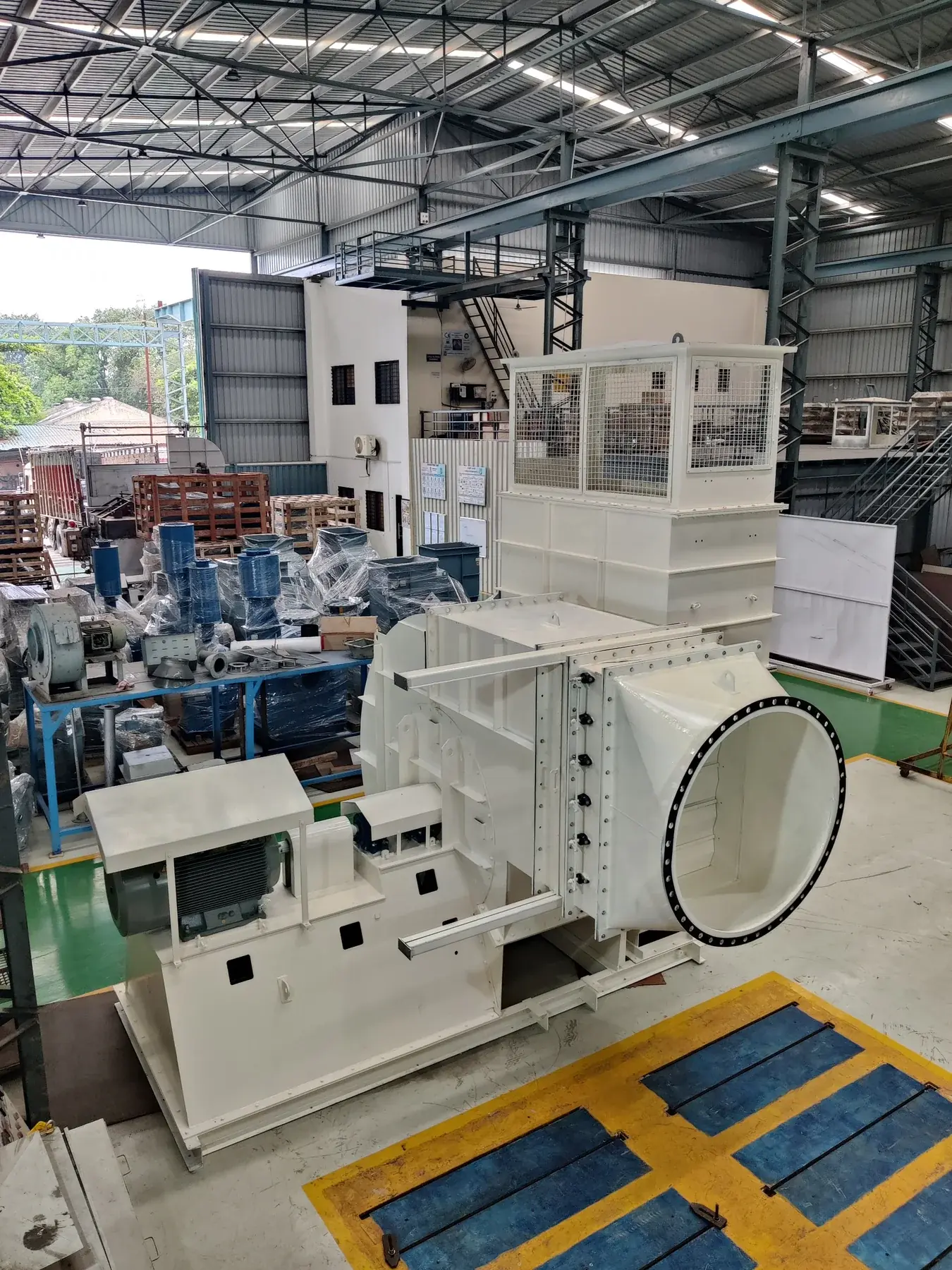
Stainless-steel centrifugal drying fan on the Jitamitra shop floor
Home  /  Applications  /  Drying (spray / fluid-bed / flash)
Applications

Drying fans — the hot supply fan and the product-laden exhaust fan, engineered as two different machines.

A dryer runs on two fans, and they could not be less alike. The supply fan pushes clean, heated air into the chamber at 150–350 °C; the exhaust fan pulls fine, sticky, hygroscopic powder and moisture to the cyclone or baghouse — powder that is often the saleable product itself. We build both across spray, fluid-bed and flash dryers for food & beverage, pharmaceuticals, chemicals and sugar, over the envelope below — up to 2,00,000 CMH, 2,000 mmWC and 400 HP.

2,00,000CMH max flow
2,000mmWC max static
350 °Chot supply air
400 HPdrive power
15,000+
fans built since 2011
200 HP
VFD test rig · IS 4894 / AMCA 210
99%
on-time delivery
3
working days to quote — always
HEATED CLEAN AIR INTO THE CHAMBER · PRODUCT-LADEN AIR OUT TO CYCLONE / BAGHOUSE · HYGIENIC · HYGROSCOPIC POWDER IS THE PRODUCT
What it does

Two fans, one dryer — a clean hot supply fan and a dirty product-laden exhaust fan.

A drying system moves heated air through the product: the supply fan delivers clean air at 150–350 °C into the spray, fluid-bed or flash chamber, and the exhaust fan draws the spent air — laden with fine powder and evaporated moisture — out to the cyclone or baghouse. The two duties share a system but almost nothing else, so we engineer them as two different fans.

  • 01
    Supply hot air

    Clean, heated air into the drying chamber at 150–350 °C — the duty is thermal, not dirty. Shaft sized for thermal growth, casing to IS 2062 or 16Mo3 where hot, curve held stable across the drying profile.

  • 02
    Exhaust the product

    Fine, sticky, hygroscopic powder plus moisture pulled to the cyclone or baghouse. The powder builds on the wheel and unbalances it — and it is often the saleable product, so capture, yield and hygiene all ride on the exhaust fan.

  • 03
    Stay clean

    Food and pharma duty means crevice-free, cleanable construction — SS304 / SS316, cleanable coatings, inspection access, and CIP or water-wash provision where the product or regulator demands it.

INDUCED-DRAFT CENTRIFUGAL FAN Single-width single-inlet — scroll cut away to reveal the impeller inlet expansion joint MOTOR IE3 / VFD GAS IN GAS OUT n 1 2 3 4 5 6 7 8 9 10 1 Inlet cone (bell-mouth) 2 Backward-curved / radial-tipped impeller 3 Spiral volute casing 4 Replaceable AR wear plates (volute throat) 5 Shaft 6 Plummer-block bearings (L10 ≥ 40,000 h) 7 Shaft cooling disc (>400 °C duty) 8 Pedestal / base frame 9 Drive — motor + coupling 10 Outlet flange + duct take-off
Fig. 1Drying-system fan pair — the hot supply fan feeding the chamber and the product-laden exhaust fan drawing to the cyclone; exhaust scroll cut away to reveal the crevice-free stainless wheel and inspection access. Numbered components keyed below the drawing.
Why it is hard

Three problems decide whether a drying fan holds balance, holds temperature and stays clean.

The exhaust fan handles powder that sticks, the supply fan handles air hot enough to demand real metallurgy, and food & pharma duty demands a fan you can actually clean. Design for each, and the fan runs balanced, hygienic and in-spec. Ignore them, and the wheel loads up, the shaft binds, or the duty fails a hygiene audit within the first 6–12 months.

01 — BUILD-UP

Product build-up on the exhaust wheel

Fine, sticky, hygroscopic powder — dairy, API, detergent, spray-dried body — accretes on the blade and redistributes mass until the rotor goes out of balance and trips protection. Worse, that powder is often the saleable product, so build-up is yield loss and a hygiene breach at once.

How we engineer it out

Radial-tipped self-cleaning wheel geometry, sloped crevice-free blade faces to encourage shedding, cleanable coatings, and Cleaning Provisions (water-wash / rapping) with hinged inspection access sized for the powder you actually dry.

02 — TEMPERATURE

Heat on the supply and early-exhaust side

Supply air at 150–350 °C grows the shaft and casing, conducts heat toward the bearings, and demands metallurgy that ordinary MS cannot give above its rating.

How we engineer it out

Shaft cooling / Heat Slinger and bearings outside the airstream, Flexible Connection / Expansion Joint at inlet and outlet for thermal growth, and casing stepped to IS 2062 or 16Mo3 on the hot side.

03 — HYGIENE

Cleanability & contamination control

On food and pharma duty a fan that cannot be cleaned is a contamination risk and an audit failure. Crevices trap product, painted MS flakes into the powder, and a welded-in wheel cannot be inspected.

How we engineer it out

Crevice-free construction in SS304 / SS316, Special Coating / Paint that is food-safe and cleanable, inspection doors for access, and CIP provision where the process calls for it.

How we design for it

Every choice is documented on the GA drawing you sign off — before we cut metal.

We don't sell a catalogue near-fit. The supply fan and the exhaust fan are each engineered to their own air temperature, powder character, hygiene class and drying profile — made to order, not off a shelf.

  • Supply fan vs exhaust fan — designed apart — The supply fan is a clean, thermal duty — efficiency, curve stability and heat handling — often a backward-curved wheel selected for high static efficiency. The exhaust fan is a dirty, hygienic duty — radial-tipped self-cleaning wheel, crevice-free, access for cleaning. We quote them as two fans, not one line item.
  • Hygienic, cleanable construction — For food & pharma duty: SS304 / SS316 wetted parts, crevice-free welds ground smooth, cleanable Special Coating / Paint, hinged inspection access, and Cleaning Provisions (water-wash / rapping) or CIP where the product and regulator demand it — so the fan can be verified clean, not just assumed clean.
  • Temperature package — Where supply or early-exhaust air runs 150–350 °C: casing stepped to IS 2062 or 16Mo3, shaft sized for thermal growth, Flexible Connection / Expansion Joint at inlet and outlet, and a Heat Slinger / cooling disc holding the bearing housing below its lubricant rating.
  • VFD for airflow & drying profile — Drying quality depends on air throughput and residence time, which shift across the batch or product change. VFD is our default on both fans — it tracks the drying profile smoothly, and on the exhaust fan it avoids the flow swings that unsettle cyclone capture and drive powder onto the wheel.
Engineered to your duty point

We size each fan onto the stable, efficient part of its curve — then prove it on the rig.

No catalogue fan forced onto your spec. The supply fan is engineered onto the falling, stable region of its curve and corrected for hot density; the exhaust fan is sized across the clean and product-loaded range onto the best-efficiency region of a self-cleaning wheel — then each is verified on the 200 HP VFD test rig before dispatch.

avoid: unstable 0 40,000 80,000 1,20,000 1,60,000 2,00,000 VOLUME FLOW RATE  [ CMH ] 0 500 1000 1500 2000 STATIC PRESSURE  [ mmWC ] 0 25 50 75 100 STATIC EFFICIENCY  [ % ] Fan static pressure System resistance Static efficiency BEP 82% DUTY POINT 1,20,000 CMH · 450 mmWC Fan static pressure System resistance Static efficiency
Fig. 2Representative drying-exhaust characteristic — fan static pressure, system resistance and static efficiency vs. flow, with the duty point engineered onto the best-efficiency region of a self-cleaning wheel and corrected for warm density. Illustrative; every fan is sized to its own duty.
Capability envelope — drying service

What we can supply, and where it stretches on application.

ParameterStandardOn application
Volume flowup to 2,00,000 CMHhigher on enquiry
Static pressureup to 2,000 mmWChigher on enquiry
Operating temperaturesupply air 150–350 °C; exhaust warm & moistup to 600 °C for hot-process drying with special metallurgy
Wetted materialsSS304 / SS316 for hygienic dutycrevice-free food-grade + cleanable coating on application
Drive powerup to 400 HPhigher with custom motor sourcing
Speed600–1,800 RPM typicalper duty + sound limits
Balance qualityISO 21940 G6.3G2.5 / G1.0 on application
Bearing life (design target)L10h ≥ 40,000 h continuouslonger L10 on application

The envelope above covers the great majority of spray, fluid-bed and flash-drying duty. The supply fan runs clean and hot — 150–350 °C — so its focus is metallurgy, curve stability and efficiency; the exhaust fan runs warm, moist and product-laden, so its focus is self-cleaning geometry, hygienic cleanable construction and capture of a powder that is often the saleable product. ATEX Zone 22 (Cat 3D) is self-declared per 2014/34/EU where the dried food or chemical dust is combustible. For duty beyond the envelope we engineer to spec and quote on enquiry.

How a Jitamitra DRY fan is specified

Specified, not picked from a shelf.

The same engineering language carries from your enquiry to the GA drawing to the nameplate — expressed in the standard AMCA conventions, with the supply fan and the exhaust fan called out separately.

Specification fieldOptions
Arrangement (AMCA 99)Arr. 1 / 8 / 9 (overhung, fan bearings outside the airstream) default for hot supply and product-laden exhaust duty; Arr. 4 (direct, motor on base) on cooler exhaust duty — selected by drive, access, temperature and cleaning.
Width / inletSWSI (single width, single inlet) default for drying duty; DWDI (double width, double inlet) for high flow at moderate pressure on large supply fans.
Wheel typeSupply fan: backward-curved / backward-inclined (clean air, best efficiency). Exhaust fan: radial-tipped self-cleaning (default for sticky hygroscopic powder) / straight-radial where build-up dominates.
Class (by pressure / outlet velocity)Class I / II / III selected from the duty point on the pressure-vs-outlet-velocity limits; higher class = heavier construction for higher pressure and tip speed.
Materials of constructionHygienic duty: SS304 food-grade / SS316 for aggressive or pharma product, crevice-free. Hot supply: IS 2062 or 16Mo3 casing. Abrasive powder: MS with Impeller Wear Protection or hard-faced wheel.
Hygiene & cleaning scopeCrevice-free construction, inspection access doors, Cleaning Provisions (water-wash / rapping), CIP provision and cleanable Special Coating / Paint where the food or pharma duty requires it — so the fan can be verified clean.
DriveDirect-coupled / V-belt / VFD (default, for airflow and drying-profile control). Drive up to 400 HP across the envelope; speed typically 600–1,800 RPM.
Accessories & thermal / hygiene scopeInlet Guide Vanes (IGV) or Discharge / Outlet Damper with VFD control; Flexible Connection / Expansion Joint at inlet and outlet for thermal growth; Heat Slinger / cooling disc on the hot supply side; Impeller Wear Protection for abrasive powder; Cleaning Provisions (water-wash / rapping) and inspection doors; drain for wash-down.
The proof, not the promise

We test before we ship — and you're welcome to witness it.

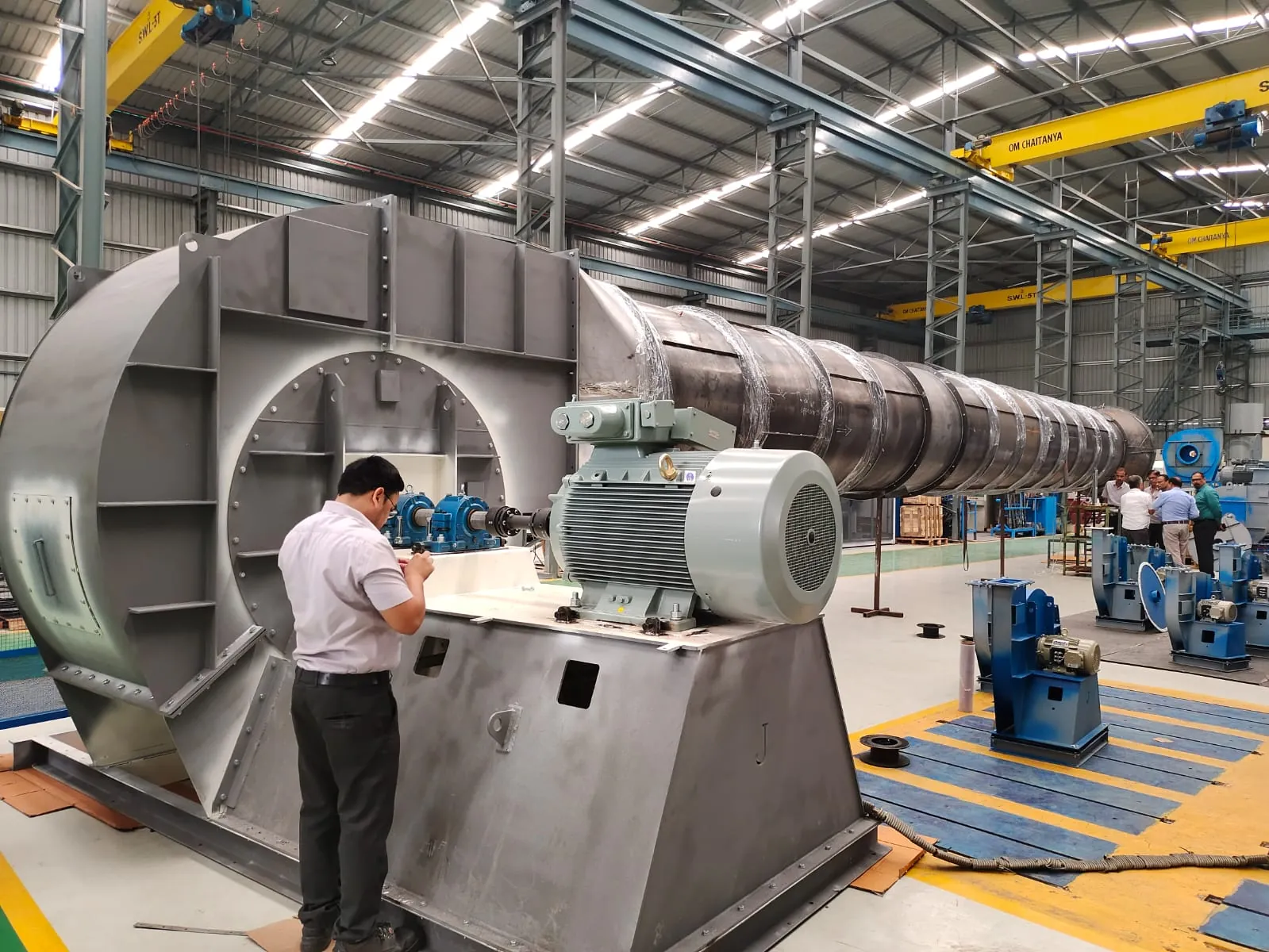
Every job's performance is verified at our works on the 200 HP VFD test rig, to the AMCA 210 / ISO 5801 method, before dispatch.

  • Customer-witnessed FAT on request — at no extra cost
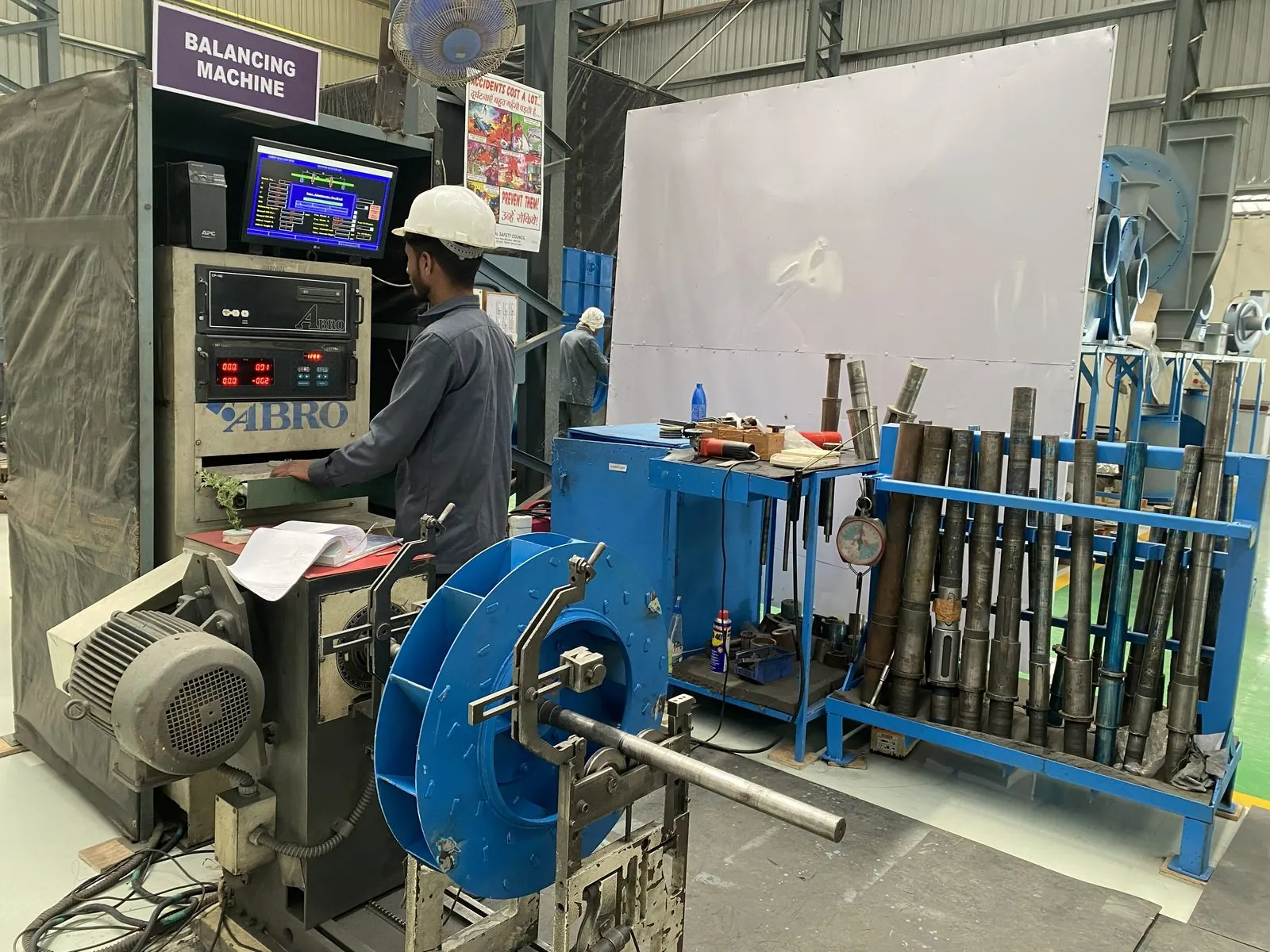
  • Rotors balanced to ISO 21940 G6.3 as standard (G2.5 / G1.0 on application) before they leave the floor
  • Full NDT in-house — DP, MPI, UT, RT — to what the duty demands
30+ INDUSTRIES · 45 APPLICATION / DUTY TYPES
Where our drying fans run

Proven on both sides of the dryer — hot supply and product-laden exhaust.

Food & Beverage

Dairy and spray-dried milk powder, coffee, food ingredients — hygienic SS exhaust fans, ATEX Zone 22 for combustible food dust.

Pharmaceuticals

API and excipient drying, fluid-bed dryers, granulation — crevice-free SS316, CIP provision, ATEX Zone 22.

Chemicals

Detergent spray drying, pigments and fine-chemical flash drying — corrosion-resistant SS, self-cleaning wheels.

Sugar & Distilleries

Spray and flash drying of sugar and by-products, spent-wash and DDGS drying exhaust.

Plastics & Polymers

Resin, polymer-powder and additive drying — supply and exhaust fans for fluid-bed and flash dryers.

Glass & Ceramics

Spray-dried body preparation for ceramic tile and sanitaryware — abrasive slurry-powder exhaust, wear-protected wheels.

Fertilizer & Minerals

Fluid-bed and flash drying of fertilizer granules and mineral powders — corrosion- and wear-protected supply and exhaust fans.

Your process

45 application/duty types engineered. Tell us yours.

Standards & conformity

Stated precisely — because procurement checks.

What our marks mean, in the words that survive an audit.

Performance

Tested to the AMCA 210 / ISO 5801 method, in-house on our 200 HP VFD rig. Tested-to-method — not AMCA-certified.

Quality system

ISO 9001:2015 — third-party certified. Our only third-party certification.

CE conformity

Self-declared per 2006/42/EC + 2014/35/EU (Module A). A self-declaration, not a notified-body certificate.

ATEX conformity

Self-declared, Zone 2/22, Category 3, per 2014/34/EU, where the area classification calls for it.

Oil & gas duty

Designed and built to API 673 as project-specific scope.

Welding

ASME Sec IX qualified welders + WPS for every joint.

Balance

ISO 21940 — G6.3 minimum, G2.5 / G1.0 on application.

Vibration

ISO 20816 evaluation; ISO 14694 for fan-specific limits.

Lead time & process

From enquiry to a tested fan on your dock.

StageStandard dutyAPI-673 / engineered
Offer / quotation3 working days — always7–10 working days
GA drawing for approval2–3 weeks from PO3–4 weeks from PO
Manufacture + balance + paint6–10 weeks10–14 weeks
Performance test + witnessed FAT~1 week1–2 weeks
Order-to-dispatch (total)9–14 weeks14–20 weeks

Shutdown-driven replacements: we have shipped fans within 6 weeks of a clean PO. Tell us your shutdown window and we commit to a dated plan.

Questions engineers ask

The eight we hear most before a PO.

Do I need one fan or two for my dryer?
Almost always two, and they are different machines. The supply fan pushes clean, heated air into the chamber at 150 to 350 °C — a thermal duty where efficiency, curve stability and metallurgy matter. The exhaust fan pulls the spent air, laden with fine sticky powder and moisture, to the cyclone or baghouse — a dirty, hygienic duty where self-cleaning wheel geometry, cleanable construction and product capture matter. We engineer and quote them separately, because a fan optimised for one is wrong for the other.
The dried powder builds up on the exhaust wheel and it's my product. What do you do about it?
Fine, sticky, hygroscopic powder accretes on the blade, redistributes mass and unbalances the rotor until it trips protection — and because that powder is often the saleable product, build-up is yield loss and a hygiene breach at once. We default the exhaust fan to a radial-tipped self-cleaning wheel with crevice-free sloped blade faces that encourage shedding, add cleanable coatings and, where the powder allows, water-wash or rapping cleaning provisions with inspection access. We size the geometry to your specific powder, not a generic wheel.
My product is food or pharma. Can your fans meet hygiene and cleanability requirements?
Yes. For food and pharma drying we build in SS304 or SS316 with crevice-free welds ground smooth, cleanable food-safe coatings, hinged inspection doors for access, a wash-down drain, and CIP provision where the process or regulator demands it. The point is a fan you can verify clean, not one you assume is clean — welded-in wheels and painted mild steel that flakes into the product have no place on a hygienic dryer. Tell us your hygiene class and cleaning regime and we build to it.
How hot does the supply-air fan run, and how do you handle it?
The heated drying-air supply fan typically runs 150 to 350 °C. We size the shaft for thermal growth, step the casing to IS 2062 or 16Mo3 on the hot side, fit expansion joints at inlet and outlet, keep the bearings outside the airstream, and add a heat slinger or cooling disc to hold the bearing housing below its lubricant rating. The fan is built for your stated supply temperature and excursion case, not a generic rating.
Should I specify VFD for a drying fan?
Yes, it is our default on both fans. Drying quality depends on air throughput and residence time, which shift across a batch, a product change or a start-up ramp, and VFD tracks that profile smoothly. On the exhaust fan it also avoids the flow swings that unsettle cyclone or baghouse capture and drive more powder onto the wheel. Inlet guide vanes or an outlet damper remain available for legacy retrofit where the existing drive cannot be changed.
Are your drying fans ATEX-rated for combustible food or chemical dust?
Where the dried dust is combustible — many food powders like milk, flour and sugar, and some chemical and pharma powders — ATEX Zone 22 is self-declared per 2014/34/EU, Category 3D, on the product-laden exhaust fan. The build uses aluminium or bronze rub rings to prevent ferrous-on-ferrous contact, bonded earthing, anti-static coatings and T-class bearing-temperature control. To be precise, that is a self-declaration of conformity, not a third-party certification. Zone 21 (Category 2D) is available on application via a Notified-Body partner.
What certifications and test standards actually apply to these fans?
To be exact: CE is self-declared per 2006/42/EC and 2014/35/EU, and ATEX Zone 2/22 is self-declared per 2014/34/EU (Category 3) where the dust classification calls for it — these are self-declarations of conformity, never third-party certifications. Performance is tested in-house to the AMCA 210 / ISO 5801 method on our 200 HP VFD test rig; that is a test method, not an AMCA certification, and we are not an AMCA member. Every fan is dynamically balanced to ISO 21940 G6.3 as standard (G2.5 / G1.0 on application), with a bearing-life design target of L10h at least 40,000 hours. Our only third-party certification is ISO 9001:2015.
What is the lead time for a drying-fan pair?
A standard engineered drying fan runs roughly 9 to 14 weeks order-to-dispatch: offer in 3 to 5 working days, GA drawing 2 to 3 weeks from PO, manufacture, balance and paint 6 to 10 weeks, and performance test plus FAT 1 to 2 weeks. A hygienic all-stainless build with CIP provision, or an ATEX exhaust fan, adds file and finishing work and runs about 12 to 16 weeks. Supplying the supply and exhaust fans as a matched pair does not add time — we schedule them together.

Across the range

Where drying fans fit — the fans that run them, related duties, and the industries served.

The same engineering, viewed three ways — by fan family, by duty, and by industry. Follow the cross-references.

Take it further

Specs an engineer can use — not a brochure.

Engineer to engineer

Send us the duty point.
We'll quote in 3 working days — always.

No model numbers needed. Give us the operating conditions — flow, static, gas temperature, composition, particulate, and any tender standard — and our application engineers size the fan and quote it. Attach a spec or GA if you have one.

+91 90110 09155  ·  mihir.jitamitra@gmail.com