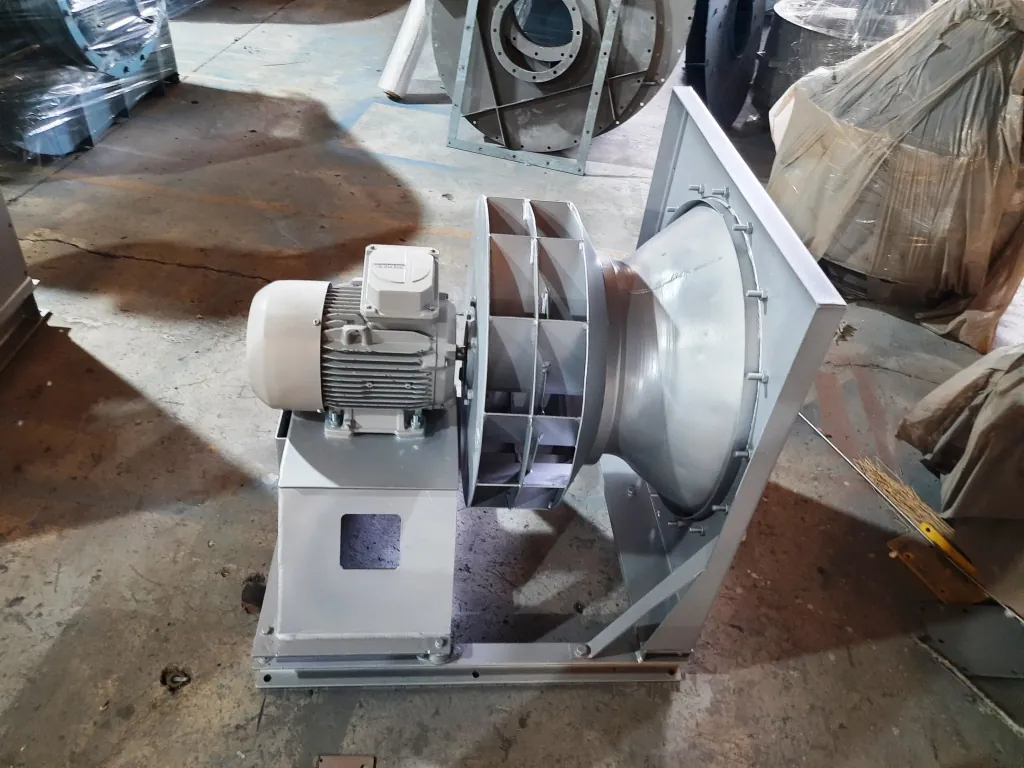
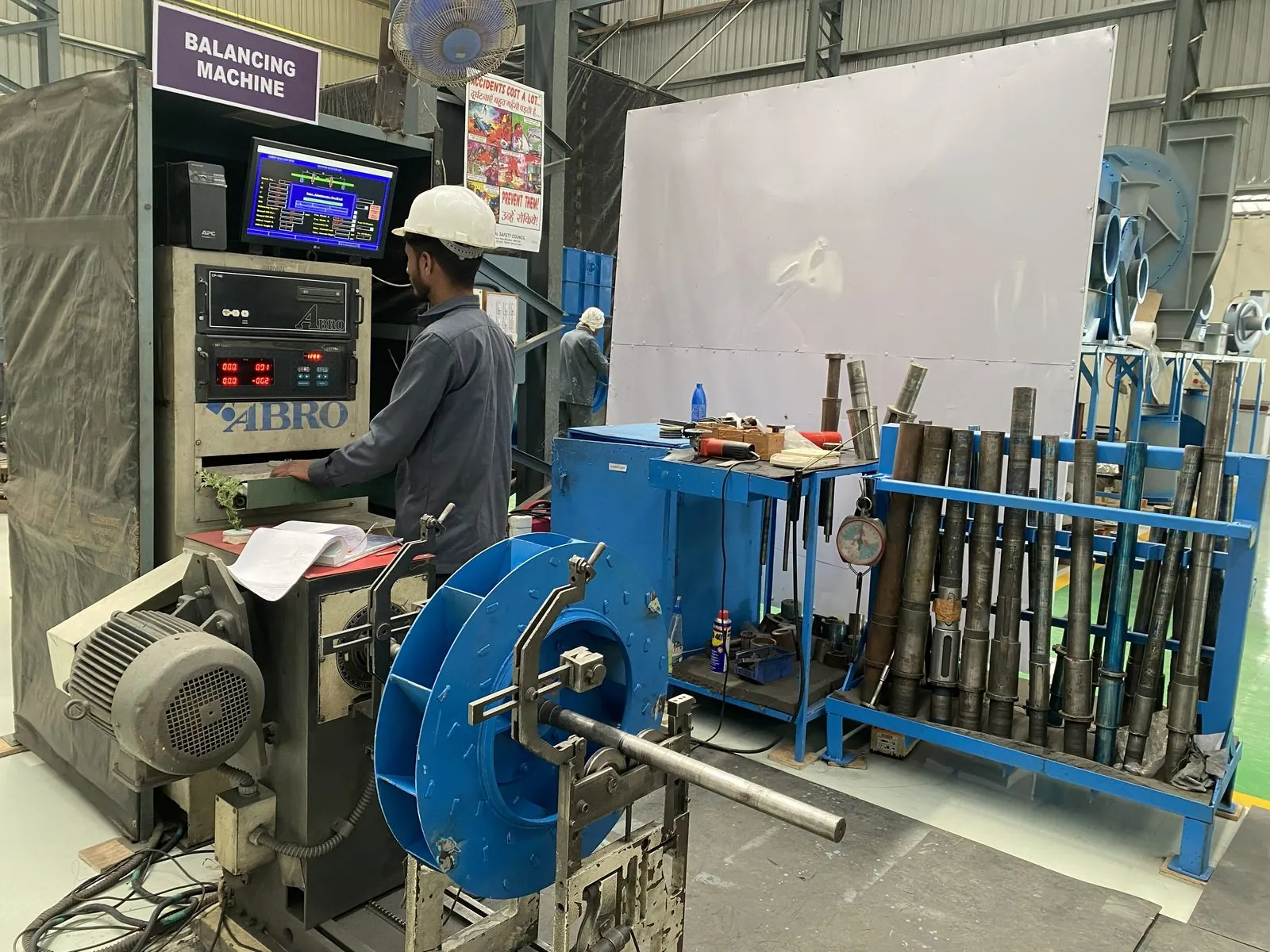
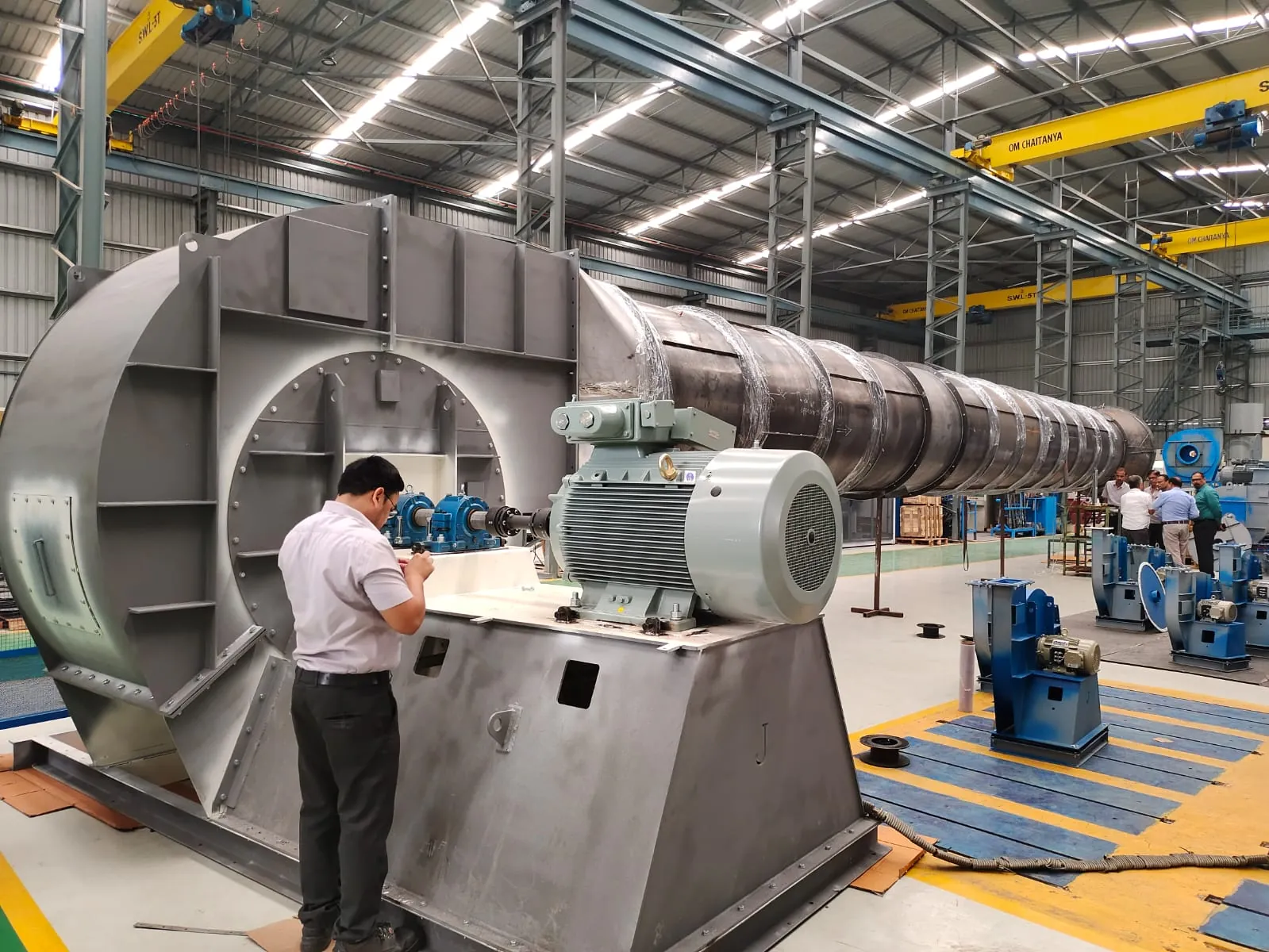
Aerofoil-bladed centrifugal impeller on the Jitamitra shop floor
Home  /  Products  /  Jitamitra Aerofoil
Products

Jitamitra Aerofoil — the highest-efficiency wheel we build, for clean air.

The Aerofoil family uses hollow, wing-profile backward blades — the cleanest-running blade form in the range. Air flows over them with the least turbulence, so the fan moves a given volume on the least motor power: the highest static efficiency in our range, a non-overloading power curve, and the quiet running that occupied buildings need. It is a clean-air family — filtered air, no more than a trace of dust — for HVAC plant, cleanroom & pharma AHU supply and return, and filtered forced-draft air. Engineered to your exact duty on our proprietary fan-selection software, sized to sit near best efficiency.

highest in rangepeak static efficiency
filtered air onlyclean-air gate
non-overloadingpower curve
to dutyengineered, not off-shelf
15,000+
fans built since 2011
200 HP
VFD test rig · IS 4894 / AMCA 210
99%
on-time delivery
3
working days to quote — always
BACKWARD WING-PROFILE BLADE · LEAST TURBULENCE · HIGHEST EFFICIENCY · CLEAN AIR ONLY
What the wheel is

An aerofoil wheel earns its place on one thing: it wastes the least power.

The blade is a hollow, wing-shaped section that leans away from the direction of rotation. That backward, smoothly-profiled form gives the cleanest airflow and the highest static efficiency of any blade type — but the thin section erodes in dust, so the family is for clean air only. Here is what that geometry does best.

  • 01
    Save power

    The wing section converts the most motor power into useful air pressure — the highest static efficiency in the range (exact figures shared with your enquiry). Over a fan running thousands of hours a year, the electricity saved is the real cost argument.

  • 02
    Protect the motor

    A backward blade gives a non-overloading power curve — power rises with flow, peaks, then falls. If the duct resistance drops, the motor cannot be overloaded, so the drive is sized safely without a large margin.

  • 03
    Run quiet

    Backward, smoothly-loaded blades run quieter than forward-curved or radial wheels — suited to occupied-building HVAC, cleanroom and pharma duty where sound limits apply.

GENERAL ARRANGEMENT to scale from our design drawings IMPELLER · AEROFOIL BLADE wheel schematic DISCHARGE ORIENTATIONS · ENGINEERED TO ORDER 45° 90° 135° 180° 225° 270°
Fig. 1General arrangement, impeller and 7 discharge orientations. Drawn to scale from our in-house design drawings; every fan engineered to your duty.
Why you choose it (and where you don't)

Three drivers decide the aerofoil — and one hard boundary rules it out.

The aerofoil is picked for running cost, drive safety and noise. The trade-off is honest: the hollow wing blade erodes in particulate, so it is a clean-air family. Keep the airstream clean and filtered and it is the most efficient wheel we make; once dust becomes more than a trace, the right answer is a tougher family, not this one.

01 — EFFICIENCY

Lowest running cost

On a fan that runs continuously, the motor bill — not the purchase price — is the lifetime cost. An over-sized or low-efficiency wheel quietly wastes power every hour.

How we engineer it out

The aerofoil's wing section gives the highest peak static efficiency in our range; the wheel is engineered onto its best-efficiency region on our proprietary fan-selection software, not over-sized for safety.

02 — DRIVE SAFETY

Non-overloading curve

If a filter is removed or a damper opens, a forward-curved fan's power keeps climbing and can overload the motor — a real off-design failure mode in HVAC plant.

How we engineer it out

The backward aerofoil characteristic is non-overloading — power peaks then falls — so the motor is protected without paying for a large drive margin.

03 — DUST BOUNDARY

Clean air only

The thin hollow aerofoil blade erodes quickly in grit or dust; run it on a dirty airstream and the wheel loses balance and life fast.

How we engineer it out

We gate the family at clean, filtered air and say so plainly — for light dust we step you to the Backward-Curved family, for FD/process and heavier dust to the Backward-Curved Plate family, the Radial-Tip family or the Radial family.

How it is built

Construction documented on the GA you sign off — before we cut metal.

Not a catalogue near-fit. The wheel, width, materials and accessories are chosen to your flow, pressure, temperature and installation — and the hollow aerofoil blade is fabricated and balanced for the 100 m/s tip.

  • Blade form & wheels — Hollow, wing-profile backward (aerofoil) blade — the lowest tip speed in the range at 100 m/s. Wheel sizes from 310–3,050 mm diameter, so the wheel is matched to the duty rather than over-sized.
  • Width, drive & mounting — SWSI (-S) for higher pressure or DWDI (-D) for high volume in a compact height; belt or direct drive; plug / plenum (unhoused) configuration that drops into AHUs and fan-wall / fan-array (N+1) builds.
  • Materials of construction — MS standard; SS304 / 316 full or airstream for clean corrosive duty; FRP variant (F suffix); Corten / duplex per duty. Wear-plating is not an Aerofoil option by design — if dust calls for it, the family is wrong.
  • Construction suffixesHT high-temperature construction (to 400 °C, on enquiry above) and SR spark-resistant (AMCA 99 Type A/B/C, ATEX) where the area classification calls for it; -S/-D set width.
Engineered to your duty point

We size the wheel where its curve crosses your system — then prove it on the rig.

No catalogue fan forced onto your spec. Your operating point is engineered onto the best-efficiency region of the selected aerofoil wheel — then verified to the AMCA 210 / ISO 5801 method in-house on our 200 HP VFD test rig before dispatch.

avoid: unstable 0 40,000 80,000 1,20,000 1,60,000 2,00,000 VOLUME FLOW RATE  [ CMH ] 0 500 1000 1500 2000 STATIC PRESSURE  [ mmWC ] 0 25 50 75 100 STATIC EFFICIENCY  [ % ] Fan static pressure System resistance Static efficiency BEP 82% DUTY POINT 1,20,000 CMH · 450 mmWC Fan static pressure System resistance Static efficiency
Fig. 2Representative aerofoil characteristic — fan static pressure, the non-overloading power curve and static efficiency vs. flow, with the duty point engineered onto the best-efficiency region. Illustrative; every fan is sized to its own duty.
Capability envelope — Aerofoil clean-air service

What we can supply, and where it stretches on application.

ParameterStandardOn application
Volume flow800–2,00,000 CMHhigher on enquiry
Static pressure10–650 mmWCper-wheel max ~537 mmWC; higher on enquiry
Peak static efficiencyhighest in our range — shared on enquirynear-best-efficiency selection per duty
Inlet dust loading (gate)clean, filtered air onlyabove gate → step to the Backward-Curved, Backward-Curved Plate, Radial-Tip or Radial family
Continuous air temperatureup to 400 °C with HT constructionhigher on enquiry (HT-aerofoil)
Drive powerup to 400 HPhigher with custom motor sourcing
Balance qualityISO 21940 G6.3 standardG2.5 on request (occupied-building / pharma)
Bearing life (design target)L10h ≥ 40,000 h continuouslonger L10 on application

The Aerofoil family is offered engineered-to-order. The published envelope — 800–2,00,000 CMH, 10–650 mmWC, up to 400 HP and 400 °C — is the family capability across our aerofoil range. The hard limit is dust: clean, filtered air only. For anything dusty, the aerofoil is the wrong family and we will say so.

How a Jitamitra Aerofoil fan is specified

Specified, not picked from a shelf.

The same engineering language carries from your enquiry to the GA drawing to the nameplate — expressed in the standard AMCA conventions.

Specification fieldOptions
Arrangement (AMCA 99)Arr. 1 (overhung, fan bearings) / Arr. 4 (direct, motor on base) / Arr. 8 (overhung on common base) / Arr. 9 (overhung, motor side) / plug-plenum (unhoused) for AHU and fan-array — selected by drive, access and mounting.
Width / inletSWSI (single width, single inlet, -S) for higher pressure; DWDI (double width, double inlet, -D) for high volume in a compact height. Peak efficiency in the family is reached on the largest DWDI wheel.
Wheel typeAerofoil — hollow, wing-profile backward blade. Wheel sizes from 310–3,050 mm diameter, tip speed 100 m/s (the lowest in the range — the aerofoil limit).
Class (by pressure / outlet velocity)Class I / II selected from the duty point on the pressure-vs-outlet-velocity limits; the aerofoil sits at the low-tip, high-efficiency, clean-air end of the class table.
Materials of constructionMS (standard) / SS304 or 316 (full or airstream) for clean corrosive duty / FRP (F suffix) / Corten or duplex per duty. No wear-plating by design — anything beyond clean, filtered air moves the duty to another family.
DriveDirect-coupled / V-belt / VFD (with shaft-earthing ring). Drive up to 400 HP across the envelope; the non-overloading curve lets the motor be sized without a large overload margin.
Discharge & rotation (AMCA orientation)Rotation CW or CCW (viewed from drive side) with discharge angle per AMCA — e.g. TH/BH/UB/DB — set to match your duct take-off and installed footprint; plug/plenum builds discharge into the plenum.
Construction suffix & accessory scopeHT high-temperature (to 400 °C) / SR spark-resistant (AMCA 99 Type A/B/C, ATEX) per area classification; inlet guide vanes (IGV / in-cone IVC) and dampers for trim control; inlet/outlet silencers for occupied-building noise; flexible connectors and anti-vibration mounts; plug/plenum mounting kit for AHU and fan-array (N+1) builds.
The proof, not the promise

We test before we ship — and you're welcome to witness it.

Every job's performance is verified at our works on the 200 HP VFD test rig, to the AMCA 210 / ISO 5801 method, before dispatch.

  • Customer-witnessed FAT on request — at no extra cost
  • Rotors balanced to ISO 21940 G6.3 as standard (G2.5 / G1.0 on application) before they leave the floor
  • Full NDT in-house — DP, MPI, UT, RT — to what the duty demands
30+ INDUSTRIES · 45 APPLICATION / DUTY TYPES
Where our aerofoil fans run

Chosen where the air is clean and the priority is power, noise and reliability.

HVAC & Buildings

AHU supply and return, fan-wall / fan-array (N+1) plenum builds, central-plant ventilation.

Pharmaceuticals

Cleanroom and pharma AHU supply and return — efficiency and low noise on filtered air.

Food & Beverage

Clean-process supply air and general clean ventilation.

Data Centers

Clean cooling-air supply where running cost and acoustics dominate.

Semiconductor & Electronics

Cleanroom AHU and filtered-air handling for controlled environments.

Boiler & Combustion

Filtered forced-draft (FD) air where the air is genuinely clean.

Commercial & Infrastructure

Large building ventilation and supply air with sound-limit constraints.

Your clean-air duty

4 aerofoil wheels engineered to duty. Tell us your flow and static.

Standards & conformity

Stated precisely — because procurement checks.

What our marks mean, in the words that survive an audit.

Performance

Tested to the AMCA 210 / ISO 5801 method, in-house on our 200 HP VFD rig. Tested-to-method — not AMCA-certified.

Quality system

ISO 9001:2015 — third-party certified. Our only third-party certification.

CE conformity

Self-declared per 2006/42/EC + 2014/35/EU (Module A). A self-declaration, not a notified-body certificate.

ATEX conformity

Self-declared, Zone 2/22, Category 3, per 2014/34/EU, where the area classification calls for it.

Oil & gas duty

Designed and built to API 673 as project-specific scope.

Welding

ASME Sec IX qualified welders + WPS for every joint.

Balance

ISO 21940 — G6.3 minimum, G2.5 / G1.0 on application.

Vibration

ISO 20816 evaluation; ISO 14694 for fan-specific limits.

Lead time & process

From enquiry to a tested fan on your dock.

StageStandard dutyAPI-673 / engineered
Offer / quotation3 working days — always7–10 working days
GA drawing for approval2–3 weeks from PO3–4 weeks from PO
Manufacture + balance + paint6–10 weeks10–14 weeks
Performance test + witnessed FAT~1 week1–2 weeks
Order-to-dispatch (total)9–14 weeks14–20 weeks

Shutdown-driven replacements: we have shipped fans within 6 weeks of a clean PO. Tell us your shutdown window and we commit to a dated plan.

Questions engineers ask

The eight we hear most before a PO.

Can the Aerofoil handle dusty or dirty air?
No — and we say so plainly. The hollow, wing-profile aerofoil blade erodes in particulate, so it is a strictly clean-air family — filtered air, no more than a trace of dust. For light dust we move you to the Backward-Curved family; for FD / process / combustion air and light-dust draught to the Backward-Curved Plate family (the workhorse); and for moderate-to-heavy abrasive dust to the Radial-Tip family or the Radial family. Putting an aerofoil on dirty air is the fastest way to lose a wheel.
Why is the aerofoil the most efficient fan you make?
The wing-shaped backward blade moves air with the least turbulence, so more of the motor power becomes useful air pressure rather than noise and heat. Its peak static efficiency is the highest of any blade form in our range (exact figures are shared with your enquiry). On a fan running thousands of hours a year, that efficiency is the real lifetime-cost argument over the purchase price.
What is a non-overloading power curve, and why does it matter?
On a backward-bladed wheel, motor power rises with flow, reaches a peak, then falls. So if the system resistance drops — a filter removed, a damper opened — the power cannot keep climbing and the motor is protected. Practically, you can size the drive close to the duty without a large overload margin, unlike a forward-curved fan whose power keeps rising off-design and can overload the motor.
Can you build it as a plug fan for our AHU or fan array?
Yes. The plug / plenum (unhoused) configuration is available and suits AHUs and fan-wall / fan-array (N+1) installations, where several smaller plug fans give redundancy and turndown. We supply the plug/plenum mounting kit, and pair it with a VFD and shaft-earthing ring, flexible connectors and anti-vibration mounts as the install requires.
What temperature can the aerofoil run at?
We attest a 400 °C ceiling with high-temperature (HT) construction. Above that, hotter duty is quoted on enquiry only. Most Aerofoil duty is HVAC and AHU air well below that — the HT scope exists for the occasional hot clean-air application, not as a routine rating.
SWSI or DWDI — which width do we need?
SWSI (single width, single inlet, -S) develops higher pressure for a given wheel and is the default for ducted housed duty; DWDI (double width, double inlet, -D) moves high volume in a compact height and is common on large AHU supply. The family's peak efficiency point is on the largest DWDI wheel. We select the width from your flow-and-static pair and the available height, not from a default.
Do you performance-test and balance before dispatch, and can we witness it?
Yes. Every fan is performance-tested in-house to the AMCA 210 / ISO 5801 method on our 200 HP VFD test rig, and dynamically balanced to ISO 21940 G6.3 as standard, with G2.5 available on request for occupied-building and pharma jobs. A witnessed FAT — run-test plus a 3-axis vibration record per bearing — is offered for spec-driven HVAC and pharma work. You see the curve and the balance report before the fan leaves the floor.
What about CE, ATEX and ISO compliance?
Spark-resistant (SR) construction to AMCA 99 Type A/B/C and ATEX 2014/34/EU is available where the area classification requires it — those are self-declarations of conformity, not third-party certifications. CE is self-declared per the Machinery Directive 2006/42/EC for EU export. Performance is rated to the AMCA 210 / ISO 5801 method, tested in-house (not AMCA-certified). Our only third-party certification is ISO 9001:2015.

Across the range

Where the Aerofoil fits — the clean-air, efficiency-led end of the range.

The same engineering, viewed three ways — by fan family, by duty, and by industry. Follow the cross-references.

Take it further

Specs an engineer can use — not a brochure.

Engineer to engineer

Send us the duty point.
We'll quote in 3 working days — always.

No model numbers needed. Give us the operating conditions — flow, static, gas temperature, composition, particulate, and any tender standard — and our application engineers size the fan and quote it. Attach a spec or GA if you have one.

+91 90110 09155  ·  mihir.jitamitra@gmail.com