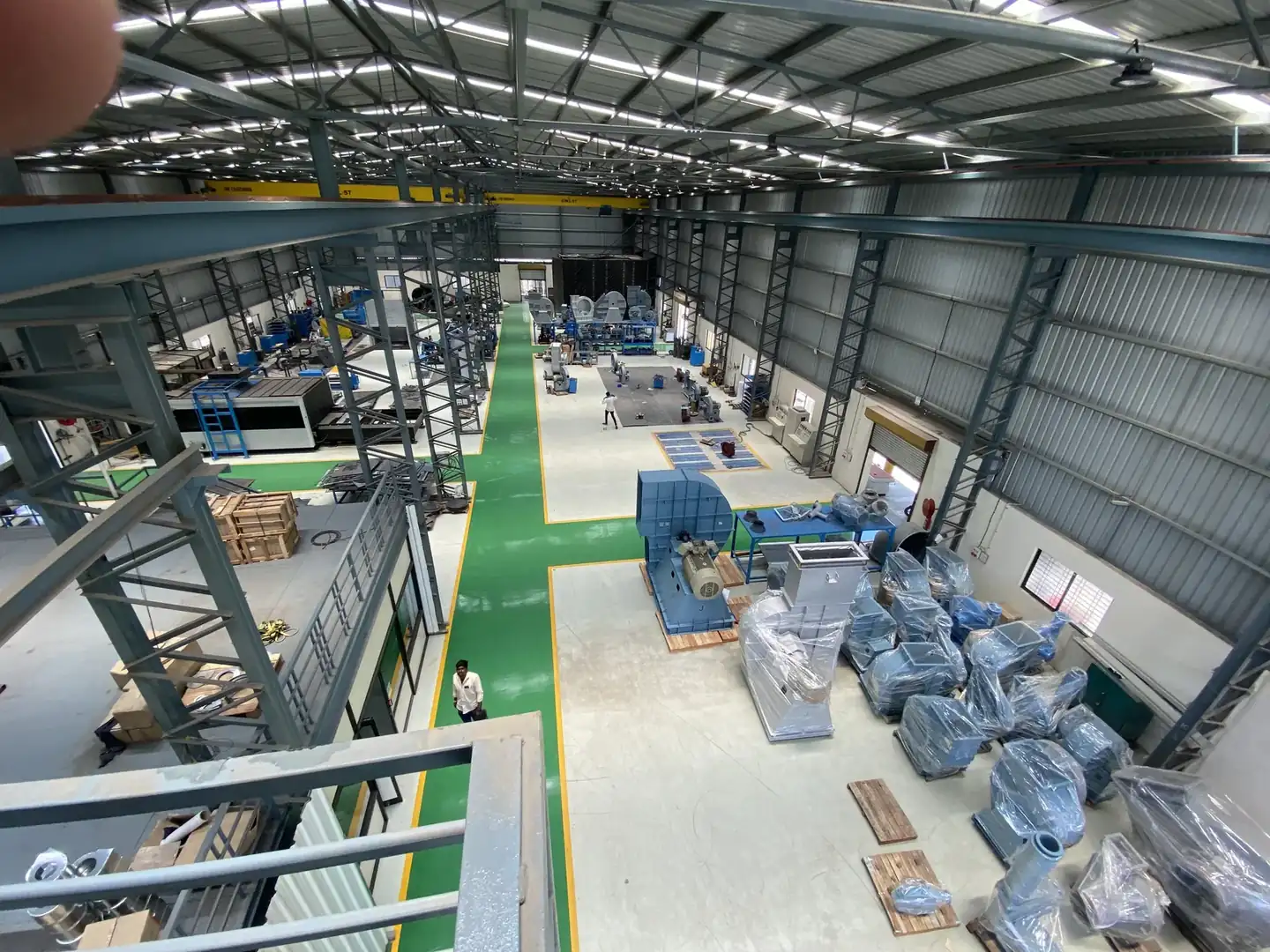
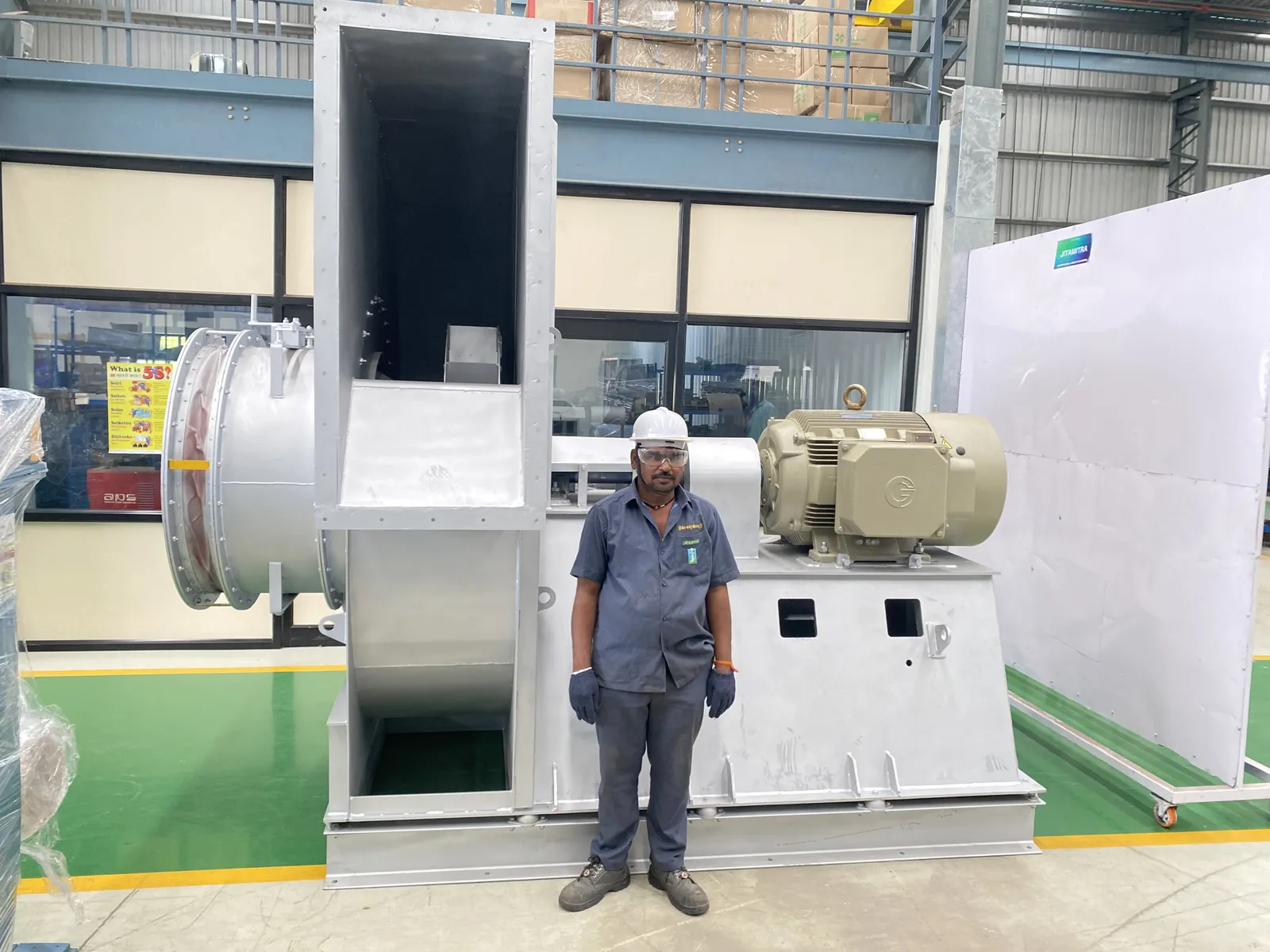
Can you supply the fans across the whole paint shop, or only the booth exhaust?
Across the whole shop. We have delivered 1,096 automotive & paint fans spanning paint-booth and cure-oven exhaust, weld and grind fume extraction, local exhaust ventilation, pre-treatment and e-coat corrosive vent, quench and tempering air, and the general and dilution ventilation and make-up air. Each fan is engineered to its own stream — the spark-resistant solvent booth exhaust and the clean general-vent fan are different machines — but they come from one partner, on one engineering convention across the plant.
The booth and oven exhaust is in a classified area. How do you make the fan spark-resistant?
We build the flammable streams to AMCA spark-resistant construction (type A, B or C to match your classification). That means non-sparking rubbing surfaces at the shaft and inlet, the rotor and casing bonded and earthed so static cannot build and discharge, and shaft seals that keep solvent vapour off the bearing. ATEX Zone 2/22 is self-declared per 2014/34/EU (Category 3) where the area classification calls for it. Tell us your zone and the solvent, and we set the construction to it rather than a default.
Overspray and lacquer keep building up on our booth-exhaust fan. What do you do about it?
Two things. We select a backward-curved plate wheel that sheds overspray instead of trapping it, with smooth, wipeable surfaces on the gas path, and we add bolted inspection and cleanout doors so the baked deposit is cleared on a maintenance schedule. That keeps the rotor in balance and, just as important, stops a solvent-soaked cake becoming a hidden fire load. On the oven side we size the wheel for the warm, resin-carrying air so it does not run hot enough to bake the deposit hard.
Our pre-treatment and e-coat vents are corrosive. What materials do you use?
We size the metallurgy to your vapour. Phosphating, e-coat and pickling vents carry acid and alkali mist, so we specify Corten or 316L on the wetted surfaces where mild steel would fail, and offer an FRP coating or a fully coated build for the most aggressive plating exhaust. Where chloride is present we avoid the stainless grades that pit and step to a higher alloy or a coating. The right answer depends on your chemistry, so we engineer it to your vent analysis, not a default.
Can you build a replacement to match our existing paint-shop fan's duty and footprint?
Yes. We reverse-engineer to the existing duty point (flow, static pressure, temperature, density and the ATEX classification), bearing centres, inlet/outlet orientation and foundation bolt pattern so the unit drops onto the existing base and ducting — whether it is a booth exhaust, an oven fan, a weld-fume fan or a general-vent fan. Made to your installation, not a nearest-catalogue substitute. Send the old GA, the nameplate and a curve if you have one, and we match it.
Do you performance-test the fans, and what about AMCA, CE, ATEX and quality certification?
Every fan is performance-tested in-house to the IS 4894 / ISO 5801 / AMCA 210 method on our 200 HP VFD test rig, and dynamically balanced to ISO 21940 G6.3 as standard (G2.5 / G1.0 on application). Fans above the rig's 200 HP are run at derated speed and scaled to the specified duty by the fan laws. To be precise: that in-house testing is to the IS 4894 / ISO 5801 / AMCA 210 method, not AMCA-certified, and we are not an AMCA member; CE is self-declared per 2006/42/EC and 2014/35/EU, and ATEX Zone 2/22 is self-declared per 2014/34/EU (Category 3) where the area classification calls for it — those are self-declarations of conformity, not third-party certifications. Our only third-party certification is ISO 9001:2015.