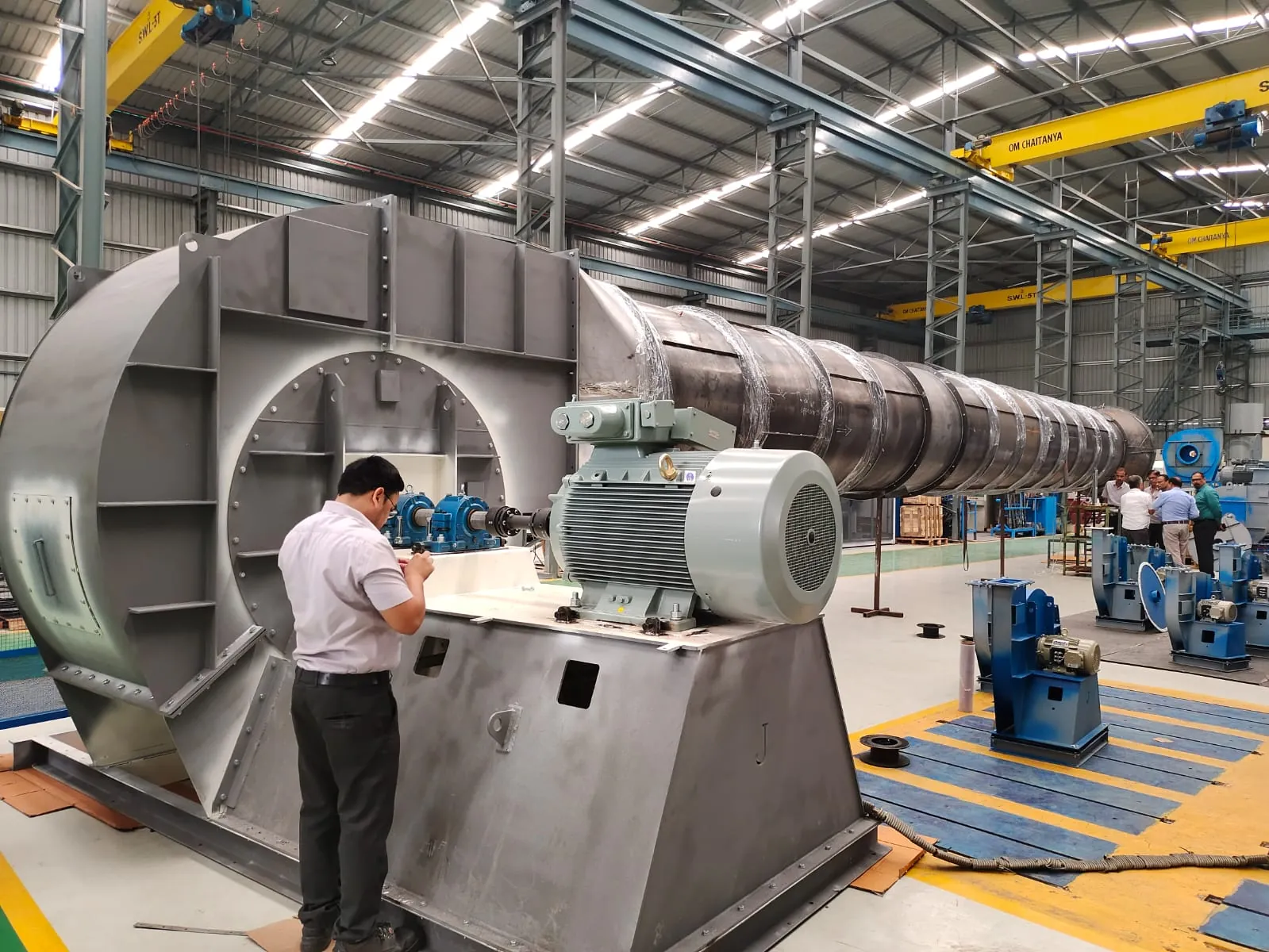
Picture a coating and finishing line where hot air has to move through a drying tunnel to cure the product. If the dryer blower stops, the line stops. Our customer — a surface-finishing and industrial-coatings manufacturer in Maharashtra — runs two identical Jitamitra hot-air blowers on exactly such a line at their end-user's plant. We'll call them the Coatings Maker. These are our fans, supplied by us, and that means when a service call comes in, it is ours to answer — and ours to diagnose honestly, wherever the cause turns out to sit.
Two service calls landed on the same fan, months apart.
A cracked component on a running fan is the kind of thing a buyer immediately reads as "manufacturing defect." The useful part of this story is what the diagnosis actually found.
Start with the finding, because it is the point of the case: the fan itself was on-spec. Our signed field record put down "Fan Manufacturing Defect = No." The crack did not begin in anything we fabricated. It traced to a bought-out heat component — the heat-slinger plate — and to its fixing bolt not being seated correctly. The earlier bearing call was normal wear: a bearing that had run its service life and needed changing, not a fault in the fan.
We didn't reach that by guessing. We tried remote diagnosis first — asking for photos and video — and when that wasn't enough to be sure, we sent an engineer to site rather than assume. On site, our engineer confirmed the failed heat-slinger, replaced the damaged plate with a new one and refitted it correctly with a new fixing bolt, properly seated, re-greased the bearing, and ran the blower under observation before signing off. On the earlier bearing call, we dispatched a full replacement bearing set with the correct adaptor sleeves and grease, changed the bearing, and re-issued the operating & maintenance manual and spare-parts list so the customer's team could maintain both blowers with confidence.
The reusable, engineer-to-engineer lesson — teach it, don't blame anyone: - A heat-slinger is a bought-out heat component that is fitted as a serviceable part. Its fixing has to be seated correctly at fitment; a fixing that isn't properly home lets the plate work loose and crack near the bearing housing. Treat the heat-slinger fixing as a checked, correctly-seated joint — at build and after any part change. - Bearings are scheduled wear parts. They are meant to be greased on a regular interval and changed on condition — a noisy bearing after a normal run is maintenance, not a defect. A simple greasing regime and the spares list keep both blowers running.
Because the failed heat component was bought-out, we didn't just swap it and move on. We debited it back to its supplier, and we tightened our own rule so any complaint involving a bought-out item (bearing, heat-slinger and the like) now routes straight to our purchasing team with supplier feedback captured. That is how a one-off field fix becomes a permanent process improvement.
(No fan-selection software, spec sheet, or internal codes are shown here; the customer's process detail is withheld.)
(No before/after vibration, noise or downtime figures are published — they were not measured in the record, and we don't invent numbers.)
When a part on a running fan fails, the easy answers are "it's a manufacturing defect" or "it's not our problem." The useful supplier does neither — they go to site, find the real cause (here: a bought-out heat component, its fixing, and a bearing at end of normal life — with the fan itself on-spec), replace the parts free under warranty, push the cause back to source, and set the maintenance right. Want a fan backed by a supplier who diagnoses the real cause and owns the fix? Talk to us.
— Jitamitra Electro Engineering · Technical Services
Engineered for Every Application.
Not necessarily, and on this hot-air dryer blower it was not. The crack traced to a bought-out heat component — the heat-slinger plate — and to its fixing bolt not being seated correctly. Our signed field record put down "Fan Manufacturing Defect = No." The crack did not begin in anything we fabricated.
On a hot-air blower the heat-slinger throws heat off the shaft to protect the drive-end bearing, so a cracked one is a reliability flag. That is why the customer's engineers raised it as top priority.
We try remote diagnosis first, asking for photos and video. When that is not enough to be sure, we send an engineer to site rather than assume — which is what happened here.
On this job, no. The damaged plate was replaced free, refitted correctly with a new fixing bolt properly seated, and the issue was closed in two days.
Not necessarily. The earlier bearing call on this same fan was normal wear: a bearing that had run its service life and needed changing, not a fault in the fan.
Flow, static, gas temperature, application — or attach a spec, GA drawing or a multi-fan schedule. Engineer to engineer.
ISO 9001:2015 quality system · performance-tested to IS 4894 / ISO 5801 / AMCA 210 method · witnessed FAT on request.
*For our standard range. ATEX and special projects need 5 to 7 working days.
This site sets no cookies of its own. Google Analytics loads only if you accept. It sets two cookies, so we can see which fan topics people actually read. Decline and no analytics loads — the site works exactly the same. What we collect →