| Who | A combustion-equipment and oven OEM in Maharashtra (furnaces, ovens, heat-treatment / burner segment) |
| Equipment | Centrifugal combustion-air blower, 8,600 CMH / 305 mmWC / 20 HP, design air temperature 20 °C, VFD-driven, tested to IS 4894 method |
| Complaint | "Low pressure at the burner" — the site could not get design head at the burner header, and asked for a new impeller design |
| Service | Joint site visit, field readings taken with the customer, system-resistance analysis, ducting and re-rate proposals |
| Response | Service engineer on site; readings, analysis and a written engineering position issued to the plant |
| Result | Measurement showed the fan below rated load and off its design point (48 Hz, 40 °C, oven back-pressure). We proposed a low-turbulence three-branch Y-duct and — if the system stayed as built — a re-rated blower at 450 mmWC / 30 HP. The record documents our diagnosis and the options put to the plant; it records no customer sign-off and no post-fix pressure reading, and we claim none. |
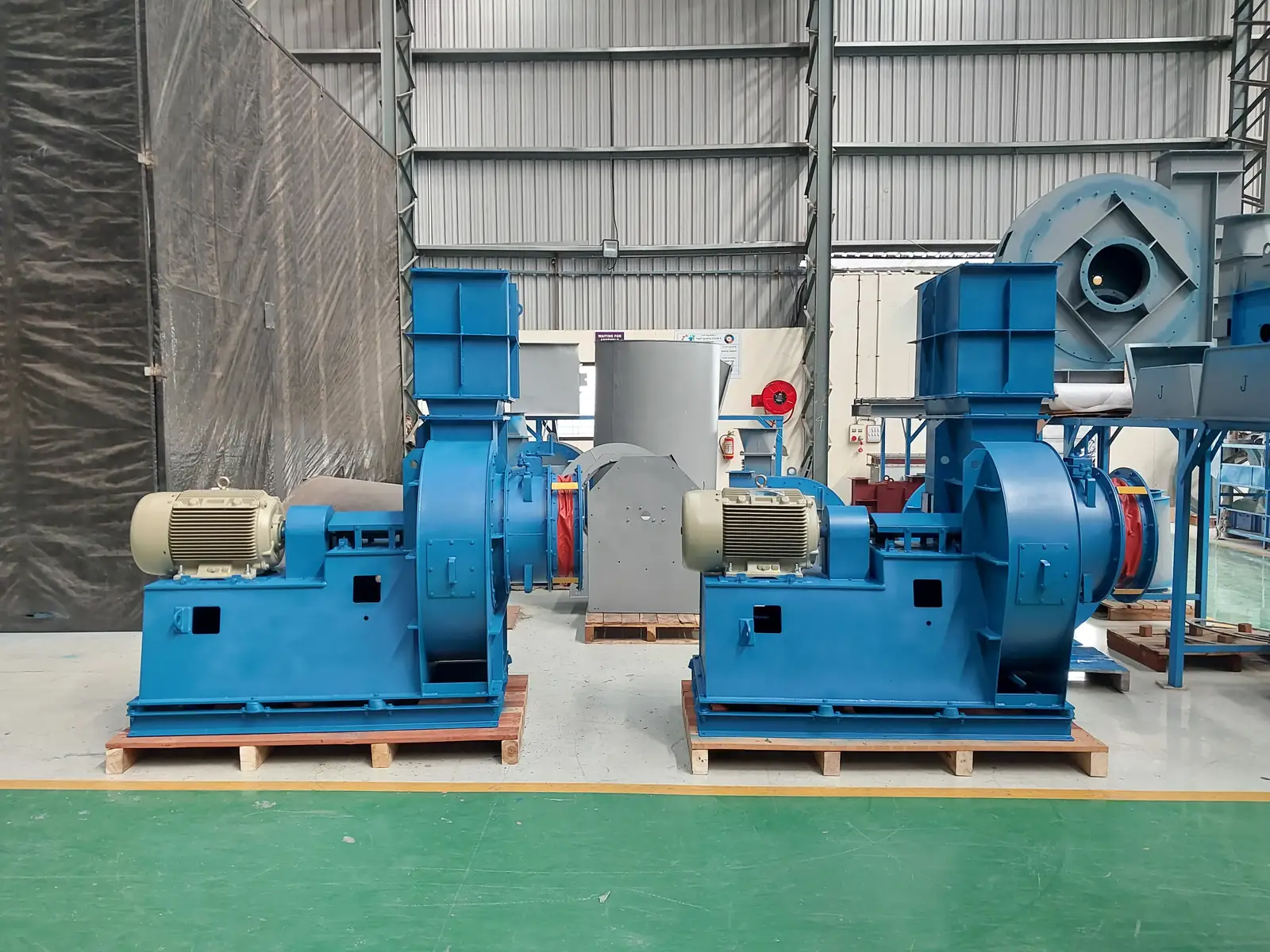
A 20 HP centrifugal blower supplying combustion air to a multi-burner oven built by an OEM in Maharashtra. Duty as supplied: 8,600 CMH at 305 mmWC, 20 HP, design air temperature 20 °C, tested to IS 4894 / ISO 5801 / AMCA 210 method, driven through a variable-frequency drive.
On a combustion-air line, pressure is not a comfort item: the burner needs a defined inlet pressure to hold its air-fuel ratio. If header pressure sags, the burner drifts, the oven's temperature profile drifts with it, and product goes off-spec long before anything mechanical fails. A production complaint, not a maintenance one.
The site's argument was clean, and it is the one we hear most often: "The same fan and the same duct arrangement work at our other location." If an identical unit works elsewhere, the difference must be the fan. They asked for a new impeller design and an engineer on site.
That is the trap. "Identical arrangement" is a statement about drawings, and a fan does not respond to drawings. It responds to the system curve it is actually connected to, at the speed it is actually turning, in the air it is actually moving. And nothing mechanical was reported — no vibration, no bearing noise, no imbalance. The fan ran. It just was not making the datasheet number.
We took the readings jointly with the plant, so the numbers could not be contested later, and ruled out in the order that costs least:
5-Why 1. Why is burner pressure low? → The fan delivers less than rated head. 2. Why? → It moves less air than design — 11 A against 15.25 A. 3. Why? → The system will not accept design flow: oven back-pressure plus branch-duct resistance sit above the fan's operating point. 4. Why was that not obvious? → It was judged at 48 Hz and 40 °C — off the speed and density it was sized to. 5. Root cause: the installed system and its real operating conditions differ from the duty basis the fan was sized against.
Two routes went to the plant. The cheap one: a low-turbulence three-branch Y-type duct to split flow into the three burners smoothly and pull resistance down. The definitive one: if the system stays as built, re-rate the machine to the system — the same 8,600 CMH, but at 450 mmWC and 30 HP at 40 °C, with the caution that the new casing stands 83 mm taller, so the foundation needs modifying.
The reusable lesson: an ammeter reading below rated current is not good news — it is a diagnosis. A fan drawing under its design current is telling you it cannot move design air, and that is a system statement, not a fan statement.
If a fan is "not making pressure," take three readings before you touch the impeller: motor current against nameplate, actual speed (or VFD frequency), and air temperature. Under-current at reduced speed in hot air is a fan doing exactly what physics allows; a redesigned impeller buys you a bigger motor and the same complaint.
We service, diagnose and re-rate industrial fans and blowers of any make. If a fan on your plant is under-performing and nobody can agree why, we will come and take the readings with you.
— Jitamitra Electro Engineering · Technical Services
Engineered for Every Application.
Not necessarily. On this 8,600 CMH / 305 mmWC combustion-air blower the site asked for exactly that. Measurement showed the fan was below rated load and off its design point — running at 48 Hz, on 40 °C air, against oven back-pressure. The impeller was not the problem.
That is the trap, and it is the argument we hear most often. "Identical arrangement" is a statement about drawings, and a fan does not respond to drawings. It responds to the system curve it is actually connected to, at the speed it is actually turning, in the air it is actually moving.
Because the burner needs a defined inlet pressure to hold its air-fuel ratio. If header pressure sags, the burner drifts, the oven's temperature profile drifts with it, and product goes off-spec long before anything mechanical fails. It is a production complaint, not a maintenance one.
A low-turbulence three-branch Y-duct to fix the system side, and — if the system stayed as built — a re-rated blower at 450 mmWC / 30 HP to meet the duty the installation actually presents.
The record documents our diagnosis and the options put to the plant. It records no customer sign-off and no post-fix pressure reading, and we claim none.
Flow, static, gas temperature, application — or attach a spec, GA drawing or a multi-fan schedule. Engineer to engineer.
ISO 9001:2015 quality system · performance-tested to IS 4894 / ISO 5801 / AMCA 210 method · witnessed FAT on request.
*For our standard range. ATEX and special projects need 5 to 7 working days.
This site sets no cookies of its own. Google Analytics loads only if you accept. It sets two cookies, so we can see which fan topics people actually read. Decline and no analytics loads — the site works exactly the same. What we collect →