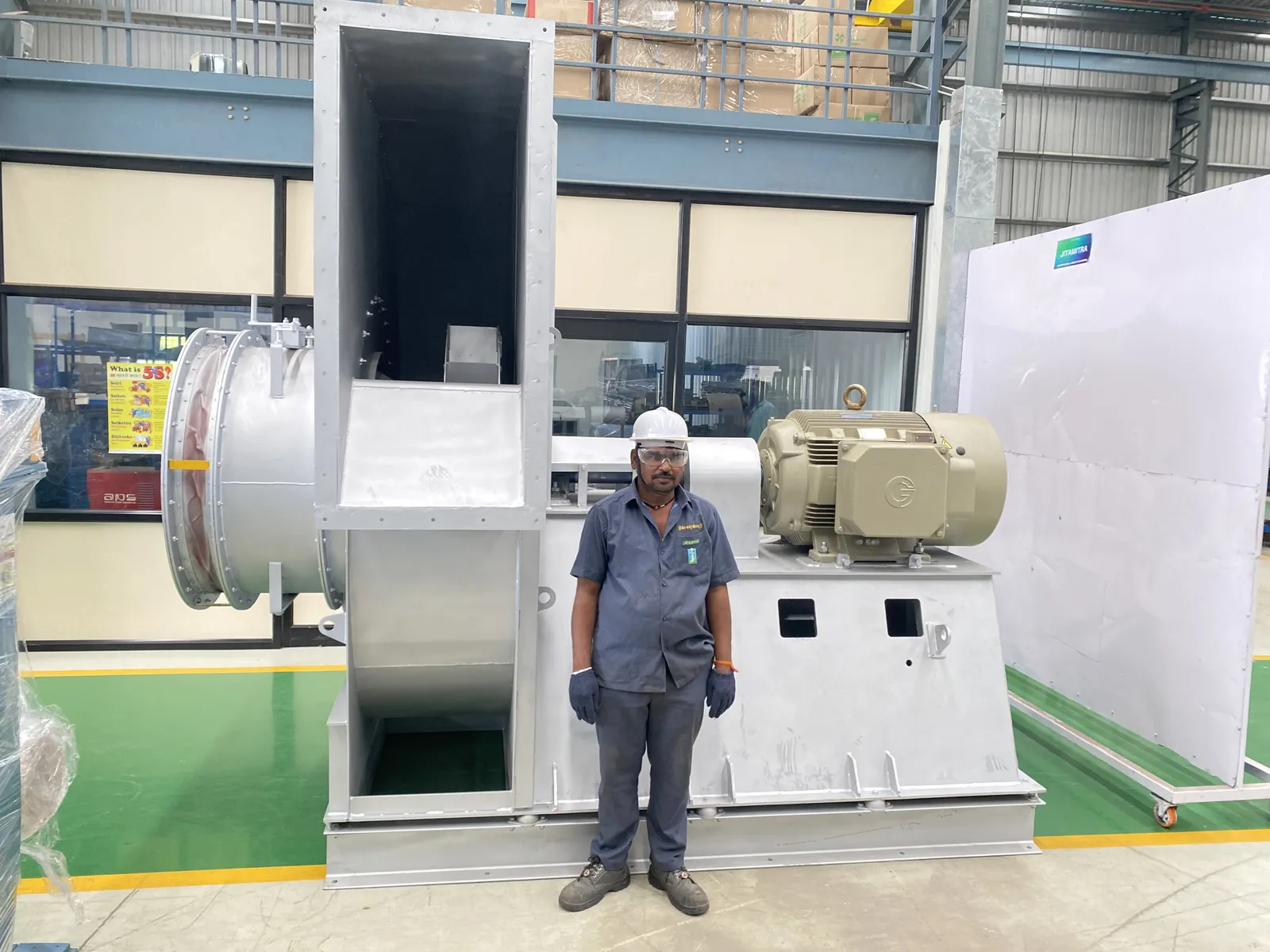
| Who | A surface-coating (paint/coating line) plant — an existing Jitamitra fan user. |
| Equipment | 10 HP centrifugal blower, rated 15,500 CMH at 60 mmWC. |
| Complaint | High vibration on the installed blower in the field. |
| Service | On-site (in-situ) rotor balancing, with a six-point vibration survey — DE and NDE, vertical / horizontal / axial. |
| Response | Field engineer to site with balancing and vibration instrumentation; no rotor removal, no despatch back to works. |
| Result | After one in-situ balancing pass, every measured axis read below 3 mm/s (peak 2.9 mm/s) — inside ISO 14694 acceptance on either mounting basis. Our record documents the corrective action and the post-balance readings; it does not record a formal customer sign-off, and we do not claim one. |
A 10 HP centrifugal blower, rated 15,500 CMH at 60 mmWC, on a surface-coating line. Not a glamorous duty — a mid-size, medium-pressure air mover that sits behind a booth or an oven and simply has to run.
Which is why it matters. On a coating line the fan is not an accessory to the process; it is part of the process — airflow across a booth governs overspray capture, airflow through a cure oven governs the temperature profile the coating actually sees. So when that fan shakes, there is no luxury of "we'll look at it next shutdown": a vibrating rotor puts bearing life, shaft life and finish quality on the same clock. The requirement on site was to restore continuous running without pulling the rotor out and sending it back to a works balancing machine.
The complaint arrived as a bald symptom: vibration level. No cause, no direction, no history.
That is the point at which most fans get blamed for something they didn't do. The obvious suspect is the fan — "you sent us a bad rotor". But a machine that ran well and then vibrates in the field is rarely telling you about what was despatched. It is telling you about everything that has happened since: the truck, the crane sling, the grouting, the alignment, the foundation — and, on a coating line above all, the process itself. A coating-line impeller lives in an aerosol of paint, powder or resin. It deposits, and it deposits unevenly. That condition does not exist on day one; it grows in service. Hence the trap: the fan was fine when it left, is not fine now, and neither fact contradicts the other.
Our method on a field vibration call: measure before concluding, and rule out in ascending order of cost.
The machine responded to step 3. A single in-situ balancing pass brought it home — itself the strongest evidence that rotor unbalance, not alignment or foundation, was the dominant contributor. Post-balance readings, as measured:
| Bearing | Vertical | Horizontal | Axial |
|---|---|---|---|
| DE (drive end) | 2.9 mm/s | 2.6 mm/s | 2.4 mm/s |
| NDE (non-drive end) | 2.8 mm/s | 2.4 mm/s | 1.6 mm/s |
Six points, all under 3 mm/s. For context, ISO 14694 sets fan acceptance at 4.5 mm/s rigidly mounted, BV-3 (alarm 7.1, shutdown 9.0) and 6.3 mm/s flexibly mounted (alarm 11.8, shutdown 12.5). At a peak of 2.9 mm/s this blower sits in the unrestricted long-term operation band on either basis. Balance quality is assessed to ISO 21940.
The chain below is the generic pattern this class of failure follows — reusable, not a forensic finding on this rotor.
Why was the vibration high? The rotor was out of balance. Why was it out of balance? Its mass distribution in service no longer matched its mass distribution as built. Why did that change? A rotor in a coating stream accumulates deposit — and deposit never lands evenly. Why wasn't it caught? Impeller build-up was on nobody's inspection list; the fan was treated as fit-and-forget. Why was it treated that way? The maintenance regime was written around the machine, not around the process the machine lives in.
The reusable lesson: On a process fan, unbalance is not usually a manufacturing state — it is an operating state that develops. The impeller is a rotating filter you never asked for. Put it on the PM checklist and most "sudden" vibration events stop being sudden.
That last bullet is deliberate. A service story that always ends in applause is a marketing story, not an engineering one.
The transferable lesson is about where you point the finger. A fan that ran well and then starts to vibrate is almost never a fan that was built wrong — it is a fan changed by its transport, its installation, or its process. Diagnose in that order, and survey six points before you take a decision. On any fan handling paint, powder, resin, tar or sticky dust, treat the impeller as a deposit-and-wear item: a scheduled clean and a periodic vibration check cost far less than a bearing, a shaft, or a shift of scrapped finish.
If a fan on your plant is shaking, running a hot bearing, or simply not doing what its nameplate says — we will come and measure it. We service centrifugal fans and blowers of any make, not only our own: in-situ balancing, vibration surveys, alignment, bearing and rotor work, and performance troubleshooting.
— Jitamitra Electro Engineering · Technical Services
Engineered for Every Application.
Rarely. A machine that ran well and then vibrates in the field is seldom telling you about what was despatched. It is telling you about everything that has happened since: the truck, the crane sling, the grouting, the alignment, the foundation — and, on a coating line above all, the process itself.
Because a coating-line impeller lives in an aerosol of paint, powder or resin. It deposits, and it deposits unevenly. That condition does not exist on day one; it grows in service — which is why the fan was fine when it went in.
Not necessarily. This 10 HP blower, rated 15,500 CMH at 60 mmWC, was balanced in situ: a field engineer attended with balancing and vibration instrumentation, with no rotor removal and no despatch back to works.
On this job, after one pass every measured axis read below 3 mm/s, with a peak of 2.9 mm/s — inside ISO 14694 acceptance on either mounting basis, measured across a six-point survey covering drive end and non-drive end in vertical, horizontal and axial directions.
Our record documents the corrective action and the post-balance readings. It does not record a formal customer sign-off, and we do not claim one.
Flow, static, gas temperature, application — or attach a spec, GA drawing or a multi-fan schedule. Engineer to engineer.
ISO 9001:2015 quality system · performance-tested to IS 4894 / ISO 5801 / AMCA 210 method · witnessed FAT on request.
*For our standard range. ATEX and special projects need 5 to 7 working days.
This site sets no cookies of its own. Google Analytics loads only if you accept. It sets two cookies, so we can see which fan topics people actually read. Decline and no analytics loads — the site works exactly the same. What we collect →