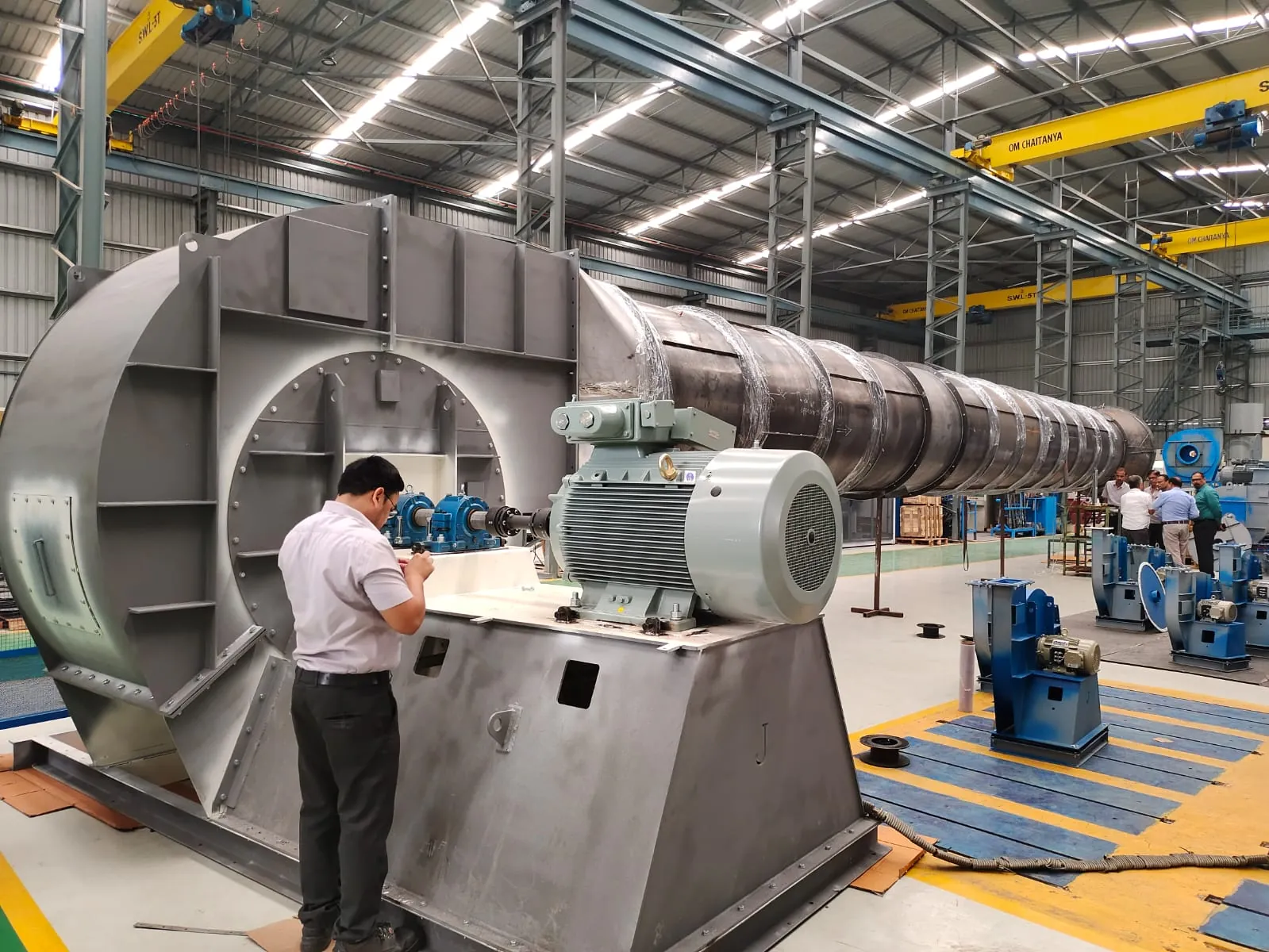
| Who | A combustion-systems OEM, whose blowers were installed at a furnace plant in Tamil Nadu |
| Equipment | Combustion-air blower cluster (10–20 HP class), design static pressure 305 mmWC |
| Complaint | "Blowers low pressure" — discharge static pressure below expectation, on the site's gauge |
| Service | Remote diagnosis first: field-measurement protocol corrected, works test report re-explained |
| Response | Complaint registered; measurement guidance and tapping-point diagram issued; site visit held in reserve |
| Result | The works test record shows the fan achieving 312 mmWC against a required 305 mmWC at design conditions. We gave the site a defined tapping point and instrument so the field reading could be taken on the same basis. The customer's re-measurement is not recorded in our file — this case reports what we found and did, not a claimed closure. |
(Corrective action delivered; customer sign-off not evidenced in the internal record.)
A combustion-systems OEM builds burner and furnace packages and buys its combustion-air blowers in. The blowers here were built to a design static pressure of 305 mmWC, supplied as a small cluster in the 10–20 HP class, and installed on a furnace at an end-user plant in Tamil Nadu.
Combustion air is not a comfort duty: the blower sets the air side of the air-to-fuel ratio. Under-deliver pressure and the burner runs rich, the flame profile shifts, process temperature wanders — on a heat-treatment line, a quality problem, not just an energy one. And the blower was a bought-out item on the OEM's package, so the end-user was looking at them.
The site reported low delivered pressure, measured on their pressure gauge. The customer also highlighted a static-pressure figure on the works test report we had issued, and asked us to explain it.
The obvious suspect is the fan. It is always the fan — and the reflex supplier response is to send an engineer and open the casing. We did not, for one reason: nothing else in the complaint behaved like a fan fault. No vibration. No noise. No bearing temperature. No motor current anomaly. A fan genuinely failing to make pressure — reversed impeller, slipping drive, a stalled aerodynamic condition — almost never fails silently and cleanly, with every other parameter normal. A number that is wrong all by itself is very often a number that was taken wrong.
So the first thing we put on trial was not the fan. It was the measurement.
Ruled out first — the mechanical failure modes. No vibration, noise, bearing or motor evidence anywhere in the complaint. Nothing to support a hardware hypothesis.
Tested second — the measurement point. A fan's static pressure is defined at a specific plane. Read it elsewhere on the ductwork and you get a number that is real, but is not the number on the datasheet. We asked the site to re-measure at the transition piece with a calibrated digital manometer, and issued a tapping-location diagram with guidelines.
Tested third — the acceptance basis. The substantive finding. Our works test report carries two sets of figures: at test conditions and at design conditions. They differ, and are meant to: the air temperature, density and RPM at the moment of testing are not those the fan was designed around, and density scales pressure directly. The figure the customer had highlighted was the test-condition value. The acceptance value is the design-condition value.
At design conditions, the fan makes 312 mmWC against a required 305 mmWC. It meets duty.
Why "low pressure"? The site's gauge read below expectation. Why? It was read on a basis that does not represent design static pressure — a test-condition figure, and/or a tapping point that is not the plane where fan SP is defined. Why the wrong basis? Test- and design-condition readings differ (density, temperature, RPM), and no field measurement point was fixed at handover. Why not caught earlier? The report did not flag which figure was the acceptance figure, and the commissioning documents named no tapping point. Root cause: a measurement-basis mismatch at commissioning — plant and works were not comparing the same quantity.
The reusable lesson: A performance number without its measurement basis is not a measurement — it is an opinion with a decimal point. Fix the plane, the instrument and the conditions before you argue about the value.
Three preventive changes went back into our own process: name the tapping point and instrument on the commissioning sheet; label the design-condition figure on every test report explicitly as the acceptance figure; and agree the acceptance basis in writing at order stage.
If a fan "isn't making pressure" but is quiet, cool, smooth and drawing normal current, be suspicious of the number before you are suspicious of the machine. Pressure means nothing without three things attached: where it was tapped, what it was tapped with, and under what air conditions it was read. Change any of the three and the value changes legitimately, with nothing wrong anywhere. Many "performance shortfall" disputes are two parties correctly measuring different things.
We service, diagnose and re-test centrifugal fans and blowers of any make, not only our own: performance verification, balancing to ISO 21940, testing to IS 4894 / ISO 5801 / AMCA 210 method, ISO 14694 vibration assessment. If a fan on your plant is under dispute, we would rather help you measure it properly than replace it unnecessarily.
— Jitamitra Electro Engineering · Technical Services
Engineered for Every Application.
Not necessarily. On this combustion-air cluster the works test record shows the fan achieving 312 mmWC against a required 305 mmWC at design conditions. The gap was in how the field reading was being taken, not in the machine.
That is the reflex, and here we resisted it for one reason: nothing else in the complaint behaved like a fan fault. No vibration, no noise, no bearing temperature, no motor current anomaly. A fan genuinely failing to make pressure — a reversed impeller, a slipping drive, a stalled aerodynamic condition — almost never fails silently and cleanly with every other parameter normal.
Remote diagnosis first. We corrected the field-measurement protocol, re-explained the works test report, and issued measurement guidance and a tapping-point diagram so the field reading could be taken on the same basis as the works test. A site visit was held in reserve.
Because a pressure reading is only comparable if it is taken on the same basis as the one you are comparing it against. Giving the site a defined tapping point and instrument is what made the two numbers mean the same thing.
The customer's re-measurement is not recorded in our file. This case reports what we found and did, not a claimed closure: corrective action delivered, customer sign-off not evidenced in the internal record.
Flow, static, gas temperature, application — or attach a spec, GA drawing or a multi-fan schedule. Engineer to engineer.
ISO 9001:2015 quality system · performance-tested to IS 4894 / ISO 5801 / AMCA 210 method · witnessed FAT on request.
*For our standard range. ATEX and special projects need 5 to 7 working days.
This site sets no cookies of its own. Google Analytics loads only if you accept. It sets two cookies, so we can see which fan topics people actually read. Decline and no analytics loads — the site works exactly the same. What we collect →