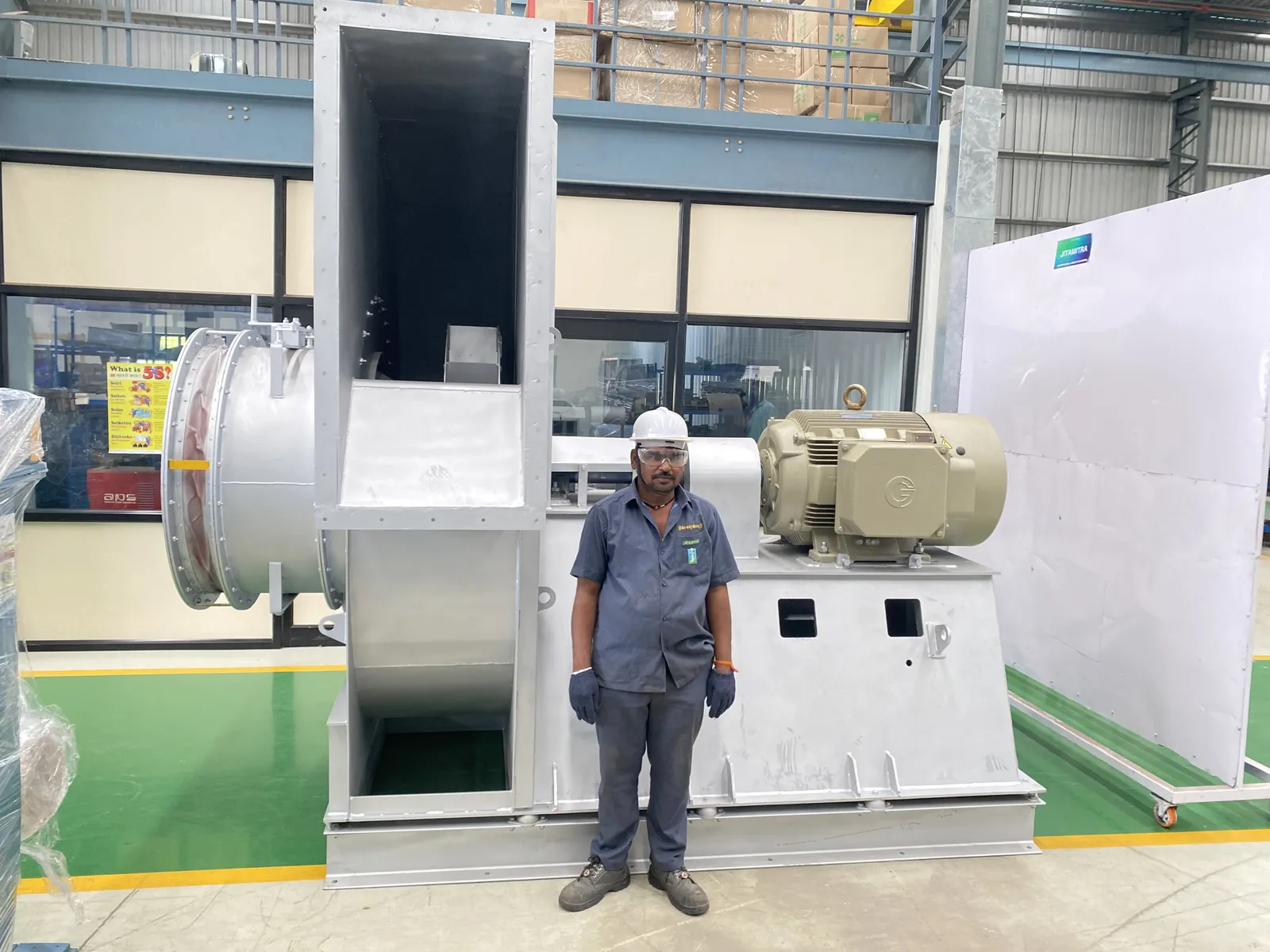
| Who | A surface-preparation equipment OEM in Karnataka, commissioning a blower inside one of its machines |
| Equipment | A Jitamitra blower package rated 2,750 CMH / 200 mmWC, driven by a 5 HP bought-out motor |
| Complaint | "Motor having noise problem" — raised at commissioning against the drive motor, not the fan. No flow or pressure shortfall, no trip, no vibration reading. Audible noise only |
| Service | Commissioning support: source-localisation on site, video review with the motor maker's engineers, and formal routing of the motor to its authorised service centre for teardown |
| Response | Our engineer was present at commissioning; the motor was decoupled from the blower on site to localise the source; the motor brand's service team was engaged and a repair route agreed |
| Result | Proven: the noise is on the motor side, not the fan side. The motor was routed to its maker's authorised centre for investigation. The record holds no teardown finding, no recheck and no customer sign-off — so we claim none. What this case delivers is a method, and a QC gate we changed because of it |
A 5 HP blower at 2,750 CMH / 200 mmWC is not a headline machine. It sits inside a larger piece of equipment and is meant to be invisible — move its air, hold its pressure, never be spoken about again. Which is why noise at commissioning costs far more than the horsepower suggests: the whole machine is on trial, and the end customer is standing there. A blower that sounds wrong at handover stops a machine that is otherwise finished. The OEM cannot ship, and the clock runs on everyone.
The obvious suspect in any fan noise call is the fan — impeller imbalance, a rubbing wheel, a loose accessory. That is where nine calls in ten go, and where the fan builder is expected to be found guilty. Here it was wrong twice.
First, the fan was not the source, and we established that on site before the argument started. Second, once everyone agreed the noise lived on the motor side, two competent engineers looked at the same motor and reached opposite conclusions. The motor maker's engineer, reviewing a video, recorded no bearing noise as such — it felt like air-cutting noise: windage off the motor's own cooling fan, normal and harmless. Our engineer, present with the motor decoupled and running solo, reported bearing noise.
Both accounts are on the record; neither is dishonest. But "I heard it" is not evidence you can send to a supplier. Commissioning stalled not on a technical disagreement, but on an evidentiary one.
Ruled out first — performance. No flow shortfall, no pressure shortfall, no trip, no overload. A machine that meets its duty while making a noise is telling you the noise is not aerodynamic.
Ruled out second — the fan. Our engineer decoupled the motor and ran it solo. The noise persisted with the impeller stationary. That single act eliminates the whole fan side — impeller imbalance, wheel rub, shaft and fan bearings, coupling — because none of it was turning. Decoupling is the cheapest diagnostic in the fan business, and almost nobody does it first.
What was left — the motor. Motor bearings, the cooling fan and cowl, or the rotor: a bought-out component, belonging with the people who built it. We reviewed the video with the motor maker's engineers and asked for the motor to go to their authorised repair centre, rather than open a warranted motor in the field and void it.
That is where the honest account ends. We know where the noise is not. The teardown that says what it is sits with the motor maker.
5-Why Why was the machine held at commissioning? — Noise from the drive motor. Why could nobody clear it? — Two engineers disagreed: bearing defect, or normal cooling-fan windage. Why could they not settle it? — One judged from a video, one by ear on site. Neither had a measurement. Why was there no measurement? — No vibration reading at commissioning, and no baseline for that motor from works. Why no baseline? — The pre-dispatch QC gate accepted a coupled run and an engineer's ear; it never required a decoupled solo-run record for a bought-out prime mover. Root cause (generic, reusable): A subjective symptom was being arbitrated with no objective reference. The component left the works without a baseline, so the field had nothing to compare against — the dispute was unresolvable by design.
The reusable lesson: A noise complaint is not settled by the most experienced ear in the room. It is settled by a number and a baseline. If a component can be complained about, it must leave your works with a signature the field can compare against. Without one, you are not diagnosing; you are negotiating.
A fan that "sounds wrong" tells you which half of the package to look at, almost never which part. The order of operations is the lesson: prove the duty; then decouple — a motor that still sings with the impeller standing still has told you more in thirty seconds than a week of email will; then take a number to a standard. Audible judgement is a hypothesis. A reading against ISO 14694, with a works baseline behind it, is a fact.
We service centrifugal fans and blowers of any make. If a machine is standing while people argue about a sound, we will come and put a number on it.
— Jitamitra Electro Engineering · Technical Services
Engineered for Every Application.
By separating them. On this 2,750 CMH / 200 mmWC package the motor was decoupled from the blower on site to localise the source, and that established the noise was on the motor side, not the fan side, before the argument started.
Not by video. The motor maker's engineer, reviewing a video, recorded no bearing noise as such and read it as air-cutting noise — windage off the motor's own cooling fan, normal and harmless. Our engineer did not agree. Video review could not settle it, so the motor was routed formally to its maker's authorised service centre for teardown.
We do the routing. The motor brand's service team was engaged, a repair route agreed, and the motor sent formally to its authorised centre for investigation.
Because the whole machine is on trial and the end customer is standing there. A blower that sounds wrong at handover stops a machine that is otherwise finished — the OEM cannot ship, and the clock runs on everyone.
It was proven that the noise is on the motor side, not the fan side, and the motor was routed for investigation. The record holds no teardown finding, no recheck and no customer sign-off, so we claim none. What this case delivers is a method, and a QC gate we changed because of it.
Flow, static, gas temperature, application — or attach a spec, GA drawing or a multi-fan schedule. Engineer to engineer.
ISO 9001:2015 quality system · performance-tested to IS 4894 / ISO 5801 / AMCA 210 method · witnessed FAT on request.
*For our standard range. ATEX and special projects need 5 to 7 working days.
This site sets no cookies of its own. Google Analytics loads only if you accept. It sets two cookies, so we can see which fan topics people actually read. Decline and no analytics loads — the site works exactly the same. What we collect →