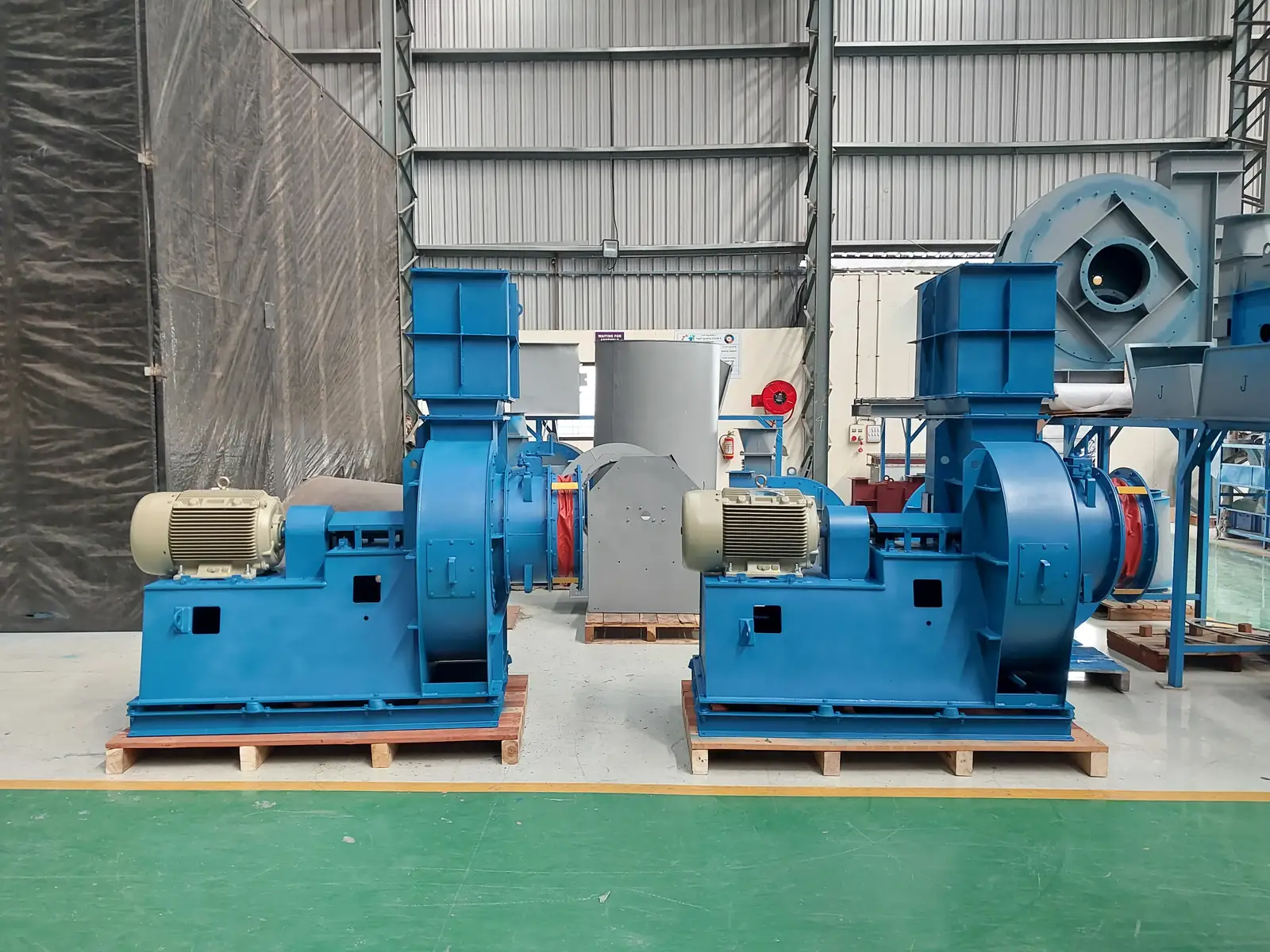
| Who | a material-handling & dust-collection equipment OEM in Maharashtra, for its end-user plant in western Maharashtra |
| Equipment | a large belt-driven centrifugal blower on pneumatic-conveying / dust-collection duty — 110,520 CMH · 168 mmWC · 120 HP · 40 °C |
| Complaint | drive belts broken on the blower — registered as a formal complaint and escalated for a site visit |
| Root cause | not the belts, not the fan: water had entered the fan casing, adding load the V-belt drive was never sized to carry |
| Service | on-site root-cause investigation, belt-set replacement, written cause + preventive action |
| Response | service engineer deputed to site; root cause reported back within a week of the complaint |
| Result | cause found and stated on the record · V-belt set replaced · service charges waived (customer bore only the bought-out belts) · ingress-prevention advice issued. The internal record carries our own technical-closure note, but no post-repair vibration reading and no customer sign-off — so we don't claim one. |
A material-handling and dust-collection equipment OEM in Maharashtra had supplied a large extraction and conveying system to an end-user plant in western Maharashtra. Its prime mover was a Jitamitra belt-driven centrifugal blower rated 110,520 CMH against 168 mmWC, on a 120 HP drive at 40 °C — a big machine moving a very large volume of dust-laden air at modest static pressure.
This blower is not an auxiliary. When it stops, the conveying line and the dust extraction it feeds stop with it — an immediate shop-floor-air problem as well as a throughput one.
The site reported broken drive belts. The complaint was logged on our register and a service engineer was deputed.
The obvious suspect on a broken-belt call is the belt — a bad batch, an under-rated set, a fitment error. It is the easy answer, and it is usually the wrong one. On a 120 HP belt drive, the V-belt set does what a fuse does: it is the weakest link in the drive line by design. Belts rarely break because they are bad belts — they break because something upstream changed the load. Replace the set without answering why the drive was overloaded and you have bought one more failure at exactly the same place.
The second easy answer — "the fan must be defective" — was also wrong. Nothing in the machine had changed. What had changed was the environment it was running in.
Our engineer went to site rather than shipping a belt set and hoping. The method was elimination, in order of consequence.
The recorded finding, in the words used at the time: the belts were broken due to additional load, caused by water that had entered the casing.
5-Why (the generic, reusable version): Why did the belts break? → The drive was carrying more load than it was rated for. Why the additional load? → The impeller was working against water collected inside the casing. Why was there water in the casing? → The machine sat in a wet/exposed site condition with no effective path to keep water out or drain it away. Why was it not caught before the belts went? → The drive was treated as fit-and-forget; nothing on the routine watched belt tension, alignment or vibration for the drift that precedes a break. Root cause: a site-environmental ingress path let water accumulate inside a fan casing, silently raising the drive load until the drive's weakest element — the V-belt set — failed. The belt was the messenger, not the fault.
The fix followed the cause. The broken V-belt set — a bought-out item — was replaced, and we issued the ingress finding in writing rather than just handing over new belts. We waived our service charges as a special case; the customer bore only the cost of the bought-out belts.
The reusable lesson: A broken belt on a large belt-driven fan is a load report, not a belt report. Before fitting a new set, answer one question — what changed the load? On an outdoor, wash-down or wet-duty machine, look inside the casing first. Water standing in a fan casing is never routine, and never free: it costs you a drive. Fix the ingress path, or the next set of belts goes the same way.
A drive line tells you the truth about the load it carries, and the belt tells you first. If a fan starts eating belts, the belts are not the problem — the load is, and something in the machine's environment or process has changed to create it. Water in a casing, product build-up on a wheel, a damper swung open, a duct whose resistance has changed: all of them surface at the V-belts. Chase the load, not the symptom, and you fix it once.
Eating belts, tripping on current, or vibrating on a fan of any make? We service, diagnose and root-cause centrifugal fans and blowers regardless of who built them — you get a written cause and a preventive action, not another parts swap.
— Jitamitra Electro Engineering · Technical Services
Engineered for Every Application.
Probably not. On a 120 HP belt drive the V-belt set does what a fuse does: it is the weakest link in the drive line by design. Belts rarely break because they are bad belts — they break because something upstream changed the load. Replace the set without answering why the drive was overloaded and you have bought one more failure at exactly the same place.
Water had entered the fan casing, adding load the V-belt drive was never sized to carry. Not the belts, and not the fan.
A service engineer was deputed to site and the root cause was reported back within a week of the complaint being registered.
On this job the service charges were waived and the customer bore only the bought-out belts. The V-belt set was replaced and ingress-prevention advice was issued so the load did not come back.
No. The internal record carries our own technical-closure note, but no post-repair vibration reading and no customer sign-off, so we do not claim one.
Flow, static, gas temperature, application — or attach a spec, GA drawing or a multi-fan schedule. Engineer to engineer.
ISO 9001:2015 quality system · performance-tested to IS 4894 / ISO 5801 / AMCA 210 method · witnessed FAT on request.
*For our standard range. ATEX and special projects need 5 to 7 working days.
This site sets no cookies of its own. Google Analytics loads only if you accept. It sets two cookies, so we can see which fan topics people actually read. Decline and no analytics loads — the site works exactly the same. What we collect →