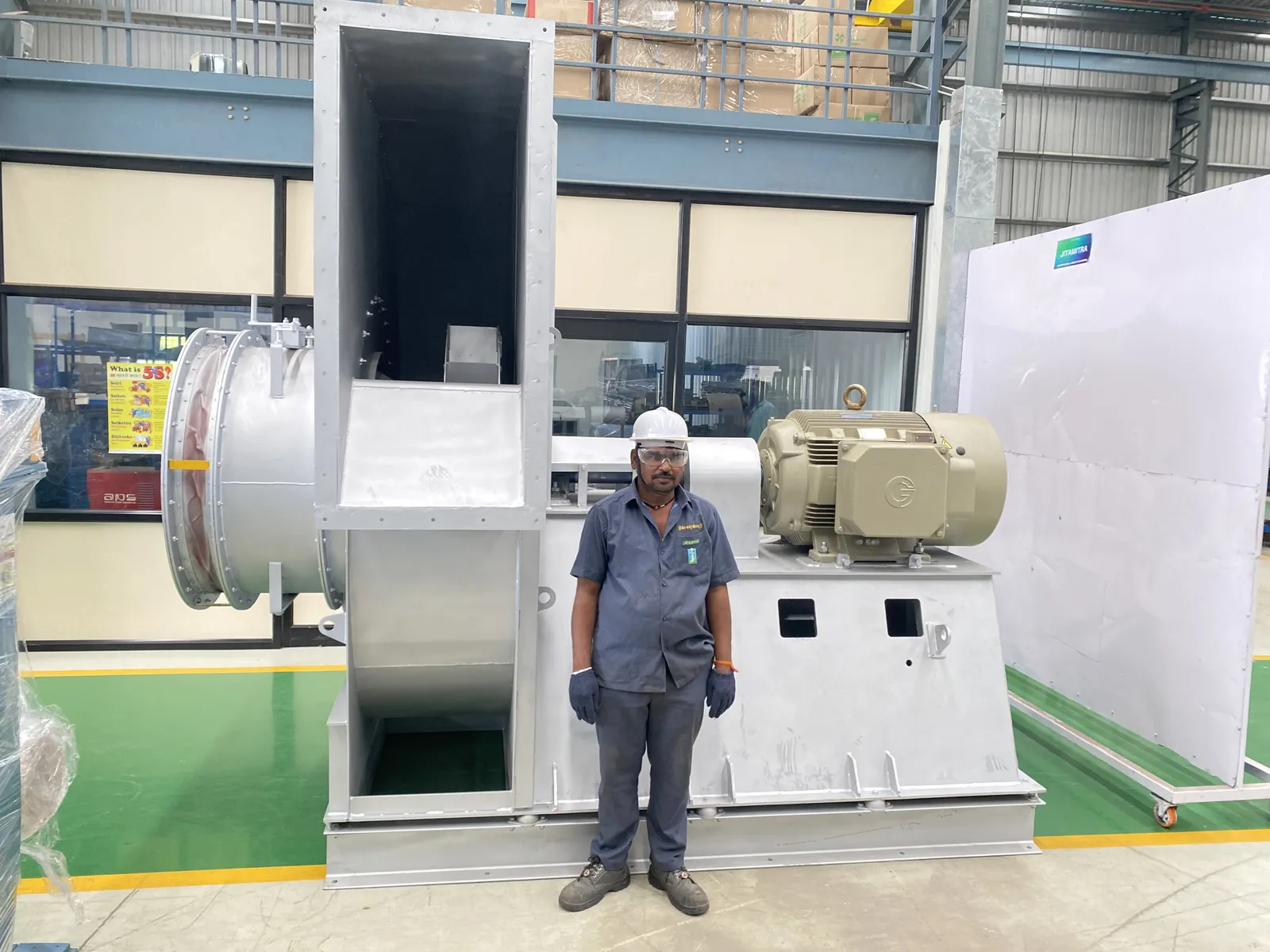
Picture a foundry in Maharashtra restarting its furnace line after a planned maintenance shutdown. Two centrifugal blowers keep that furnace alive — one feeding combustion air, one pulling the fumes away. We'll call this plant the Foundry. The exhaust blower is a high-pressure machine — roughly 2,700 CMH against about 1,170 mmWC, on a ~30 HP drive — and it is coupling-driven: the motor turns the fan shaft through a flexible pin-and-bush coupling. It had run cleanly for months. Then, on restart, it started to roar — and a foundry mid-restart cannot simply switch the furnace off and wait.
The maintenance team heard an abnormal noise from the exhaust blower the moment the line came back up, and flagged damage around the coupling. The pressure was real: production had just resumed, the fan could not come offline for long, and a loud, worsening noise on a furnace fan is the kind of thing that ends in an unplanned breakdown if it is guessed at instead of diagnosed. A first, quick fix — replacing the coupling's rubber bushes — quietened nothing. The noise came straight back. That is the tell-tale sign of a fault that a parts-swap can't reach.
The first job was to answer the obvious question honestly: was this the fan, or the drive line? Because the noise couldn't be pinned down over photos and a phone call, Jitamitra deputed a technician to site rather than shipping parts and hoping. On the machine, the team cross-checked the fan against its pre-dispatch works test — the fan body was proven on-spec, with no manufacturing fault, and had run cleanly for months. With the fan cleared, attention went to the drive line, and the team opened up the flexible coupling — where the real story was.
The educational root cause (generic — this happens on any coupling-driven fan): Why is it noisy? The coupling isn't driving true. → Why not? Its bolt holes have gone slightly oval. → Why did they go oval? The coupling's rubber bushes had worn past their service life, so the drive was hammering metal-on-metal in the holes. → Why didn't a new set of bushes fix it? By then the hammering had already elongated the holes — the coupling hub itself was out of tolerance. → Root cause: a flexible pin-and-bush coupling run past the life of its rubber bushes until the bolt holes elongated — at which point new bushes treat the symptom, not the cause.**
The fix followed the cause. A like-for-like pin-and-bush set and a fresh alignment were the first move; when the ovalised hub meant that couldn't hold, Jitamitra procured the correct coupling and machined it to the fan-shaft drawing, restoring a true, concentric bore and the proper pin-and-bush fit. The team re-installed it, re-aligned the drive, and ran the fan to confirm the noise was gone.
The reusable lesson (the preventive takeaway): a flexible coupling is a scheduled wear part, not a fit-and-forget one. Treat its rubber bushes as consumables — replace the full pin-and-bush set to the coupling maker's spec on a maintenance interval, never substitute plain bolts for the proper pins and bushes, and stop and inspect at the first abnormal noise. Catch it while it's a bush change; ignore it and it becomes a coupling change.
(No vibration-survey numbers are published here because none were recorded on this job — the verification was quiet running confirmed on a signed site report, and we don't publish figures we didn't measure.)
A fan that suddenly gets loud after months of good running usually isn't a fan problem — it's a drive-line problem, and most often the coupling. A flexible coupling is a wear part: keep its bushes serviced to the maker's spec and it lasts; run it past their life and the hub itself pays for it. New bushes won't fix an ovalised coupling — the honest fix is to prove the fan out, find the worn part on site, and machine it back to spec.
Running an any-make coupling-driven fan that has started to roar, rattle or vibrate? Ask us for an on-site root-cause investigation — you'll get a written corrective action and the fan running true again, not another parts swap.
— Jitamitra Electro Engineering · Technical Services
Engineered for Every Application.
Because a parts-swap could not reach the fault. Once the rubber bushes had worn past their service life the drive was hammering metal-on-metal, and by then the hammering had already elongated the coupling's bolt holes — they had gone slightly oval, so the coupling was no longer driving true. New bushes cannot fix a hole that is no longer round.
Not here. The fan was cross-checked against its pre-dispatch works test and proved on-spec with no manufacturing fault, and it had run cleanly for months. With the fan cleared, attention went to the drive line, which is where the story was.
On site. The coupling was re-machined to spec at the plant and the fan ran quiet again — which mattered, because a foundry mid-restart cannot simply switch the furnace off and wait.
Because the noise could not be pinned down over photographs and a phone call. Shipping parts and hoping is exactly what the first quick fix did, and it quietened nothing.
Worn bushes do not stay a bush problem. Left past their service life they let the drive hammer the hub, and once the holes have gone oval the repair is no longer a consumable — it is machining.
Flow, static, gas temperature, application — or attach a spec, GA drawing or a multi-fan schedule. Engineer to engineer.
ISO 9001:2015 quality system · performance-tested to IS 4894 / ISO 5801 / AMCA 210 method · witnessed FAT on request.
*For our standard range. ATEX and special projects need 5 to 7 working days.
This site sets no cookies of its own. Google Analytics loads only if you accept. It sets two cookies, so we can see which fan topics people actually read. Decline and no analytics loads — the site works exactly the same. What we collect →