| Who | a dust-collection & pollution-control equipment OEM in Karnataka |
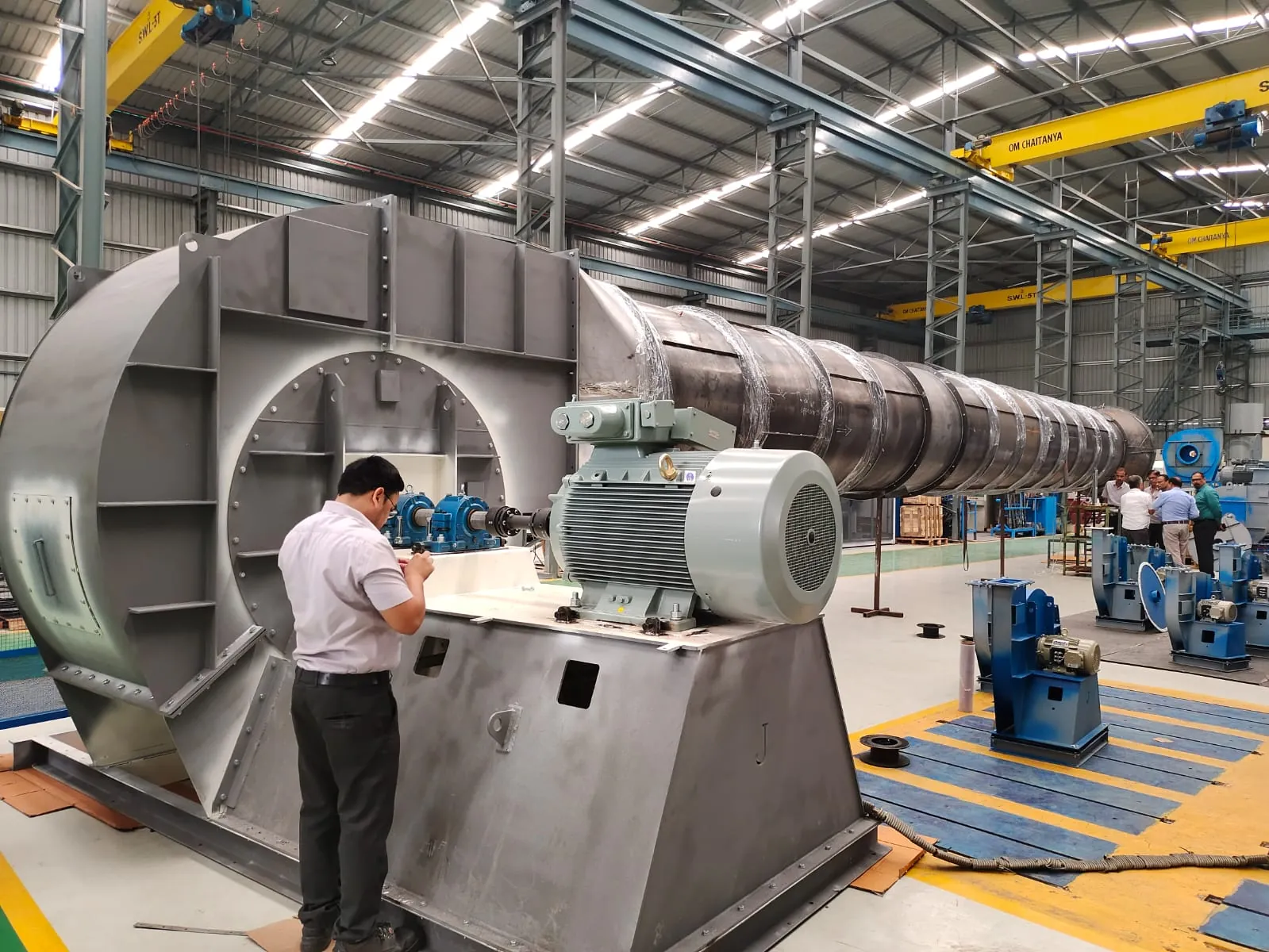
| Equipment | a centrifugal blower supplied by us — 12,000 CMH · 440 mmWC · 30 HP, selected and GA-approved for a 60 °C gas temperature |
| Complaint | "blower high current" — the motor drawing more current in operation than the site expected, with a field video sent in support |
| Service | On-site assessment by our Senior Manager, Technical Services + root-cause analysis + written corrective action |
| Response | Complaint registered on our customer complaint form, then a physical site assessment: current measured, motor body temperature measured after a 3-hour continuous run, and actual gas temperature established against the approved GA |
| Result | Cause proven as an off-design operating condition, not a fan fault — the plant was running at ~32 °C against a 60 °C design. Interim engineering clearance given to keep running. Corrective action specified: re-impeller to the real cold duty. The record evidences the diagnosis and the specified corrective action; it does not record a post-fix current reading or a customer sign-off. |
An OEM that builds dust-collection and pollution-control equipment had one of our centrifugal blowers in the field: 12,000 CMH at 440 mmWC, driven by a 30 HP motor, selected and GA-approved against a gas temperature of 60 °C.
On a dust-collection plant the blower is not an accessory — it is the process. If it trips on overload, the collector stops pulling, the hoods stop capturing, and the plant runs dirty or stops. So when the site reported the motor drawing high current, the question was not academic: is this fan going to survive, and whose fault is it?
The complaint came in as "blower high current", backed by a field video. The obvious suspects lined up immediately, and all of them pointed at us — a wrong selection, an oversized impeller, a motor problem, mechanical drag in the machine. High current is the classic symptom that gets a fan condemned.
But the obvious suspects were wrong, and one measurement gave the game away early: the motor body sat at 40 °C after three hours of continuous running. A motor in genuine distress does not sit at 40 °C — it cooks. This one was electrically loaded but thermally comfortable. Whatever was pulling the amps up was not damage.
We ruled out, in order.
Mechanical failure — ruled out. No bearing failure, no abnormal noise, no impeller defect found or reported. Nothing in the machine was broken.
Thermal distress — ruled out by measurement. 40 °C motor body after a three-hour continuous run is a benign figure. The motor was carrying real load, not fighting a fault.
The machine itself — ruled out. The blower was doing exactly what a 12,000 CMH / 440 mmWC fan should do. The problem was not what the fan was doing — it was what the fan was doing it to.
The gas — that's where it was. Measured motor current: 38 A. Measured gas temperature at the fan: ~32 °C. Design and approved-GA gas temperature: 60 °C. The plant was running nearly 30 °C colder than the case the fan had been sized against.
That single fact explains the whole complaint. Gas density rises as absolute temperature falls: from 60 °C to 32 °C the ratio is (60+273)/(32+273) ≈ 333/305 ≈ 1.09 — roughly 9% denser air than the selection point. At a fixed volumetric duty, fan pressure and absorbed power both scale with density. Nine percent denser gas means about nine percent more shaft power — precisely the shove that pushes a correctly-sized motor toward and past its rated current.
The 5-Why:
Why was the motor current high (38 A)? → The motor was delivering more shaft power than the selection point called for. → Why more shaft power? → The impeller was moving a denser gas than it was sized for. → Why denser? → Actual gas temperature ~32 °C against a 60 °C design — about 9% denser air. → Why does density raise current? → At a fixed volumetric duty (CMH), fan pressure and absorbed power scale with gas density. → Why the temperature gap at all? → The plant was operating substantially colder than the design case the fan was selected and GA-approved against. Root cause: an off-design operating condition — a cold-running duty point, not a defect in the fan.
The corrective action follows straight from the physics: match the impeller to the real operating temperature. A colder, denser gas needs an impeller of lower parameters, so that at 32 °C the absorbed power falls back inside the 30 HP motor's rated current. That is what we specified. Meanwhile, because the motor showed no thermal distress, we gave written engineering clearance that the unit could keep running — the plant did not have to stop while the corrective route was decided.
The reusable lesson: high motor current is not automatically a fault in the fan. Check the actual gas density first. A fan run colder than its design temperature moves denser gas and pulls more amps even though nothing is broken — and the fix is to match the impeller to the real operating temperature, not to blame the motor or the bearings.
Stated honestly — what the record shows, and what it does not.
Fan sizing is usually argued at the hot end — will the impeller survive the heat, is the motor rated for it. This case is the reminder that on a variable-temperature plant, the sizing-critical case is often the cold one. The hot condition sets the metallurgy; the cold condition sets the amps. A fan selected for a hot duty and run cold is not misbehaving — it is faithfully doing more work on denser air, and the ammeter is simply reporting that fact.
So before condemning a fan that pulls high current: measure the gas temperature, compare it to the approved GA, and do the density arithmetic. It takes two minutes and it saves a wrongful conviction.
We service centrifugal fans and blowers of any make — root-cause investigation, on-site assessment, duty-point verification, impeller and drive corrections. You get a written engineering finding, not a guess and a parts quote.
— Jitamitra Electro Engineering · Technical Services
Engineered for Every Application.
Not necessarily, and here it was not. The blower — 12,000 CMH at 440 mmWC on a 30 HP motor — was selected and GA-approved against a gas temperature of 60 °C. The plant was actually running at about 32 °C, and a colder, denser gas loads the same fan harder. The cause was an off-design operating condition, not a fan fault.
One measurement gave it away early. The motor body sat at 40 °C after three hours of continuous running. A motor in genuine distress does not sit at 40 °C — it cooks. This one was electrically loaded but thermally comfortable.
On this job, yes. Interim engineering clearance was given to keep the plant running while the corrective action was specified.
Re-impeller to the real cold duty. The fan was right for the duty it had been approved against and wrong for the duty the plant actually runs — so the impeller, not the motor, is what changes.
The record evidences the diagnosis and the specified corrective action. It does not record a post-fix current reading or a customer sign-off.
Flow, static, gas temperature, application — or attach a spec, GA drawing or a multi-fan schedule. Engineer to engineer.
ISO 9001:2015 quality system · performance-tested to IS 4894 / ISO 5801 / AMCA 210 method · witnessed FAT on request.
*For our standard range. ATEX and special projects need 5 to 7 working days.
This site sets no cookies of its own. Google Analytics loads only if you accept. It sets two cookies, so we can see which fan topics people actually read. Decline and no analytics loads — the site works exactly the same. What we collect →