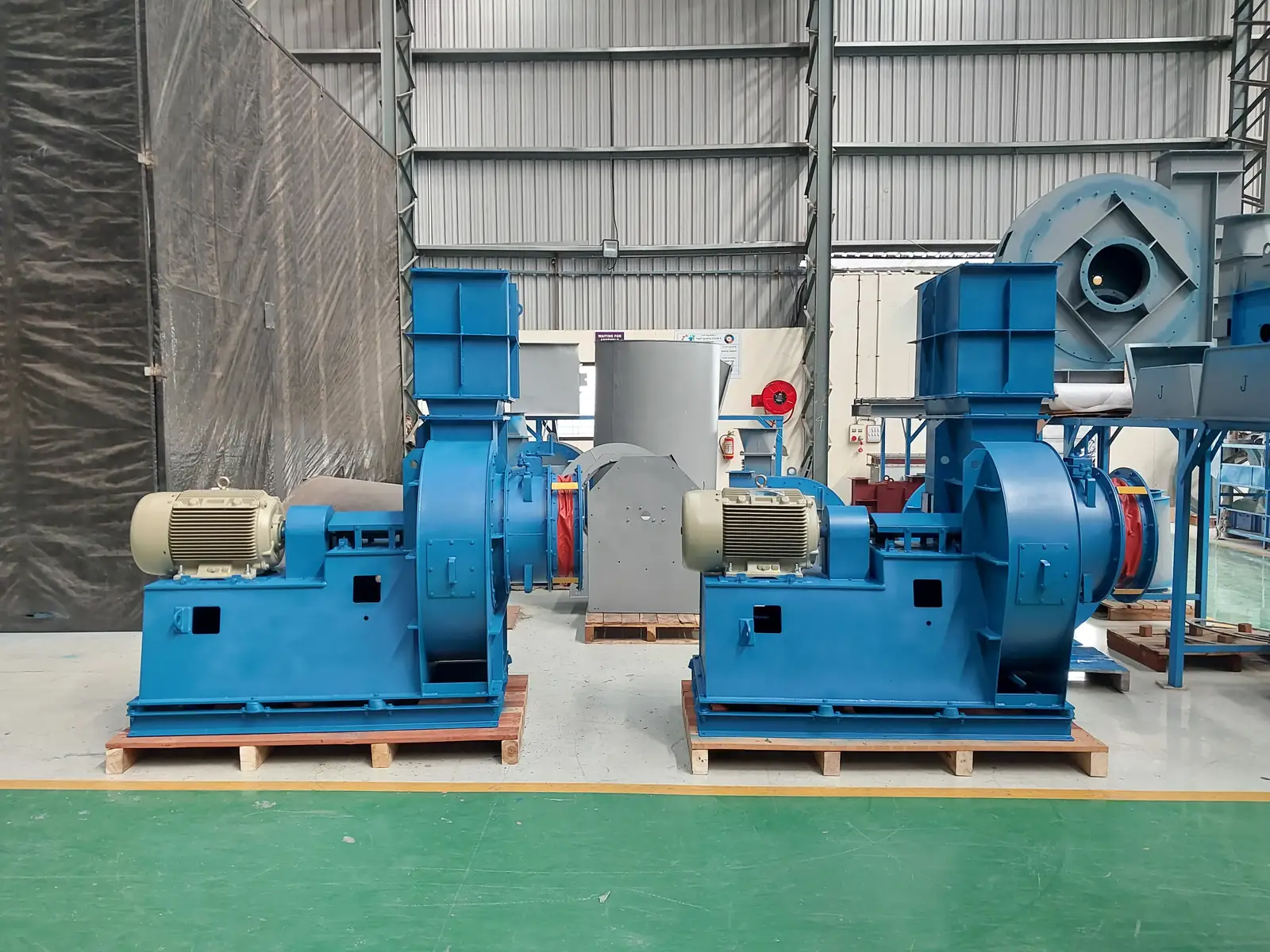
An OEM that builds paint & surface-coating systems had just put up a new line for its end customer, a filter-manufacturing plant. The air-handling fans on that line were ours. A brand-new turnkey line is a nervous moment: the OEM's acceptance with its own customer rides on every bought-in component behaving. So when a motor failed and one fan started shaking soon after start-up, the OEM raised it with us straight away — and, understandably, wondered whether the fans were at fault.
Three different things were reported across the line, and only site work could separate them: - a motor that had failed on one fan; - a fan running with high vibration, which the site suspected was a balance problem; and - a third fan under-performing on airflow.
For the OEM, "is it the fan?" was the question that mattered — because the answer decided who fixed what, and how fast the line could be handed over.
Our engineer went to site and worked the three problems one at a time — measuring and looking before concluding. - The failed motor was replaced with a new one at no cost to the customer, under warranty, and routed back to the motor supplier. The fan itself checked out and ran. - The shaking fan was the interesting one. The rotor was balance-good — it had passed its works test and was suitable for rigid mounting — but on site it was sitting on a light transition duct that hadn't been given proper structural support. A perfectly balanced rotor will still shake if its mounting flexes underneath it. Rather than stop at "not our fault," our engineer added stiffening to the fan and carried out fine-tuning dynamic balancing on site, tuned to that mounting, until the fan ran smoothly. The site signed off the correction. - The under-performing fan traced not to the fan but to the ducting — sharp perpendicular bends and no flexible bellows at the inlet and outlet, which disturb the air before and after the wheel. The fan met its performance on test; the fix belonged in the duct routing (softer bends, air deflectors, flexible bellows), which we set out for the customer.
Two engineering points a comparable plant can copy from this: - A fan that passes its balance test at works can still vibrate on a weak or under-supported mounting. Check the stiffness of the transition piece and the supports before start-up — the cure is often at the foundation, not the impeller. - Give the fan clean air. Sharp perpendicular bends and missing flexible bellows at the inlet/outlet cost you performance that the fan actually has.
Our fans are performance-tested in-house on our 200 HP VFD test rig, to the IS 4894 / AMCA 210 method, and the test reports go with the fan — which is exactly what let us settle, calmly and on evidence, what was the fan and what was the installation.
| Came in (Before) | Left us (After) | |
|---|---|---|
| Failed motor | dead on one fan | new motor fitted, running — at no cost (warranty) |
| Shaking fan | high vibration on a weak, under-supported mounting | stiffened + field-re-balanced, running smoothly on site |
| Root of the vibration | assumed to be fan balance | shown to be the mounting — solved without argument |
| Service outcome | a stalled, disputed hand-over | signed off on site; service acknowledged in writing |
In a single site visit, the motor was replaced free of charge, and the high-vibration fan was brought back to a smooth run on site by stiffening and re-balancing it to suit its mounting. The site signed off the correction, and the customer went on to acknowledge the service in writing. The one open item — the airflow shortfall on the third fan — was correctly located in the ducting, not the fan, and handed back with a clear corrective route; we make no claim to have closed it.
The honest through-line: we didn't spend the visit arguing about whose mistake it was. We fixed what could be fixed on site, told the customer plainly where the remaining fix belonged, and kept the line moving.
(No before/after vibration or airflow figures are published for this case — the site records are qualitative, and we don't publish numbers we didn't measure.)
If a new fan shakes, trips or under-performs the moment it's installed, the fan is often not the culprit — the mounting and the ducting usually are. A balanced rotor still needs a stiff, well-supported base and clean air in and out.
Seeing high vibration or lost airflow on a newly installed fan? Send us the fan and site details — we'll diagnose it honestly, tell you plainly whether it's the fan or the installation, and fix on site what can be fixed on site.
— Jitamitra Electro Engineering · Technical Services
Engineered for Every Application.
One, on this job. Our engineer went to site and worked the three problems one at a time, measuring and looking before concluding, rather than diagnosing them as a single complaint.
A perfectly balanced rotor will still shake if its mounting flexes underneath it. Here the rotor was balance-good and suitable for rigid mounting, but on site it sat on a light transition duct that had not been given proper structural support.
Rather than stop at "not our fault", our engineer added stiffening to the fan and carried out fine-tuning dynamic balancing on site, tuned to that mounting, until the fan ran smoothly. The site signed off the correction.
No. It traced to the ducting: sharp perpendicular bends and no flexible bellows at the inlet and outlet, which disturb the air before and after the wheel. The fan met its performance on test, and the fix belonged in the duct routing — softer bends, air deflectors and flexible bellows, which we set out for the customer.
It was replaced with a new one at no cost to the customer, under warranty, and routed back to the motor supplier.
Flow, static, gas temperature, application — or attach a spec, GA drawing or a multi-fan schedule. Engineer to engineer.
ISO 9001:2015 quality system · performance-tested to IS 4894 / ISO 5801 / AMCA 210 method · witnessed FAT on request.
*For our standard range. ATEX and special projects need 5 to 7 working days.
This site sets no cookies of its own. Google Analytics loads only if you accept. It sets two cookies, so we can see which fan topics people actually read. Decline and no analytics loads — the site works exactly the same. What we collect →