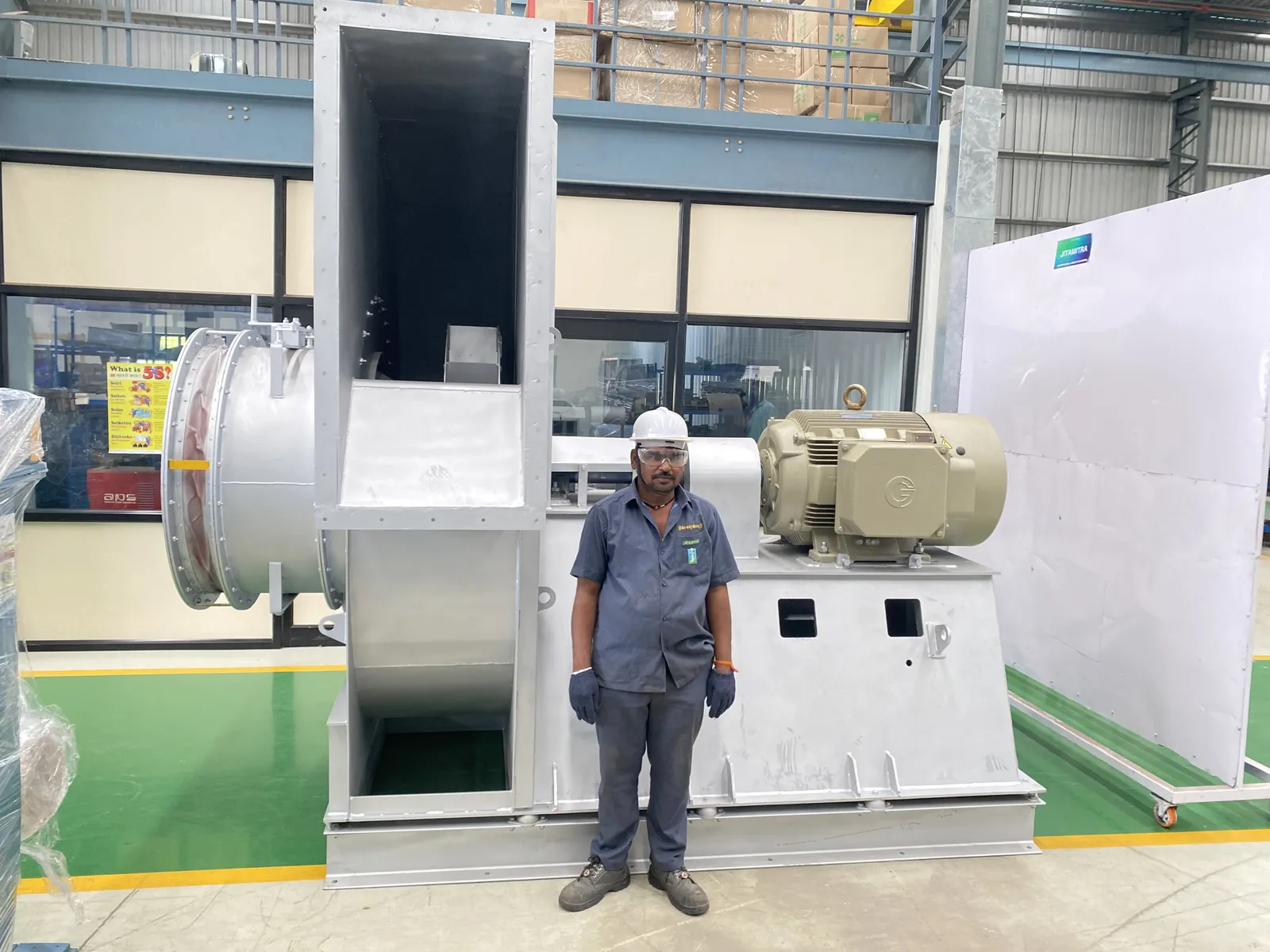
| Who | A foundry and casting plant in Uttar Pradesh |
| Equipment | A Jitamitra centrifugal blower on a foundry process duty |
| Complaint | "Motor tripping issue" — the drive motor kept tripping its protection |
| Service | Site attendance, complaint-RCA, operating-point and start-method correction |
| Response | Complaint registered and a service engineer on site the same day |
| Result | Damper adjusted on site to bring the operating point back inside the motor rating; the plant advised to convert to a star-delta start. No spare parts required — nothing on the fan was found broken. The record carries no post-fix current reading and no customer confirmation of trip-free running, so we claim none. |
A foundry is a hard home for a fan: hot air loaded with sand and fines, a supply that sags all day, and nobody looking at the fan until it stops. This plant ran a Jitamitra centrifugal blower on a process duty.
The duty figures were never captured on the complaint form — a gap we will come back to. What was captured was the sentence that mattered: the blower's motor was tripping. On a foundry floor that is not a nuisance — that fan is the extraction, cooling or combustion air for a process that does not pause while you investigate.
The complaint arrived as four words: motor tripping issue. No trip frequency. No measured current. No note of whether it tripped at start or after minutes under load. No damper position. No photographs.
And here the obvious suspect leads you astray. "The motor keeps tripping" reads, to almost everyone, as the fan is dragging the motor down. A seized bearing. A rubbing impeller. A rotor out of balance. That intuition sends a maintenance team straight into stripping a machine that has nothing wrong with it.
Nothing in the report pointed there — no noise, no vibration, no bearing heat, no aerodynamic symptom of any kind. The only fact on the table was electrical: the protection was doing its job. So the honest question was not what has broken? but why is this motor drawing more current than it is rated for?
A motor trips on overcurrent for a small number of reasons, and they rank by how cheap they are to rule out. That ranking is the method.
First, rule out the mechanical failures — the expensive suspects. A failing bearing, a fouled impeller, a rub, a serious imbalance: each announces itself with noise, heat or vibration long before it announces itself with a trip. Our engineer found none on site. Nothing needed replacing.
Second, ask where the fan is actually operating. A centrifugal blower is a rising-power machine: the further open you run it, the more air it moves and the more shaft power it absorbs. The motor is sized for the design point. Run the damper open past design intent — because someone wanted "more air", or because nobody ever set it — and the operating point slides out into high flow, absorbed power climbs past the nameplate, and the overload relay trips. Correctly. Our engineer adjusted the damper on site, pulling the operating point back inside the motor's rating.
Third, ask how the machine is being started. A motor started direct-on-line draws roughly six to eight times its running current while it accelerates — and a fan, with all that inertia in the impeller, is a slow load to bring up to speed, so it holds the motor in that inrush far longer than a light load would. On a foundry-scale motor that alone can trip protection before the fan reaches duty. The plant was instructed to convert to a star-delta starter, capping starting current rather than leaving the panel to absorb it.
The two mechanisms are not rivals: one explains a trip under load, the other a trip at start. Both were addressed, because the form never recorded which it was.
5-Why Why did the motor trip? Protection saw more current than the motor is rated for. Why was the current too high? The motor was asked for more torque than its design duty — running, or accelerating. Why running? The damper sat open past the design point, and a centrifugal fan absorbs more power the more air it passes. Why accelerating? It was started direct-on-line, drawing full inrush against the impeller's inertia. Why was either allowed? Operating point and start method were never verified against the motor rating at commissioning.
The reusable lesson: A fan is not an independent machine. It is one element of a system — duct, damper, panel, motor — and the motor's current is the honest report card for all four. When a fan "pulls high current", the fault is far more often in how it is asked to run than in how it was built.
What we proved - The complaint was electrical in origin, not mechanical. No bearing, impeller, casing or balance fault was found or reported. - No spare part was required. Nothing on the fan was replaced.
What we changed - The damper was adjusted on site, bringing the operating point — and the absorbed power — back within the motor's rating. - The plant was instructed to convert to a star-delta start, capping the inrush the protection had been seeing. - Both actions were delivered on the day the complaint was registered.
What the record does not confirm - We hold no post-fix current measurement and no customer confirmation of trip-free running. A closure note was directed to the plant; confirmation never came back into the file. We will not dress that up as an ending we cannot evidence.
What we changed in ourselves - Start method is now verified against motor size at dispatch, and damper setting at handover. - Every trip complaint now asks three questions: at start or on load? measured current? damper position?
A fan that trips its motor is usually telling you about its system, not about itself. Check two things that cost nothing before you open the machine: how it is being started, and where on its curve it is running. Check the panel before you strip the machine — otherwise you will find a healthy fan and still have the problem.
If a fan on your plant is tripping, surging, vibrating, or simply not delivering what it used to, we will come and look at it — and we service fans of any make, not only ours. Balancing to ISO 21940, vibration assessment against ISO 14694, performance verification tested to IS 4894 / ISO 5801 / AMCA 210 method, and an honest answer on whether you need a repair, a rebuild, or a change in how the machine is run.
— Jitamitra Electro Engineering · Technical Services
Engineered for Every Application.
Probably not. A tripping motor reads to almost everyone as the fan dragging the motor down — a seized bearing, a rubbing impeller, an imbalance. Each of those announces itself with noise, heat or vibration long before it announces itself with a trip. On this foundry blower our engineer found none of them. Check the panel before you strip the machine.
Yes. A centrifugal blower is a rising-power machine: the further open you run it, the more air it moves and the more shaft power it absorbs. The motor is sized for the design point. Run the damper open past design intent and the operating point slides out into high flow, absorbed power climbs past the nameplate, and the overload relay trips. Correctly.
That points at the start method, not the damper. A motor started direct-on-line draws roughly six to eight times its running current while it accelerates, and a fan, with all that inertia in the impeller, is a slow load to bring up to speed. This plant was instructed to convert to a star-delta starter, capping starting current.
Three things, at minimum: does it trip at start or after minutes under load, what current was measured, and where the damper was sitting. This complaint arrived as four words — motor tripping issue — with no trip frequency, no measured current, no damper position and no photographs. Both mechanisms had to be addressed because the form never recorded which it was.
We cannot say. Damper adjustment and the star-delta instruction were both delivered on the day the complaint was registered, and no spare parts were required — nothing on the fan was found broken. But we hold no post-fix current measurement and no customer confirmation of trip-free running. A closure note went to the plant; confirmation never came back into the file.
Yes — we service fans of any make, not only ours. If a fan on your plant is tripping, surging, vibrating, or simply not delivering what it used to, we will come and look at it: balancing to ISO 21940, vibration assessment against ISO 14694, performance verification tested to IS 4894 / ISO 5801 / AMCA 210 method.
Flow, static, gas temperature, application — or attach a spec, GA drawing or a multi-fan schedule. Engineer to engineer.
ISO 9001:2015 quality system · performance-tested to IS 4894 / ISO 5801 / AMCA 210 method · witnessed FAT on request.
*For our standard range. ATEX and special projects need 5 to 7 working days.
This site sets no cookies of its own. Google Analytics loads only if you accept. It sets two cookies, so we can see which fan topics people actually read. Decline and no analytics loads — the site works exactly the same. What we collect →