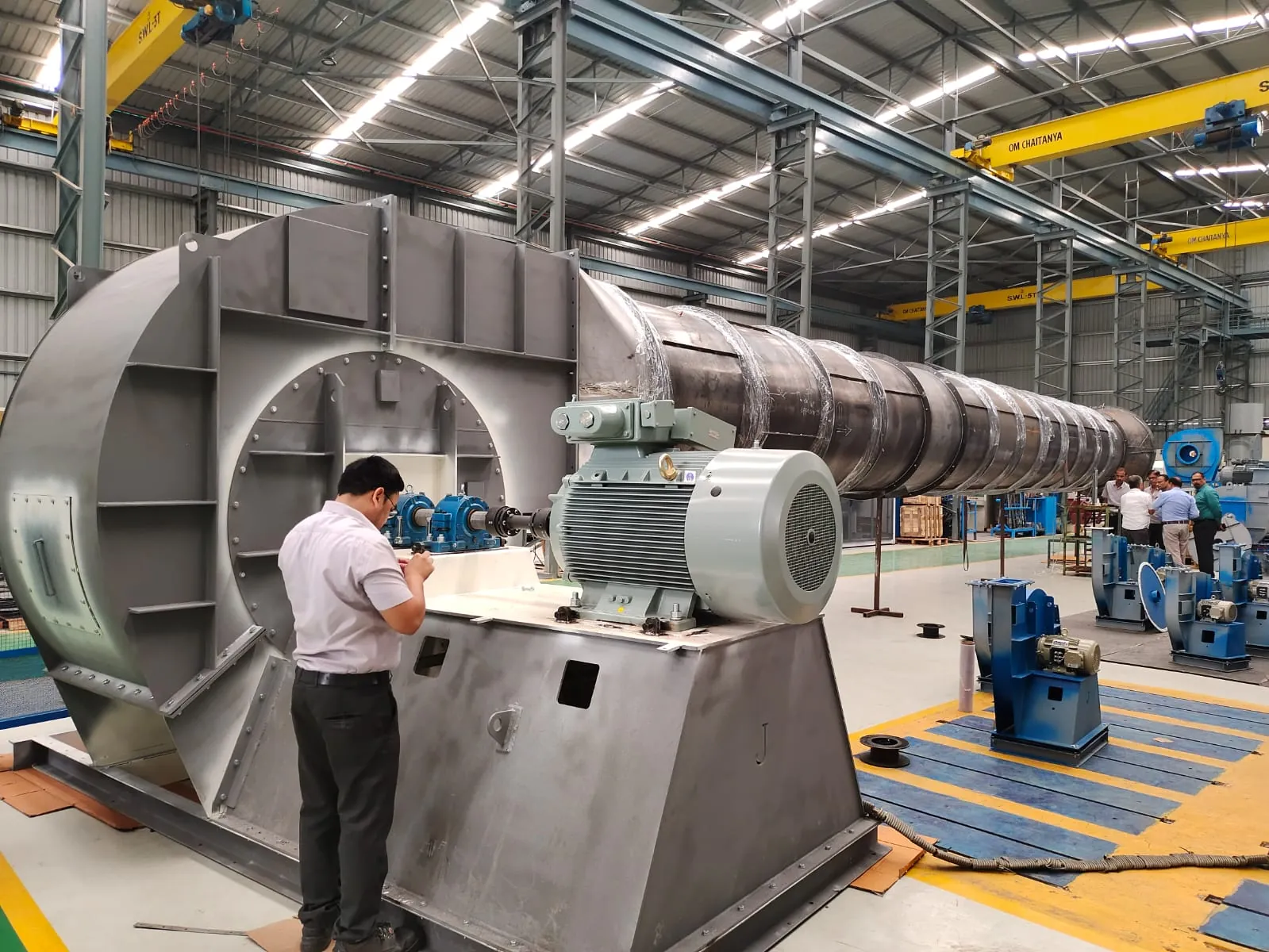
A heat-treatment furnace OEM had built a mesh-belt tempering furnace for a demanding end customer — a bearing and automotive-components plant — and fitted it with a compact Jitamitra furnace blower. It is the classic pressure-cooker: the OEM's name is on the furnace, the fan is two customers deep, and any wobble at the end-user's plant reflects straight back on the builder. So when the new blower ran noisy at start-up, the OEM needed a fast, credible answer — not a blame match.
Two symptoms, arriving one after the other. First, from the moment it started, the blower was noisy and visibly vibrating — enough that the plant sent a video and asked for an immediate fix. Then, after that was addressed, a second worry surfaced: the plant reported the blower wasn't building its pressure — they were reading only a few millibars where the duty called for far more. To the end user, both symptoms read as "the fan is defective." Left unresolved, it's the kind of complaint that quietly turns an OEM off a supplier — even when the fan is sound.
Jitamitra worked the problem the disciplined way: prove the fan first, then look along its lifecycle — how it was set up at commissioning and how it was installed — instead of condemning a new blower on a site reading.
Start from the fan. The blower had already met its rated duty on its performance test, current and power within limits. On site, rather than argue over a gauge reading, an engineer disconnected the ductwork and measured the blower directly at its outlet: shut-off pressure came in above the fan's rated duty. The fan was on-spec. With that established, both symptoms resolved to two ordinary lifecycle touchpoints — commissioning and installation.
Cause 1 — the noise: an inlet-cone running clearance to set at commissioning. From the video, photos and a structured phone walk-through with the site technician (we asked for the tell-tale reads: vibration, and noise with the inlet open versus closed), the noise was isolated to a light rubbing contact inside the fan — the inlet cone was just touching the spinning impeller.
Why the noise? A rubbing contact inside the fan. → Why the rub? The inlet cone was touching the impeller. → Why touching? The inlet-cone-to-impeller running clearance wasn't uniform (a knock to the casing had closed the gap on one side). → The lesson: the inlet-cone running clearance is a commissioning-set parameter — set it, and gauge-check it to a uniform gap, before the line runs. Restore the gap and the noise goes with it — no new bearing, no rebalancing, no new fan.
The fix was exactly that: re-establish a uniform cone-to-impeller running clearance (a millimetre or two of correction, and clearing a dent in the casing). Noise and vibration — gone, confirmed by the plant.
Cause 2 — the pressure: a sharp bend right at the outlet. With the fan proven on-spec at its outlet, the missing pressure had to be downstream. It was: the installed ductwork put a sharp ~90° bend right off the fan outlet, throwing the airflow into turbulence and burning off pressure before it ever reached the process. The fix was the ductwork, not the fan — corrected to good ducting practice — and we said so plainly, with the measurement to back it, without disparaging the install.
The reusable lesson: two of the most common "the fan is bad" complaints usually aren't the fan. A brand-new blower that's suddenly noisy is very often a running clearance that drifted in handling and needs setting at commissioning — a cone kissing the impeller; restore the gap before you condemn the fan. And a fan that "won't make pressure" at site is very often a system-effect at the outlet — a tight elbow too close to the fan — that you can prove in minutes by measuring the fan with the duct off. Measure first; leave a straight run off the outlet; set the clearances at commissioning.
No vibration mm/s figure is quoted here because none was measured on site — we won't publish a number we didn't take.
A new fan that's "noisy and won't make pressure" is usually two ordinary lifecycle problems wearing one complaint: a running clearance to set at commissioning, and a duct bend to correct at install — not a fan to scrap. The value isn't a new fan; it's an engineer who will measure, tell you which is which, and put it in writing.
Running a fan — any make — that's noisy, or that "won't make its pressure" at site? Ask us for a root-cause investigation. You'll get a measured verdict and a written corrective action that tells you honestly whether it's the fan, the commissioning, or the install.
— Jitamitra Electro Engineering · Technical Services
Engineered for Every Application.
On this furnace blower it was not. From the video, photos and a structured phone walk-through with the site technician — we asked for the tell-tale reads: vibration, and noise with the inlet open versus closed — the noise isolated to a light rubbing contact inside the fan: the inlet cone was just touching the spinning impeller. No new bearing, no rebalancing, no new fan.
It is the gap between the inlet cone and the impeller, and it is a commissioning-set parameter — set it, and gauge-check it to a uniform gap, before the line runs. Here a knock to the casing had closed the gap on one side. The fix was a millimetre or two of correction and clearing the dent; noise and vibration went with it.
Measure the fan on its own. Rather than argue over a gauge reading, our engineer disconnected the ductwork and measured the blower directly at its outlet: shut-off pressure came in above the fan's rated duty. With the fan proven on-spec, the missing pressure had to be downstream. It takes minutes and it settles the argument with a number.
It did here. The installed ductwork put a sharp ~90° bend right off the fan outlet, throwing the airflow into turbulence and burning off pressure before it ever reached the process — the plant was reading only a few millibars where the duty called for far more. The fix was the ductwork: leave a straight run off the outlet.
Root cause plus a written corrective action was issued on the logged noise/vibration complaint in 2 working days — well inside our commitment of a written corrective action within 10 working days. There is no vibration figure to give you: none was measured on site, and we won't publish a number we didn't take. The plant did confirm the noise and vibration were gone.
Prove the fan first, then look along its lifecycle — how it was set up at commissioning and how it was installed — instead of condemning a new blower on a site reading. Here that produced a measured verdict: the fan was on-spec, the noise was a commissioning clearance, the low pressure was an install matter. Said plainly, with the measurement behind it, without disparaging the install.
Flow, static, gas temperature, application — or attach a spec, GA drawing or a multi-fan schedule. Engineer to engineer.
ISO 9001:2015 quality system · performance-tested to IS 4894 / ISO 5801 / AMCA 210 method · witnessed FAT on request.
*For our standard range. ATEX and special projects need 5 to 7 working days.
This site sets no cookies of its own. Google Analytics loads only if you accept. It sets two cookies, so we can see which fan topics people actually read. Decline and no analytics loads — the site works exactly the same. What we collect →