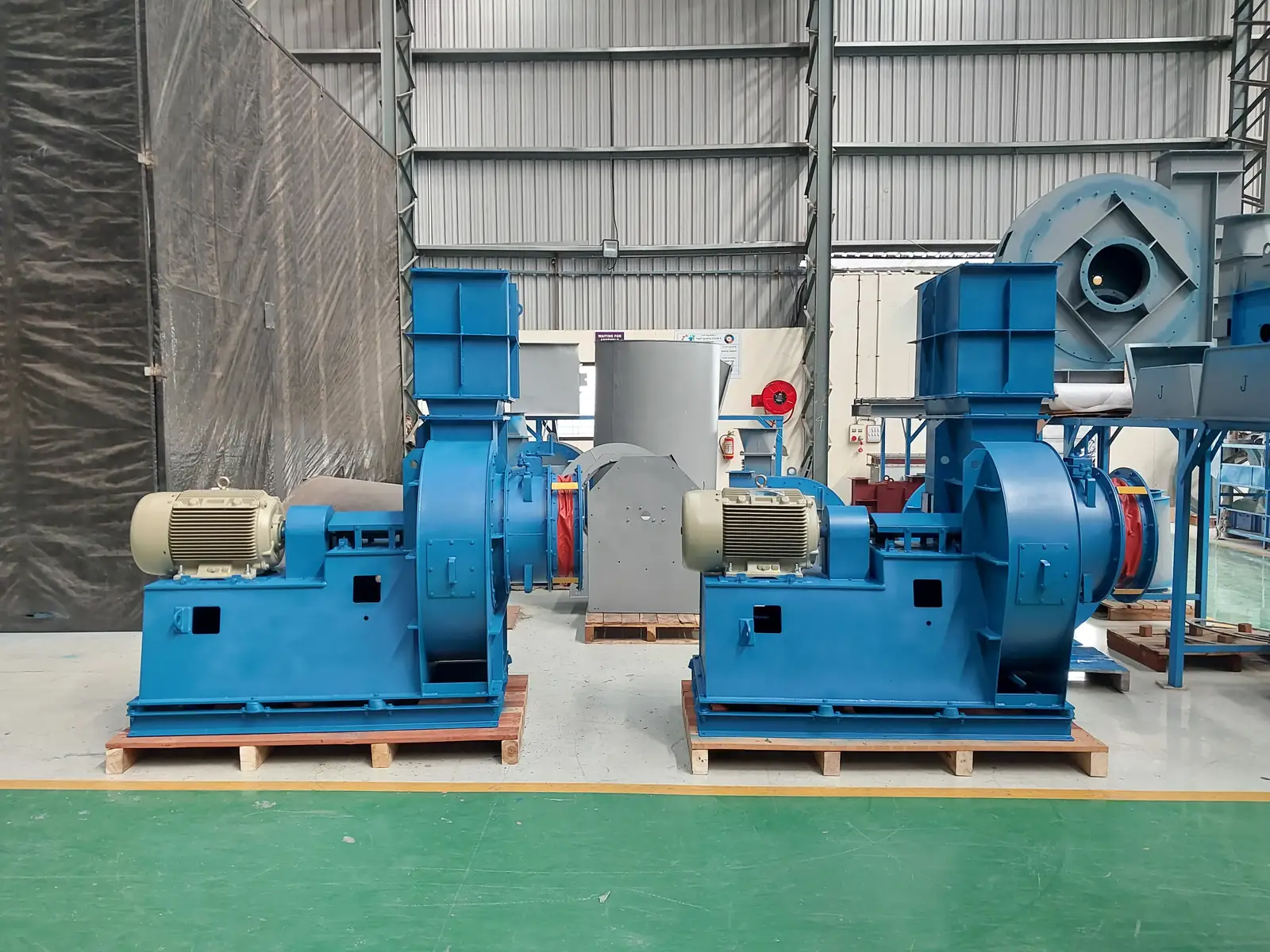
| Who | A heat-treatment furnace OEM in Maharashtra (furnaces, ovens & heat-treatment segment) |
| Equipment | One direct-drive centrifugal blower — 20,000 CMH / 70 mmWC / 10 HP / 40 °C |
| Complaint | Drive motor failed in service; raised as a warranty claim, with plant activity stopped by the breakdown |
| Service | Same-day field attendance, failure adjudication, motor lifted out, repaired in our works and returned to site |
| Response | Call raised mid-afternoon; engineering verdict issued the same day; repaired motor scheduled back to site the next working day |
| Result | Failure traced to incorrect electrical connections made at site by the customer's own connecting contractor. No defect found in the blower. Motor repaired and returned; liability and charges set in writing. Our record documents the diagnosis and the corrective action delivered — it does not carry a signed post-repair acceptance, and we do not claim one. |
Heat-treatment plants do not tolerate a stopped fan. The blower on this line was a direct-drive centrifugal unit moving 20,000 CMH at 70 mmWC on a 10 HP motor, handling air at 40 °C — an unremarkable duty on paper, and exactly the kind of workhorse machine whose reliability nobody thinks about until it stops.
When it did stop, the furnace line stopped with it. The customer, an OEM building heat-treatment equipment, was under pressure from their own end user, and the call reached us with the plant already down. In that state, the diagnosis matters less to the caller than the restart. Our job was to do both, and to do them in the right order.
The claim arrived under warranty — the natural reading: a fan supplied by us, a motor on that fan, a failure inside the warranty window, therefore a manufacturing defect.
The obvious suspect was the machine. It was the wrong suspect. A motor does not fail in isolation; it fails inside a system that includes the supply, the starter, the terminal block, the cable and whoever landed the leads. Our field engineer looked at the connection before he looked at the winding — and what he found in the terminal box explained the failure without ever opening the blower.
We work the same sequence on every motor claim, cheapest and most reversible checks first:
Five whys 1. Why did the fan stop? — The drive motor failed. 2. Why did the motor fail? — It was electrically mis-connected at site. 3. Why was it mis-connected? — The leads were landed by a third-party contractor during installation, without a connection check before first start. 4. Why did nobody catch it? — There was no pre-energisation gate: no one verified the terminal-box configuration, supply and phasing against the nameplate before the machine was switched on. 5. Root cause — A site-side electrical installation error, downstream of the equipment supply, energised without a pre-start connection check.
The reusable lesson: A rotating machine is only as good as the terminal box it is wired into. If nobody signs off the connection before first start, the motor becomes the test instrument — and it fails the test destructively. "Under warranty" is a claim, not a verdict; inspect the connection interface before you accept or reject the machine.
Honestly stated, this is what the record supports:
The transferable lesson costs nothing to apply. The fan's warranty ends at the terminal box; the fan's reliability does not. A 10 HP motor connected wrongly — a star/delta error, a mis-landed lead, a lost phase — will draw current it was never designed for and destroy its own windings long before anything mechanical complains. Ten minutes with a meter and a nameplate, before the first start, is the cheapest insurance on the whole installation. Put a named person on that check, and make them sign it.
We service centrifugal fans and blowers of any make — not only ours: failure diagnosis, motor and bearing repair, balancing to ISO 21940, vibration checks against ISO 14694 (rigid BV-3: 4.5 mm/s accept, 7.1 alarm, 9.0 shutdown; flexible: 6.3 / 11.8 / 12.5), and performance re-testing to IS 4894 / ISO 5801 / AMCA 210 method. If a fan on your plant is failing and the cause is not obvious, that is exactly the call we like to take.
— Jitamitra Electro Engineering · Technical Services
Engineered for Every Application.
No. "Under warranty" is a claim, not a verdict. A motor does not fail in isolation; it fails inside a system that includes the supply, the starter, the terminal block, the cable and whoever landed the leads. On this 20,000 CMH / 70 mmWC / 10 HP blower the fault sat in the terminal box — the connections had been made incorrectly at site.
Cheapest and most reversible checks first. Rule out the air path — impeller, bearings, casing, aerodynamics: no imbalance, no rub, no bearing distress. Then rule out the fan build, the motor mounting and the drive. Only then look at the electrical interface, the one remaining boundary. Here the first two closed out clean and the third held the fault.
A pre-energisation connection check: star/delta, lead landing, supply voltage and phase confirmed against the nameplate, signed off before the machine is switched on. On this job there was no such gate, so the motor became the test instrument — and it fails that test destructively. Ten minutes with a meter and a nameplate is the cheapest insurance on the whole installation.
Here we lifted the motor out, repaired it in our works and returned it rather than swapping in a replacement — faster to restore, and the original machine stayed intact. The call was raised mid-afternoon, the engineering verdict was issued the same day, and the repaired motor was scheduled back to site the next working day so the line could restart.
Stated in writing before the work goes back. The failure was traced to incorrect electrical connections made at site by the customer's own connecting contractor, with no defect found in the blower. Liability and the associated service and repair charges were set out in writing before the motor returned to site — no surprises after the fact.
No. Our record closes with the repaired motor released and the reinstallation instructed. It does not contain a post-repair run report, re-test readings, or a customer sign-off. We are not claiming closure we cannot evidence. What the record does document is the diagnosis and the corrective action delivered.
Flow, static, gas temperature, application — or attach a spec, GA drawing or a multi-fan schedule. Engineer to engineer.
ISO 9001:2015 quality system · performance-tested to IS 4894 / ISO 5801 / AMCA 210 method · witnessed FAT on request.
*For our standard range. ATEX and special projects need 5 to 7 working days.
This site sets no cookies of its own. Google Analytics loads only if you accept. It sets two cookies, so we can see which fan topics people actually read. Decline and no analytics loads — the site works exactly the same. What we collect →