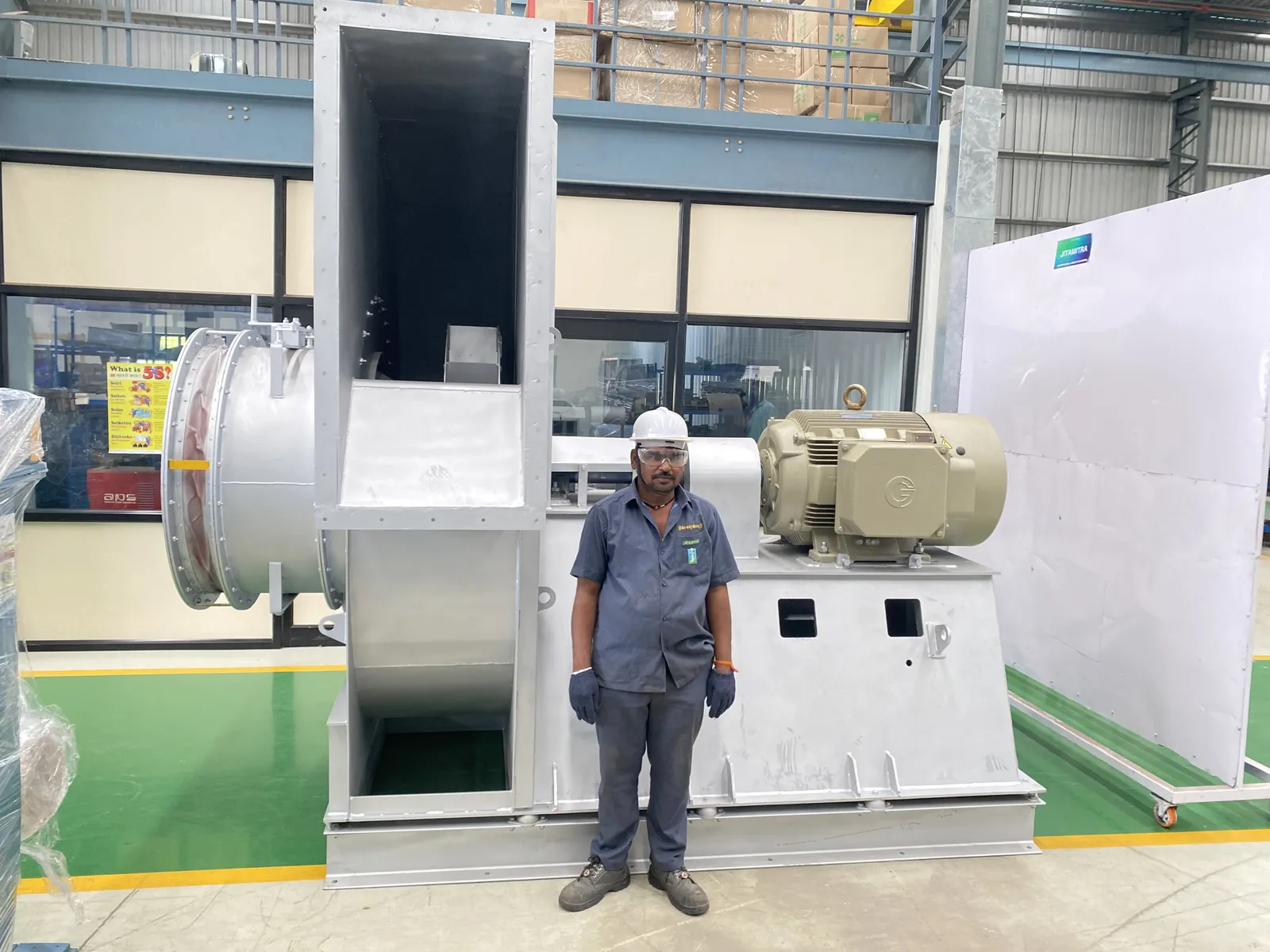
Picture the position our customer was in: an EPC projects team, right at the finish line of a plant, about to hand it over to their client — a mineral-processing operation in western India. Three fans we had supplied (a ~60 HP unit and two ~30 HP units, belt-driven, mounted high on an outdoor platform) had been part of the build for a while and were commissioned only about a month before. That is exactly the moment a contractor cannot afford a surprise. We'll call them the Contractor.
About a month after start-up, the fans came up noisy and vibrating — one ~30 HP fan with an abnormal noise, the ~60 HP fan with abnormal vibration. For a contractor in the middle of handover, that is not a small thing: you cannot sign a plant over to your client with the fans shaking on the platform. Understandably, the Contractor's first assumption was that the fans themselves were at fault — an off-spec build under warranty. Our job was to find out what was actually causing each symptom, prove it, fix it, and be straight about anything that turned out to be ours.
We acknowledged within minutes and had a service engineer mobilised to an out-of-region, outdoor, high-platform site — with a welder and welding gear arranged in advance, because we suspected on-site fabrication might be needed. On site, we worked all three fans and, crucially, separated the build from what happened to it between dispatch and start-up — with evidence, not opinion. The build held up: the field symptoms came from installation and commissioning.
The educational root-cause chain (generic — the pattern, not one customer's file): Why were the fans noisy and vibrating at start-up? → Not the fans themselves — the build checked out on-spec. The symptoms traced to what happens between dispatch and first run: installation and commissioning. → The ~60 HP fan's vibration = whole-assembly imbalance (impeller, shaft, pulley and belts together) that a commissioning trim-balance had never corrected, aged and slack V-belts, and a base frame fixed to the platform's checkered plate rather than to the supporting channel underneath. → The ~30 HP fan's noise = a bearing that had run dry, because the fan sat a long stretch before start-up and was never re-greased at commissioning. → Root cause: installation and commissioning factors at handover — plus one part that was genuinely on us: a belt-tensioning arrangement that should have shipped with the fan and didn't.
What we did about each: - Balanced the ~60 HP rotating assembly on site to ISO 1940 balance grade G 2.5 — the commissioning-stage trim-balance the assembled rotor (impeller, shaft, pulley and belts together) had never had, not just the bare impeller. - Fabricated and fitted the missing belt-tensioning arrangement on the spot — the one thing that was genuinely on us. We said so plainly, in writing, and corrected it there and then. - Replaced the dry-run bearing on the noisy fan, re-greased to the fan's lubrication schedule, and serviced the third fan. - Answered the "is the fan off-spec?" question with our own quality records — the fan's dimensional inspection was within drawing, and its impeller had been balanced to well inside the ISO 1940 G 2.5 limit (a residual of about 0.4 against an allowable ~1.8 gm·mm/kg), with the works performance test within limits. The build was to spec; the field symptoms came from installation and commissioning — and where a part was genuinely missing, we owned it.
The reusable lesson: fans that have waited between dispatch and start-up need a proper commissioning routine at handover — Jitamitra Electro Engineering · Technical Services (not just the bare impeller), re-grease and re-check the bearings before the first run, inspect and re-tension or replace the belts, and confirm the base is fixed to real load-bearing structure, not to floor plate. Balance and alignment checks belong at commissioning, not after the complaint. Then prove the build with the maker's own QA records — and own anything that turns out to be yours.
No before/after vibration figure is published here because none was recorded on site — we don't publish numbers we didn't measure. What we can stand behind: the build was proven to spec on our own quality records, the root causes were found and fixed at commissioning, and we were straight about the one thing that was on us.
A fan that starts up noisy or shaking after a long wait between dispatch and first run is usually telling you about its commissioning — balance, alignment, belts, lubrication and how it's fixed down — not about a bad casting. The engineer worth having is the one who proves that with evidence, fixes every fan on the platform, and tells you honestly which part of it was theirs.
Commissioning a plant and worried about a fan that's noisy, shaking, or sat a long time before start-up — ours or any make? Ask us for an on-site root-cause investigation. You'll get a written corrective action, the fan's quality records, and a straight answer.
— Jitamitra Electro Engineering · Technical Services
Engineered for Every Application.
Probably not, and that was the first assumption here too. Three fans — a ~60 HP unit and two ~30 HP units, belt-driven on an outdoor platform — came up noisy and vibrating about a month after start-up. The build held up: the symptoms came from installation and commissioning, from what happened between dispatch and first run.
On the ~60 HP fan it was whole-assembly imbalance — impeller, shaft, pulley and belts together — that a commissioning trim-balance had never corrected, plus aged and slack V-belts and a base frame fixed to the platform's checkered plate rather than to the supporting channel underneath. We balanced the assembly on site to ISO 1940 balance grade G 2.5.
That was exactly it on the ~30 HP fan: a bearing that had run dry, because the fan sat a long stretch before start-up and was never re-greased at commissioning. We replaced the bearing, re-greased to the fan's lubrication schedule, and serviced the third fan on the same visit.
Trim-balance the assembled rotor — impeller, shaft, pulley and belts together, not just the bare impeller. Re-grease and re-check the bearings before the first run. Inspect and re-tension or replace the belts. Confirm the base is fixed to real load-bearing structure, not to floor plate. Balance and alignment checks belong at commissioning, not after the complaint.
Ask the maker for their own quality records. Here the fan's dimensional inspection was within drawing, and its impeller had been balanced well inside the ISO 1940 G 2.5 limit — a residual of about 0.4 against an allowable ~1.8 gm·mm/kg — with the works performance test within limits. The build was to spec; the field symptoms were installation and commissioning.
No before/after vibration figure is published here because none was recorded on site — we don't publish numbers we didn't measure. What we can stand behind: the build was proven to spec on our own quality records, the root causes were fixed at commissioning, and we owned the one genuine gap in writing — a belt-tensioning arrangement that should have shipped with the fan, fabricated and fitted on site.
Flow, static, gas temperature, application — or attach a spec, GA drawing or a multi-fan schedule. Engineer to engineer.
ISO 9001:2015 quality system · performance-tested to IS 4894 / ISO 5801 / AMCA 210 method · witnessed FAT on request.
*For our standard range. ATEX and special projects need 5 to 7 working days.
This site sets no cookies of its own. Google Analytics loads only if you accept. It sets two cookies, so we can see which fan topics people actually read. Decline and no analytics loads — the site works exactly the same. What we collect →