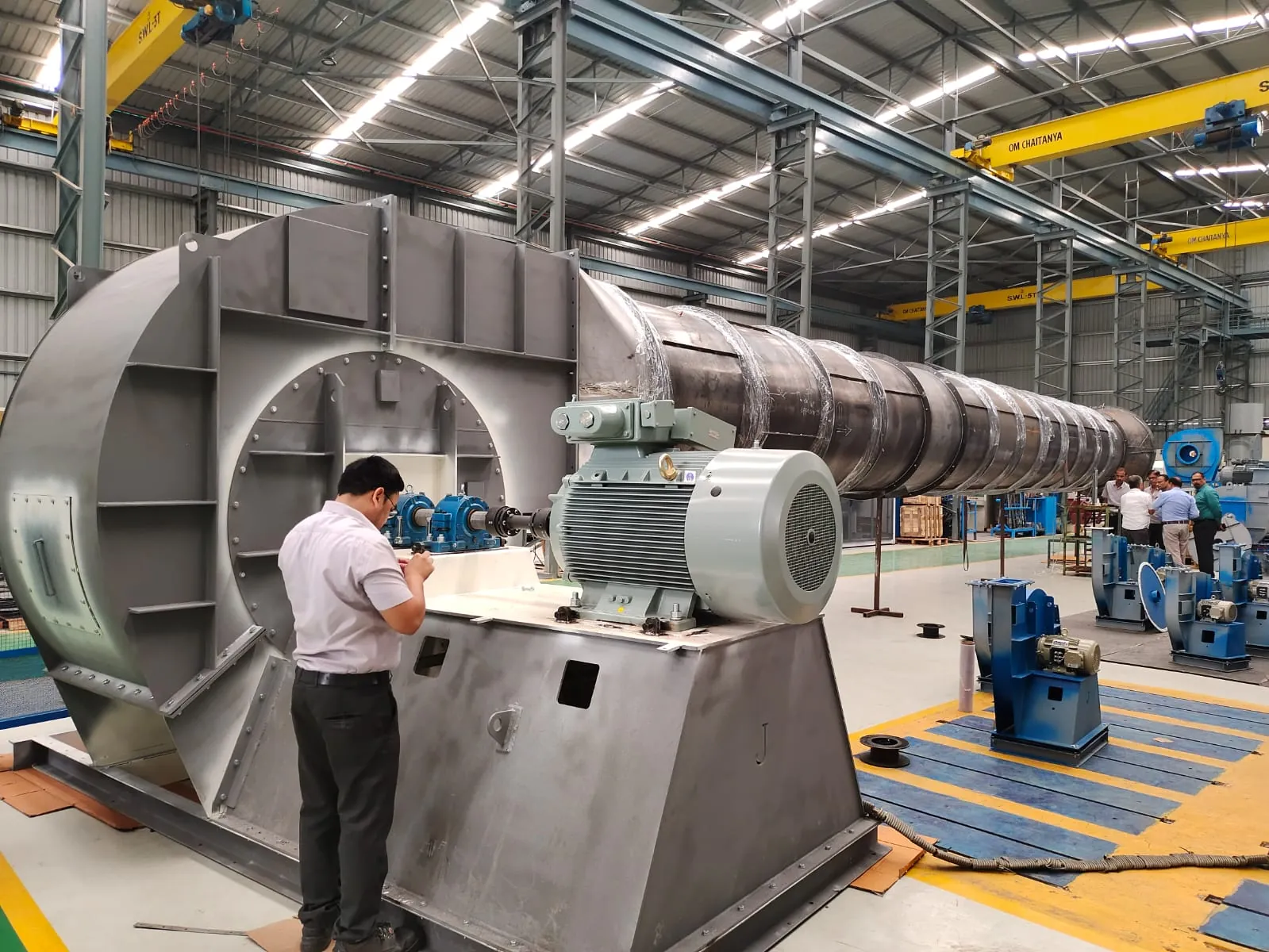
An OEM that builds dust-collection and air-pollution-control systems had installed one of our 30 HP centrifugal ID fans (≈15,000 CMH · 350 mmWC · 50 °C class) into a package delivered to their end customer — a metal-casting foundry in eastern India. The fan sat in a live production line: it couldn't simply be pulled out and bench-tested. When the motor started drawing high current soon after commissioning, two reputations were on the line at once — the OEM's, with their end client, and ours, because it was our fan.
The site reported the motor pulling high current — up near the motor's full-load limit. It stayed high even with the damper only ~40% open, and it didn't come down when the site extended the star-delta changeover timing. The natural first suspicion fell on the fan: was it a design or manufacturing fault? With a foundry line running, the OEM asked us to resolve it "most urgent."
We led with method, not guesswork. First we established whether the fan itself was healthy: its factory routine-test record showed current comfortably inside limits (full-open ~32 A against a 38 A motor full-load rating), and five identical fans we'd supplied to the same customer since 2016 had never shown this behaviour. That pointed away from the fan — so we ran a disciplined field checklist to rule out the usual culprits one by one: water in the casing (none), dust on the impeller (none), direction of rotation (correct), supply voltage, connections and cable continuity (all sound), timer and relay settings. Every electrical box was ticked, and the current was still high. That narrowed it to the air side — the system the fan was connected to. So we deputed a service engineer to the foundry.
The educational root cause — a 5-Why that lands on a generic cause:
Why was the motor current high? The fan was moving more air than its duty point. → Why more air? The connected ducting had leaks, so the system resistance was lower than design. → Why did that raise the current? With less resistance, the fan "over-breathes" — it rides out along its curve to higher flow, and a backward-curved fan draws more power there. → Why was it leaking? Duct joints on the site-erected ductwork weren't fully sealed. → Root cause: air in-leakage through the connected ductwork — an installation/system issue, not a fan fault. The earlier timer and rotation checks were treating symptoms, because the real cause sat outside the fan.
The fix followed the cause: our engineer located and sealed all the duct leaks, restoring the system's design resistance so the fan settled back onto its intended operating point. We then ran a verification trial on the spot: the motor current came down to roughly 28–29 A — well within its rated range — with no parts replaced.
The reusable lesson: a fan that draws high current the moment it's installed is usually telling you about the system it's connected to, not about itself. Check the ductwork for leaks and confirm the operating point before you condemn the fan.
A fan complaint that looks electrical ("high current") is often a system problem in disguise — duct leaks, a wrong operating point, an open damper. The value isn't a parts swap; it's an engineer who reads the test record, rules causes out in order, and finds where the current is really coming from.
Running an any-make or Jitamitra fan that pulls high current, trips, or vibrates after install? Ask us for a root-cause investigation — you'll get a written corrective action, not another guess.
— Jitamitra Electro Engineering · Technical Services
Engineered for Every Application.
That is the natural first suspicion, and it was wrong here. The motor was pulling high current up near its full-load limit, staying high even with the damper only ~40% open. The fan's own factory routine-test record showed current comfortably inside limits — full-open ~32 A against a 38 A motor full-load rating.
Those checks treat symptoms. Work a disciplined field checklist first: water in the casing, dust on the impeller, direction of rotation, supply voltage, connections and cable continuity, timer and relay settings. Here every electrical box was ticked and the current was still high, which narrowed it to the air side — the system the fan is connected to.
Leaks make the system resistance lower than design, so the fan moves more air than its duty point. It over-breathes — riding out along its curve to higher flow — and a backward-curved fan draws more power there. On this job the duct joints on the site-erected ductwork weren't fully sealed.
Our engineer located and sealed all the duct leaks, restoring the system's design resistance so the fan settled back onto its intended operating point. A verification trial ran on the spot: motor current came down to roughly 28–29 A against a 38 A full-load rating — well within its rated range, with no spares consumed.
Two records, read before anyone guesses. The fan's factory routine test showed full-open current at about 32 A against a 38 A motor full-load rating. And identical fans supplied to the same customer since 2016 had never shown this behaviour. That pointed away from the fan and towards the system it was connected to.
Yes. Because the fault was in the installed ductwork and not the fan, we said so plainly — and we still went to site, fixed it, and got the line running. Root-caused on the first visit, with a written corrective action issued. The current held within range on the trial and the end user signed off that it was "well within the range"; no recurrence was reported back to us.
Flow, static, gas temperature, application — or attach a spec, GA drawing or a multi-fan schedule. Engineer to engineer.
ISO 9001:2015 quality system · performance-tested to IS 4894 / ISO 5801 / AMCA 210 method · witnessed FAT on request.
*For our standard range. ATEX and special projects need 5 to 7 working days.
This site sets no cookies of its own. Google Analytics loads only if you accept. It sets two cookies, so we can see which fan topics people actually read. Decline and no analytics loads — the site works exactly the same. What we collect →