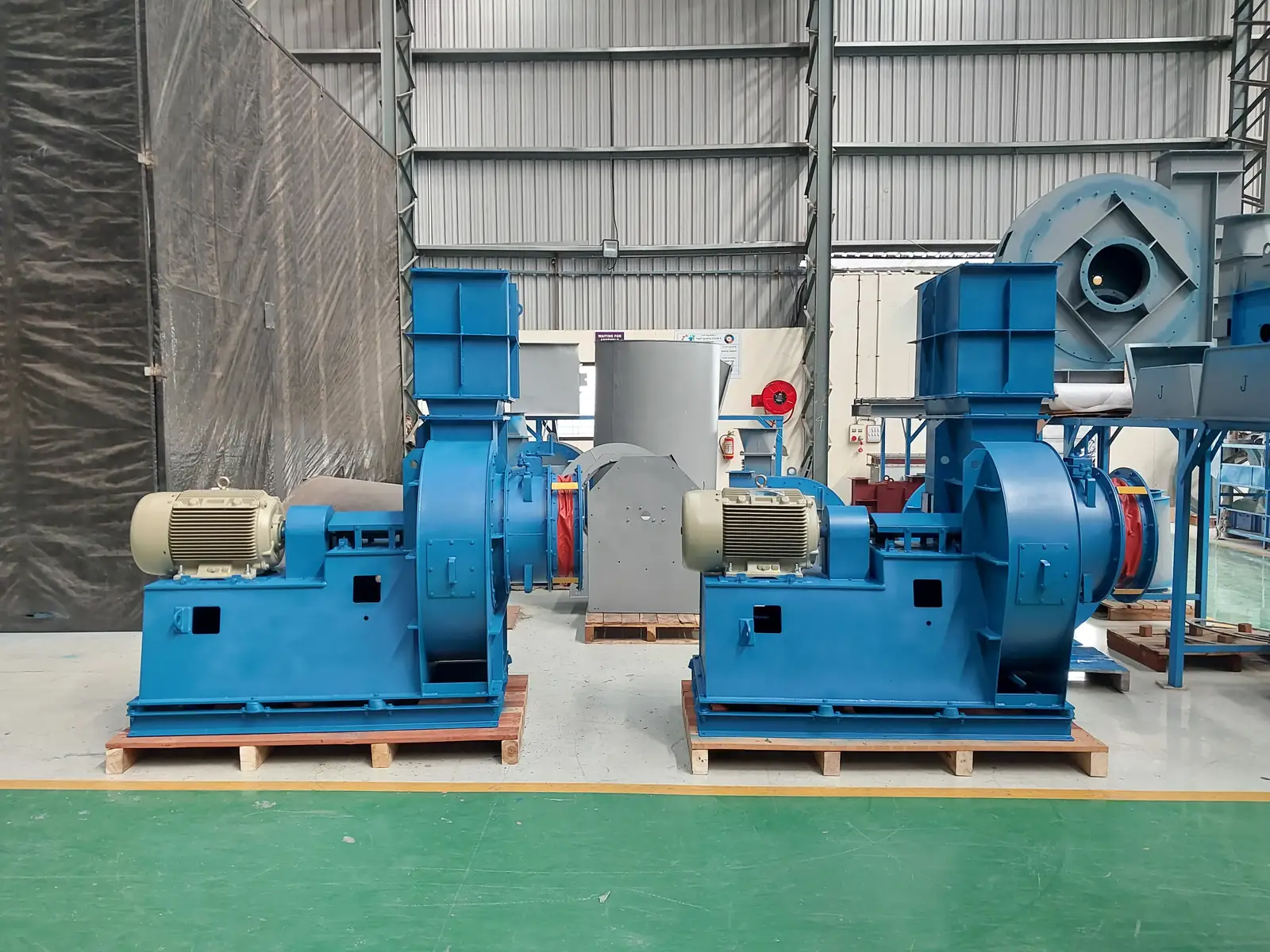
| Who | a metals & alloys plant in Punjab — the complaint was raised and pursued through the process-systems contractor who had integrated the blower into their package |
| Equipment | a 75 HP (~55 kW) high-pressure centrifugal blower, rated 11,400 CMH @ 1,110 mmWC, installed in the plant's process air system |
| Complaint | "blower performance issue" — the blower judged to be under-delivering against the process requirement. No bearing, vibration or noise failure reported: a pure output-shortfall claim |
| Service | On-site performance verification against the machine's own curve and works test report, plus a root-cause direction and a written technical position |
| Response | Complaint registered, service engineer deputed to site, field readings taken at two operating points within days |
| Result | The blower was proven on-curve on site, throttled and at full open, against its performance curve and test report. We issued a written finding of no fan defect and directed the investigation to the installed system resistance (ducting, damper, filter). The record does not confirm what that system-side investigation found, or a customer sign-off |
A metals and alloys plant in Punjab was running a high-pressure centrifugal blower on its process air system — 11,400 CMH against 1,110 mmWC, driven by a 75 HP motor. Well over a metre of water gauge: a genuinely high-pressure duty, with the fan doing real work at every point on its curve. The blower had not been bought direct; it sat inside a package assembled by a process-systems contractor, so three parties were tied to the same complaint — the plant, the contractor, and us.
Duties like this are unforgiving of the system around them. At 1,110 mmWC, small changes in installed resistance — a damper left where a commissioning engineer last put it, a loaded filter, a duct run re-routed on site — move the operating point far more than most people expect. That is what makes an "underperformance" complaint on a high-pressure blower so easy to mis-diagnose.
The report from site was blunt: the blower was not delivering the required performance. Nothing was broken — no bearing noise, no vibration alarm, no overheating. The machine ran. It simply was not giving the process what the process wanted.
The obvious suspect, the one everyone reaches for first, is the fan. A machine that "feels weak" invites the assumption that it was built weak: wrong impeller, wrong selection, something short in the works. And with the complaint arriving through a contractor with its own client to answer to, the pressure to concede a fan fault and rebuild the machine was real. The obvious suspect was wrong — but saying so is worthless without evidence. So we went and got the evidence.
The method was to prove the machine against its own published characteristic before taking any position, commercial or technical. Our service engineer was deputed to site and took direct measurements — with photographs — at two deliberately chosen operating points:
Read the two together and the picture closes. The fan traded pressure for flow exactly as a centrifugal machine should: throttled, it made its rated pressure; opened up, it pushed more air at lower pressure and drew more power. That is a machine sitting on its own curve. Ruled out, in order: mechanical failure (nothing reported, nothing found), an aerodynamic shortfall (rated pressure achieved), an electrical shortfall (current consistent with the test report at both points). Nothing was left inside the fan — which leaves only one place for the shortfall to live.
A 5-Why that lands on a generic, reusable cause: Why is process output low? → The blower is not operating where the process needs it to. → Why not? → The fan is proven on-curve on site, so the machine is not the constraint. → Why then is the point wrong? → The installed system's resistance curve is steeper or higher than the resistance the fan was selected against. → Why? → The as-built ducting, damper setting or filter loading does not match the resistance assumed at selection. → Root cause (inferred from the site data): system resistance mismatch — the fan is being forced to an operating point by the system, not failing to reach one.**
The corrective direction followed the evidence. No part was changed and no rework was done — none was warranted, and modifying a machine already on its curve only makes a good fan worse. Instead we set the finding out in writing: the blower performs to specification, and the investigation belongs on the system side — ducting, damper position, filter condition, and any design-versus-as-built difference in the duct run. We also asked for the spec and schematic of a comparable blower the customer ran at another site, so the two installations could be compared one-to-one and the difference isolated quickly.
The reusable lesson: before you condemn a blower that "feels weak", prove it against its own curve and test report on site — pressure, flow and current, at the operating point and at full open. If the machine is on its curve, the fault is in the system resistance, and your job changes from rebuilding a good machine to helping the plant find the real restriction.
A fan cannot deliver an operating point the system will not allow. When a high-pressure blower is accused of being weak, the fastest route to the truth is not an argument — it is a set of readings taken against the machine's own curve. Prove the fan, then go and find the restriction. That order saves weeks, and it saves good machines from being rebuilt for a fault they never had.
We service fans of any make. If a blower on your plant is being blamed for a shortfall it may not be causing, ask us for an on-site performance verification — measured numbers against a curve, and a written finding either way.
— Jitamitra Electro Engineering · Technical Services
Engineered for Every Application.
Prove it against its own curve before anyone takes a position. On this 75 HP high-pressure blower our engineer measured two operating points on site: 1,110 mmWC throttled, and 13,880 CMH at full open. Pressure at rating, flow and current consistent with the works test report. That is a machine sitting on its own curve.
That the fault has moved off the fan and onto the system. A fan cannot deliver an operating point the system will not allow. Once mechanical, aerodynamic and electrical shortfalls are ruled out, the installed resistance curve — ducting, damper position, filter loading — is steeper or higher than the resistance the fan was selected against.
Pressure, flow and current, at the operating point and at full open, photographed against the machine's own test certificate. Read together the two points close the picture: throttled, the fan should make its rated pressure; opened up, it should push more air at lower pressure and draw more power. That is a centrifugal machine behaving exactly as it should.
At 1,110 mmWC, yes. High-pressure duties are unforgiving of the system around them — a damper left where a commissioning engineer last put it, a loaded filter, a duct run re-routed on site — these move the operating point far more than most people expect. That is what makes an underperformance complaint on a high-pressure blower so easy to mis-diagnose.
No. On this job no part was changed and no rework was done — none was warranted, and modifying a machine already on its curve only makes a good fan worse. What we delivered was a measurement-backed technical position, a written finding of no fan defect, and a specific direction for the system-side investigation.
We cannot claim that. The record captures our diagnosis and our corrective direction; it does not capture what the system-side investigation subsequently found, nor a confirmation that the process reached target, nor a customer sign-off. We are not going to write an ending we did not witness.
Flow, static, gas temperature, application — or attach a spec, GA drawing or a multi-fan schedule. Engineer to engineer.
ISO 9001:2015 quality system · performance-tested to IS 4894 / ISO 5801 / AMCA 210 method · witnessed FAT on request.
*For our standard range. ATEX and special projects need 5 to 7 working days.
This site sets no cookies of its own. Google Analytics loads only if you accept. It sets two cookies, so we can see which fan topics people actually read. Decline and no analytics loads — the site works exactly the same. What we collect →