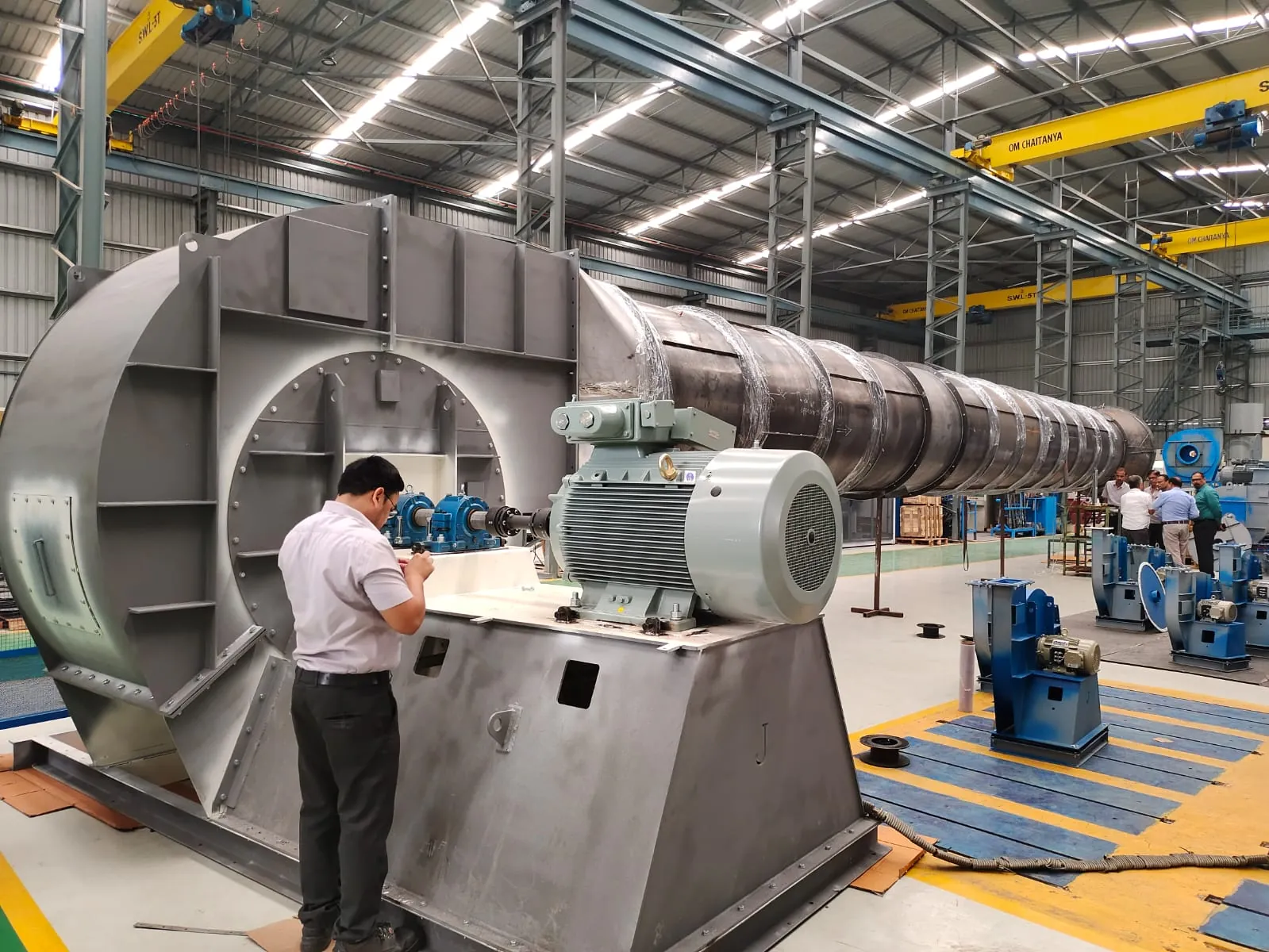
Picture the pressure: a hot-air-systems builder has just installed a brand-new, 500 °C-duty centrifugal fan at its own customer's plant — a remote site, far from anywhere — and the whole new drying line is waiting on it. The fan had run barely ten or twelve hours into commissioning. This is exactly the moment a builder cannot afford trouble, because the trouble happens in front of their customer. We'll call the builder the Integrator.
A bearing let go. One of the fan's plummer blocks (bearing housings) was reported damaged, with an abnormal noise — on a machine barely run in. The Integrator's site team had already opened the housing to look, topped up grease, and tried to nurse it along "on a different method," but the problem persisted, and the pressure was rising from their end customer. A brand-new fan with a failed bearing, on a remote site, in front of the client — that is the problem the Integrator brought to us. And because it was our fan and still new, the first fair question was: is this a manufacturing defect?
Start with the fan itself, because that is the question everyone was really asking. Against the approved design — 27,000 CMH at 85 mmWC, 40 HP, rated for a 500 °C duty — the fan checked out, and the investigation would go on to confirm it: no manufacturing defect. The fan was on-spec. So the real answer did not lie in the machine — it lay in what had happened to the high-temperature bearing arrangement during commissioning and run-in.
We began before anyone got on a plane. From the site video, our engineer could see the plummer-block casting itself wasn't broken — the loose part on screen was the bearing's oil circulation (slinger) ring, which rattles and starves the bearing if the oil isn't doing its job. That single observation moved the diagnosis away from "just replace the bearing" and toward lubrication and assembly during run-in. We advised an interim arrangement so the fan could keep running, then sent an engineer to the remote site to prove it on the machine.
On site, the picture completed itself. During commissioning the oil-cooled housing had been opened and re-assembled, and in the process the oil slinger ring — clearly present in the earlier video — was now gone, with an unsuitable grease in its place. A high-temperature bearing that loses its oil ring and gets the wrong lubricant is running dry within hours. This was a commissioning-stage event on an otherwise sound, on-spec fan — not a fault built into it.
The educational root cause (generic 5-Why): Why did the bearing fail? It ran without proper lubrication. → Why no lubrication? Its oil-cooled housing had been opened and re-assembled during site commissioning, and the oil circulation (slinger) ring that keeps the oil film moving was missing. → Why did that matter so quickly? On a 500 °C-duty bearing there is no margin — with the oil ring gone and an unsuitable grease in its place, the lubricant film simply cannot form. → Why an unsuitable grease? A "high-temperature" grease had been used that wasn't the right grease for a bearing at this duty. → Root cause: a high-temperature oil-cooled bearing arrangement disturbed during commissioning / run-in — missing oil ring plus the wrong lubricant. The fan was proven on-spec; this was a lifecycle event at commissioning, not a manufacturing or design defect.**
The fix that actually cures it isn't "another bearing." We rebuilt both bearing housings with new bearings and a correct grease-lubricated arrangement, using the specified high-temperature bearing grease, and ran the fan back into operation. For the long term at 500 °C, we set out the original-design route — Jitamitra Electro Engineering · Technical Services — so the machine runs cool and clean for years, not just past the crisis.
The reusable lesson (commissioning discipline): On a high-temperature fan, the bearing arrangement is set at the works — commissioning is where you confirm alignment and lubrication, not re-open it. Don't disturb the oil-cooled housing during run-in; keep the oil slinger ring and oil level as the manual specifies; and use the exact bearing grease that was specified — a "high-temperature" grease is not automatically the right bearing grease. On a 500 °C duty there is no lubrication margin to spare, so a clean, disciplined run-in is the whole game.
Honest note: this case is reported on what was verified — a fan proven on-spec, an on-site rebuild, a running fan, and a signed closure. We publish only the vibration and temperature figures we recorded, and the turnaround the remote site actually allowed.
A new fan that loses a bearing in its first hours is usually telling you about commissioning and lubrication, not casting a verdict on the fan — and on a 500 °C machine, the oil slinger ring and the right grease are not details, they're the whole game. The value isn't only replacing a part on a hard-to-reach site; it's proving the fan is sound, pinpointing the real cause, and closing it so the next start-up is clean.
Bearing trouble on a new high-temperature fan during commissioning? Send us the details and site photos — we'll triage remotely, then attend site with the correct spares and a written corrective action, wherever the site is.
— Jitamitra Electro Engineering · Technical Services
Engineered for Every Application.
Usually not, and it was not here. Against the approved design — 27,000 CMH at 85 mmWC, 40 HP, rated for a 500 °C duty — the fan checked out with no manufacturing defect. A new fan that loses a bearing in its first hours is usually telling you about commissioning and lubrication, not casting a verdict on the fan.
On a 500 °C duty, yes. Here the oil-cooled housing was opened and re-assembled during commissioning, and the oil circulation (slinger) ring — clearly present in the earlier video — was gone, with an unsuitable grease in its place. A high-temperature bearing that loses its oil ring and gets the wrong lubricant is running dry within hours.
Not automatically. A high-temperature grease is not automatically the right bearing grease for a bearing at this duty. On a 500 °C duty there is no lubrication margin to spare: use the exact grease that was specified, keep the oil slinger ring and oil level as the manual specifies, and do not re-open the oil-cooled housing during run-in.
That is how this one started. From the site video our engineer could see the plummer-block casting itself was not broken — the loose part on screen was the bearing's oil circulation (slinger) ring, which rattles and starves the bearing if the oil is not doing its job. We advised an interim arrangement, then attended site to prove it on the machine.
No. Both bearing housings were rebuilt with new bearings and a correct grease-lubricated arrangement, using the specified high-temperature bearing grease, and the fan was returned to service. For long-term running at 500 °C we also set out the original-design route, so the machine runs cool and clean for years, not just past the crisis.
No. The complaint was closed satisfactorily with a signed site report, on a fan proven on-spec and running again — that is what was verified. We publish only the vibration and temperature figures we recorded, and the turnaround the remote site actually allowed.
Flow, static, gas temperature, application — or attach a spec, GA drawing or a multi-fan schedule. Engineer to engineer.
ISO 9001:2015 quality system · performance-tested to IS 4894 / ISO 5801 / AMCA 210 method · witnessed FAT on request.
*For our standard range. ATEX and special projects need 5 to 7 working days.
This site sets no cookies of its own. Google Analytics loads only if you accept. It sets two cookies, so we can see which fan topics people actually read. Decline and no analytics loads — the site works exactly the same. What we collect →