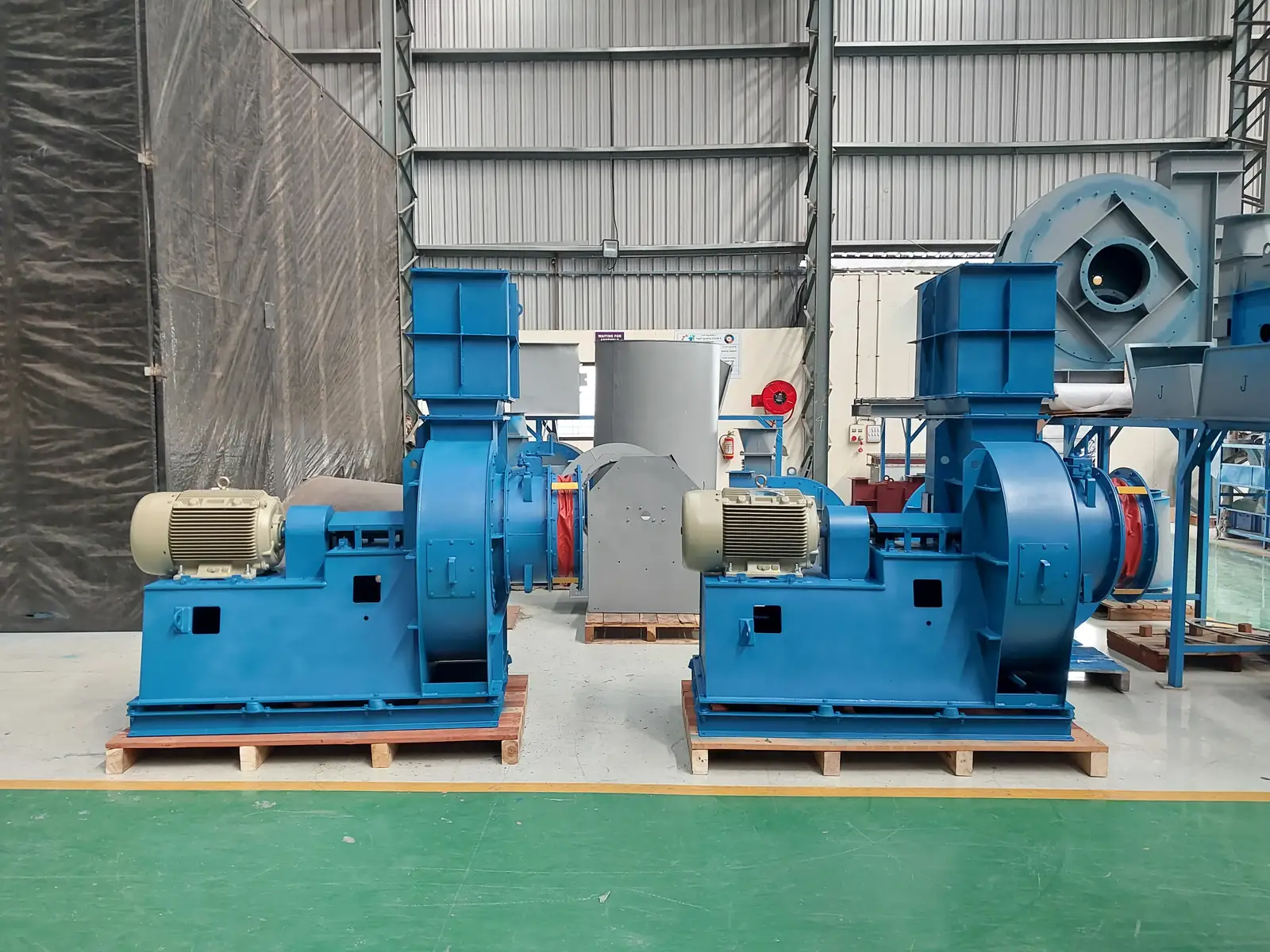
| Who | A pollution-control equipment OEM in Karnataka, buying ID fans for a dust-extraction package |
| Equipment | ID fan (centrifugal blower) — 35,000 CMH / 400 mmWC / 75 HP / 50 °C |
| Complaint | Fabric outlet flexible (bellows) found torn at receiving inspection, before installation. Reported as transit damage |
| Service | Photo-based receiving-inspection RCA; part and mechanism identified; replacement bellows offered and the damaged one recalled to works for examination |
| Response | Acknowledged the same afternoon; engineering assessment of the site photographs returned the same day |
| Result | Mechanism identified: the fabric was not a road-shock casualty but tore when a handling party stripped the outlet retaining strap to reduce the fan's shipping height. Corrective action delivered (replacement offered, damaged part recalled). Closure and customer acceptance are not confirmed in our record |
A pollution-control equipment OEM in Karnataka builds dust-collection and industrial-ventilation packages. We supplied a centrifugal ID fan rated 35,000 CMH at 400 mmWC, 75 HP, 50 °C — a large, tall, floor-mounted machine — with a sister fan for a second project riding in the same consignment.
The stakes were schedule, not physics. Nothing had run yet: the fan stood on the receiving bay with the packing off, not installed, let alone commissioned. But a fan that fails its own receiving inspection stalls a package already sold on to their customer — and a reported transit failure is also a commercial fork. Someone is about to pay for a new part.
The site reported one thing, narrowly and precisely: the outlet flexible connector — the fabric bellows — was damaged, and it had happened "in transit." Six photographs came with it. Nothing else was called out: no impeller damage, no casing dents, no motor complaint. The sister fan in the same consignment was untouched.
That last detail is what makes the obvious suspect wrong.
The two easy verdicts on a torn bellows are a works defect — bad fabric, weak seam, slack clamp — or road shock, the "rough highway" reading that "transit damage" always implies. Both are contradicted by the same photographs. A workmanship fault does not pick one fan out of two built in the same shop and shipped in the same lorry. And road shock does not tear fabric while leaving paint, guards and lashing points unmarked. Bellows do not fail from vibration. They fail from being unrestrained. Something had removed the restraint.
We worked by elimination, in order, on the only evidence that existed: six photographs and a consignment of two.
Ruled out first — a works escape. The images showed no parted seam and no slipped clamp; the bellows was correctly assembled.
Ruled out second — road shock. Impact leaves a trail: scuffs, bent guards, witness marks at the lashing points. The photographs showed a clean machine with one torn soft component. Damage that specific is not kinetic. It is procedural.
What was left. The fan ships with a yellow flexible retaining strap ("patti") across the outlet — the restraint holding the fabric bellows and outlet stub in position while the machine is moved. In the site images, that strap was gone. Our manufacturing engineer read the photographs as showing the strap had been removed by a handling party to drop the outlet and reduce the blower's overall height — almost certainly to clear a route or a gate — leaving the fabric unsupported, and torn in the process.
Why was the fan rejected at receipt? The fabric outlet bellows was torn. Why was the fabric torn? It was left unsupported and mishandled. Why was it unsupported? Its transit retaining strap had been removed. Why was the strap removed? To lower the outlet and cut the machine's shipping height. Why was the height cut that way? Because the shipping height exceeded the clearance on the route, and no approved method of reducing it had been supplied — so the handler improvised on the only part that would move.
The reusable lesson: when a component is a transit restraint and a service part at the same time, it must be labelled for both roles. If your despatch documents do not state the shipping height and the approved way to reduce it, someone on the road will invent one — and they will invent it on the softest thing they can reach.
What we did. Acknowledged the same afternoon, took the photographs into engineering that day, and offered a replacement outlet bellows with the damaged one recalled to our works — because a photo-based finding, however consistent, is not a proven one until the torn part is in your hands.
Honestly stated, because the record only supports so much:
The transferable lesson is not about fabric. It is the gap between how a machine is designed to stand and how it is actually moved. A large ID fan is dimensioned for its duty and its foundation; nobody at the drawing board is thinking about a low gate on a state highway. The people who are thinking about it have a spanner in their hand, and will solve their clearance problem with whatever loosens first.
So: publish the shipping envelope. Tag the restraints. Protect the soft parts. And when a fan arrives damaged, resist the two lazy verdicts — "bad build" and "bad roads" — and ask which part should have been holding it.
We service centrifugal and axial fans of any make: receiving-inspection disputes, vibration and balancing to ISO 21940, bearing and shaft failures, performance shortfalls, post-transit damage assessment. Send us the photographs and the duty, and we will tell you what we actually see.
— Jitamitra Electro Engineering · Technical Services
Engineered for Every Application.
Look at what is not damaged. Road shock does not tear fabric while leaving paint, guards and lashing points unmarked, and a workmanship fault does not pick one fan out of two built in the same shop and shipped in the same lorry. Bellows do not fail from vibration. They fail from being unrestrained.
A handling party solving a clearance problem. The fan ships with a yellow flexible retaining strap — a patti — across the outlet, holding the fabric bellows and outlet stub in position while the machine is moved. In the site images that strap was gone: removed to drop the outlet and reduce the blower's overall height, leaving the fabric unsupported.
Publish the shipping envelope and tag the restraints. The standing preventive action here was a DO NOT REMOVE — transit restraint tag on the outlet strap, shipping height and any approved height-reduction method printed on the despatch note, hard protection over the fabric bellows for road transit, and a receiving-inspection note so damage is caught before unloading.
Not on its own. We offered a replacement outlet bellows with the damaged one recalled to our works, because a photo-based finding, however consistent, is not a proven one until the torn part is in your hands. Physical examination of the returned bellows remained outstanding — until that is done, the root cause is well-supported, not confirmed.
There is no documented closure. Our file does not evidence that the replacement was fitted, that the fan was commissioned, or that the customer signed the complaint off. The last recorded state is our corrective-action offer, and we are not going to dress that up as an ending it does not contain.
Yes. We service centrifugal and axial fans of any make: receiving-inspection disputes, vibration and balancing to ISO 21940, bearing and shaft failures, performance shortfalls, post-transit damage assessment. Send us the photographs and the duty, and we will tell you what we actually see.
Flow, static, gas temperature, application — or attach a spec, GA drawing or a multi-fan schedule. Engineer to engineer.
ISO 9001:2015 quality system · performance-tested to IS 4894 / ISO 5801 / AMCA 210 method · witnessed FAT on request.
*For our standard range. ATEX and special projects need 5 to 7 working days.
This site sets no cookies of its own. Google Analytics loads only if you accept. It sets two cookies, so we can see which fan topics people actually read. Decline and no analytics loads — the site works exactly the same. What we collect →