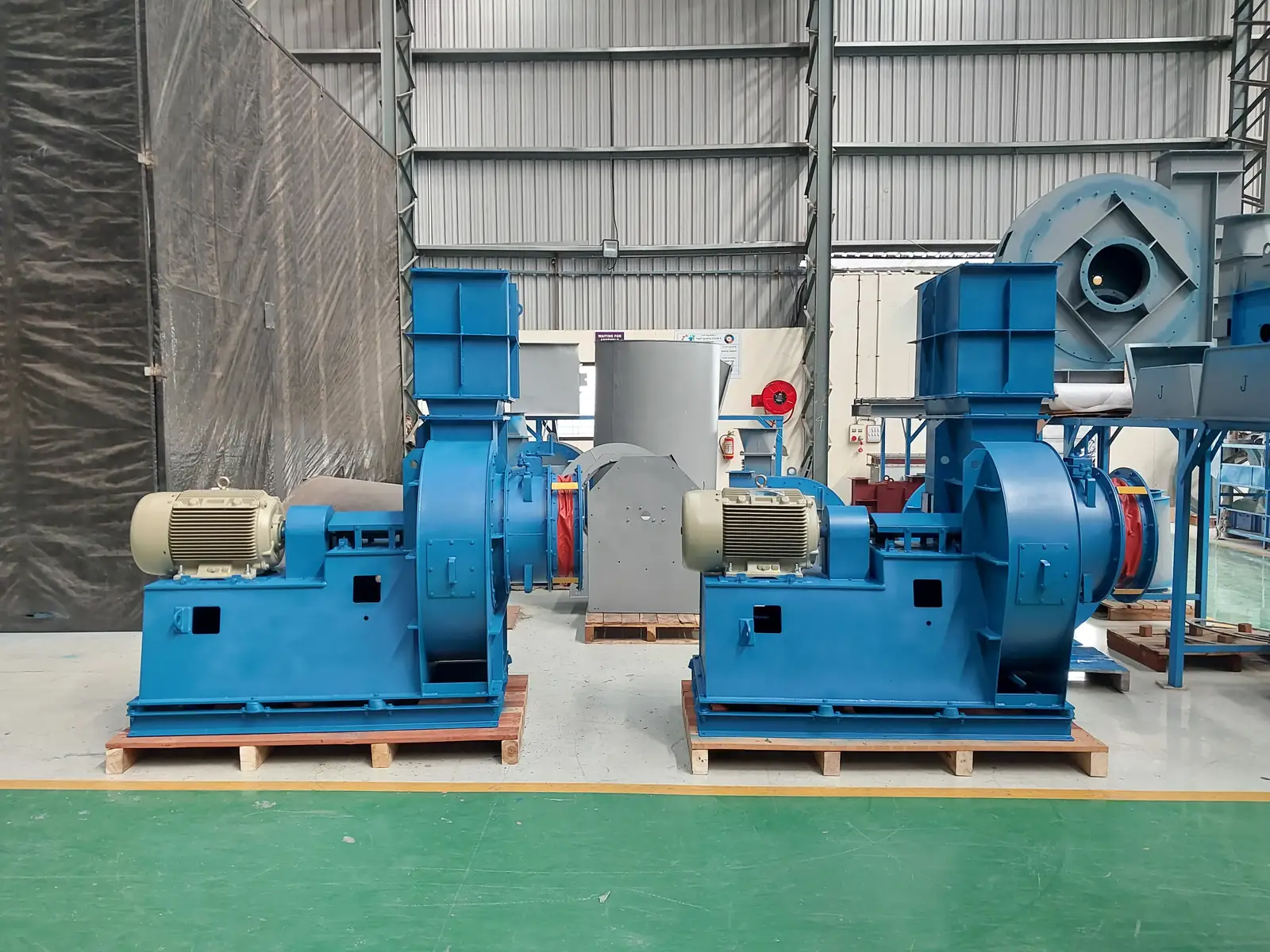
An industrial systems integrator built a ventilation/dust-handling package around two centrifugal blowers we supplied, and installed them at their end customer — a heavy-engineering manufacturing plant. The reader will recognise the position: it is a running install at your own prestigious client, where a noise-and-vibration complaint is visible (and audible) on the shop floor, and the pressure to explain it lands on you — the integrator — first. The fans are belt-driven, ~25 HP, running near 1,470 RPM on the plant's steel-and-foundation structure.
Once commissioned, the end user reported the blowers as noisy and vibrating, and pressed — repeatedly — for it to be sorted. The natural first suspicion, as always, was the fan: was it built or balanced wrong? That is the reusable frustration in this trade — a fan that behaves on the works test bed can be reported as shaking once it is bolted onto a real structure in the field. The only way to settle it is to measure it running, in place, rather than argue from the test certificate.
The disciplined move is to separate the fan from the installation before touching anything.
We measured it running. On site, at operating speed, we took overall-velocity readings (vertical, horizontal and axial) at every bearing — both fan pedestal bearings and both motor bearings, on both machines — and compared them against ISO 14694 Table 5, the in-situ vibration limits written specifically for fans. That standard, not a generic rule of thumb, is the yardstick.
We proved where the vibration was — and wasn't. The fan bearings themselves were already low (around 3–4 mm/s) and comfortably within limit — so the rotors were not the problem. On one of the two fans, a single elevated channel showed up at the motor drive end (~10 mm/s). The other fan was within limit everywhere and needed nothing.
We fixed what needed fixing — in place. We trim-balanced the affected fan at running speed — no rotor removal, no dispatch back to works — and brought that worst point down to about 5.5 mm/s; the motor's other end came down in step. We also re-greased bearings. Measured again against ISO 14694, everything sat within the in-situ limit.
The reusable lesson (the preventive takeaway): a fan that "shook in the field but passed at works" is best answered with a running-speed measurement at the actual foundation, judged against a fan standard — before anyone opens up a rotor or blames the machine. And if you suspect the structure, remember that trim-balancing a fan will not cure a foundation that is too flexible.
(No 200 HP VFD test-rig line is used here — the factory acceptance was the standard IS 4894 works test, and the field work was an on-site vibration survey, not a rig run.)
Overall velocity (mm/s), operating speed ~1,470 RPM — measured on site. These are overall readings per bearing, not a spectral analysis.
| As-found | As-left | |
|---|---|---|
| Fan (pedestal) bearings | ~3–4 mm/s — already within limit | within limit (unchanged) |
| Worst point — motor drive end | ~10 mm/s | ~5.5 mm/s |
| Second fan (both machines measured) | within limit throughout | no balancing required |
| ISO 14694 in-situ status | within limit | within limit (confirmed) |
| > Honest note: the value here was confirming compliance and trimming the one high point — the fan bearings were low to begin with, so this is a within-limits vindication, not an 80 % reduction story. |
Quote: withheld — consent is not signed. (The integrator did thank us for the prompt support.)
For comparable plants: a fan reported as noisy or shaking once installed is not automatically a bad fan. Measure every bearing at running speed against a fan standard (ISO 14694); if the fan's own bearings are within limit, the vibration is usually coming from the installation or the structure — and a running-speed survey tells you which, before you open anything up.
Running an any-make fan with a noise or vibration complaint and not sure whether it's the fan or the foundation? Book an on-site vibration survey — we measure it running, judge it against the standard, and balance in place if it needs it, usually without pulling a rotor.
— Jitamitra Electro Engineering · Technical Services
Engineered for Every Application.
Not automatically. A fan that behaves on the works test bed can be reported as shaking once it is bolted onto a real structure in the field. The only way to settle it is to measure it running, in place, rather than argue from the test certificate — at running speed, at every bearing, against a fan standard.
ISO 14694 Table 5 — the in-situ vibration limits written specifically for fans. That standard, not a generic rule of thumb, is the yardstick. On this call we took overall-velocity readings, vertical, horizontal and axial, at every bearing: both fan pedestal bearings and both motor bearings, on both machines, then judged them against it.
Usually the installation or the structure. Here the fan bearings were already low, around 3–4 mm/s, and comfortably within limit — so the rotors were not the problem. One elevated channel showed up at the motor drive end, about 10 mm/s, on one of the two fans. The other fan was within limit everywhere and needed nothing.
On this job, yes. We trim-balanced the affected fan at running speed — no rotor removal, no dispatch back to works — and brought that worst point down from about 10 to about 5.5 mm/s, with the motor's other end coming down in step. But remember: trim-balancing a fan will not cure a foundation that is too flexible.
Be careful what you expect. The honest note on this job is that the value was confirming compliance and trimming the one high point — the fan bearings were low to begin with, so this is a within-limits vindication, not an 80 % reduction story. These were overall readings per bearing, not a spectral analysis.
No published quote — consent is not signed, so it is withheld. What the record does hold: the complaint was closed satisfactorily in a single follow-up visit with a signed site record, and the integrator thanked us for the prompt support. Root cause was placed on the installed system, explicitly not on manufacturing or design.
Flow, static, gas temperature, application — or attach a spec, GA drawing or a multi-fan schedule. Engineer to engineer.
ISO 9001:2015 quality system · performance-tested to IS 4894 / ISO 5801 / AMCA 210 method · witnessed FAT on request.
*For our standard range. ATEX and special projects need 5 to 7 working days.
This site sets no cookies of its own. Google Analytics loads only if you accept. It sets two cookies, so we can see which fan topics people actually read. Decline and no analytics loads — the site works exactly the same. What we collect →