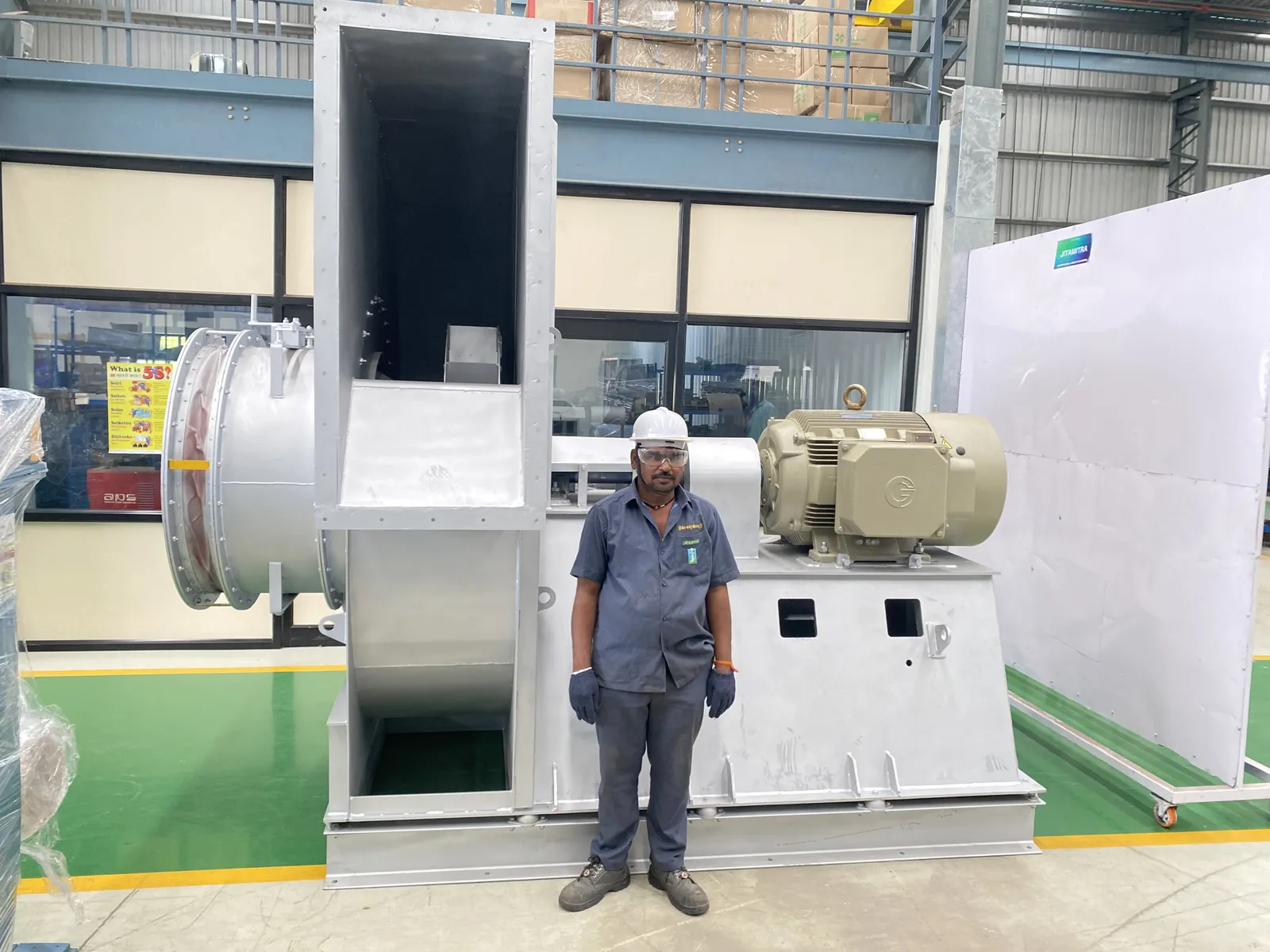
Our customer is an industrial oven and thermal-systems OEM in western India. They had built a large industrial curing oven for their own end-customer — a high-security research facility in southern India — using a bank of 16 belt-driven centrifugal air-circulation blowers we supplied, plus two exhaust fans, each moving 8,500 CMH at 150 mmWC in 200 °C service. Two things made this a hard call to answer: the end-user needed to start the oven urgently, and the site is a restricted facility where no cameras or mobile phones are allowed — so there was no way to diagnose the fault remotely from photos or video. Someone had to go, with the right method and the right spares in hand.
Four of the blowers were reported with abnormal "bearing noise." Because the site was camera-restricted, the customer could not send us the video or photographs we would normally use to triage — they told us plainly: depute an engineer to physically check and resolve it, and it is urgent. On a belt-driven fan, "bearing noise" is a reasonable first guess, but it is not always the bearing — and swapping four sets of bearings on a hunch, at a site you can only reach with pre-cleared entry passes, is exactly the wrong way to work. We needed the actual cause, found once, on one trip.
First, we closed out the most serious question with data: each fan had passed its pre-dispatch works test to the IS 4894 method before it ever left our works — noise and vibration were good at dispatch — so a manufacturing fault at source was ruled out on evidence, not assertion. Then we deputed a service technician to the facility with entry passes, carried spare bearings in case any were genuinely bad, and — because remote tools were impossible — did it the disciplined way on site: a full vibration survey of all sixteen blowers and both exhaust fans (motor and blower, drive-end and non-drive-end, in mm/s), not just the four that were flagged.
The educational root cause (generic 5-Why): Why the noise? A rough-running belt drive. → Why rough? The belt was slack / mis-tensioned. → Why slack? The belt-tension bolts had worked loose. → Why loose? Fasteners relaxed after transport and the first hot run-in, and had not been re-torqued at commissioning. → Root cause: loose belt-tension hardware after installation — an installation/commissioning matter, not a manufacturing defect. Of the four fans, only one had a bearing that genuinely needed changing; the rest simply needed the belt tension restored.
The fix followed the finding, not the guess: re-tension and tighten the belt-tension bolts on the affected fans, replace the single worn bearing (with its adapter sleeve), then prove it — a repeat vibration survey and a 2-hour endurance run at operating condition, oven door open and closed. We also fed the lesson back into our own engineering: a design change to the plug-fan motor mounting plate to keep post-installation vibration low on future units, and installation recommendations to the customer (flexible bellows on the exhaust-fan inlet and outlet; close the open gap around the circulation-fan outlet) to raise performance, lower motor current and extend fan life.
The reusable lesson: on a belt-driven fan, "bearing noise" after a new installation is more often loose belt-tension hardware than a failed bearing. Check and re-torque the belt tension — and quantify vibration — before you condemn four sets of bearings.
A fan that "sounds like the bearing" is not always a bearing — and the fastest resolution comes from a method that finds the real cause on the first visit, even when the site won't let you diagnose from your desk.
Chasing a noisy fan — yours or any make — on a site you can't easily photograph or take offline? Ask us for a root-cause site investigation. You'll get a written cause, a vibration survey, and a verified fix — not a guess at a parts swap.
— Jitamitra Electro Engineering · Technical Services
Engineered for Every Application.
Often not. On a belt-driven fan, "bearing noise" after a new installation is more often loose belt-tension hardware than a failed bearing. On this bank of oven-circulation blowers — 8,500 CMH at 150 mmWC in 200 °C service — four were reported noisy, and only one had a bearing that genuinely needed changing. The rest simply needed the belt tension restored.
Follow it back. The noise came from a rough-running belt drive; the belt was slack or mis-tensioned because the belt-tension bolts had worked loose; the fasteners relaxed after transport and the first hot run-in and had not been re-torqued at commissioning. Root cause: loose belt-tension hardware after installation — an installation and commissioning matter, not a manufacturing defect.
That is exactly this case. The facility is restricted, no cameras or mobile phones allowed, so there was no way to diagnose the fault remotely from photos or video. We deputed a service technician with pre-cleared entry passes and spare bearings in hand, then did it the disciplined way on site rather than swapping parts on a hunch.
All of them. The survey covered all sixteen blowers and both exhaust fans — motor and blower, drive-end and non-drive-end, in mm/s — not just the four that were flagged. Each fan had also passed its pre-dispatch works test to the IS 4894 method, so a manufacturing fault at source was ruled out on evidence, not assertion.
It was proved, not declared. After re-tensioning the belt hardware and replacing the single worn bearing with its adapter sleeve, we ran a repeat vibration survey and a 2-hour endurance run at operating condition, oven door open and closed. Worst-case vibration came down from around 7 to under 3.5 mm/s and held stable, with motor current comfortably inside the motor rating.
The customer's site authority signed the resolution report and the complaint was closed. Who they are stays private: the record identifies only an industrial oven and thermal-systems OEM in western India, and their end customer as a high-security research facility in southern India. The findings and the measurements are what stand here.
Flow, static, gas temperature, application — or attach a spec, GA drawing or a multi-fan schedule. Engineer to engineer.
ISO 9001:2015 quality system · performance-tested to IS 4894 / ISO 5801 / AMCA 210 method · witnessed FAT on request.
*For our standard range. ATEX and special projects need 5 to 7 working days.
This site sets no cookies of its own. Google Analytics loads only if you accept. It sets two cookies, so we can see which fan topics people actually read. Decline and no analytics loads — the site works exactly the same. What we collect →