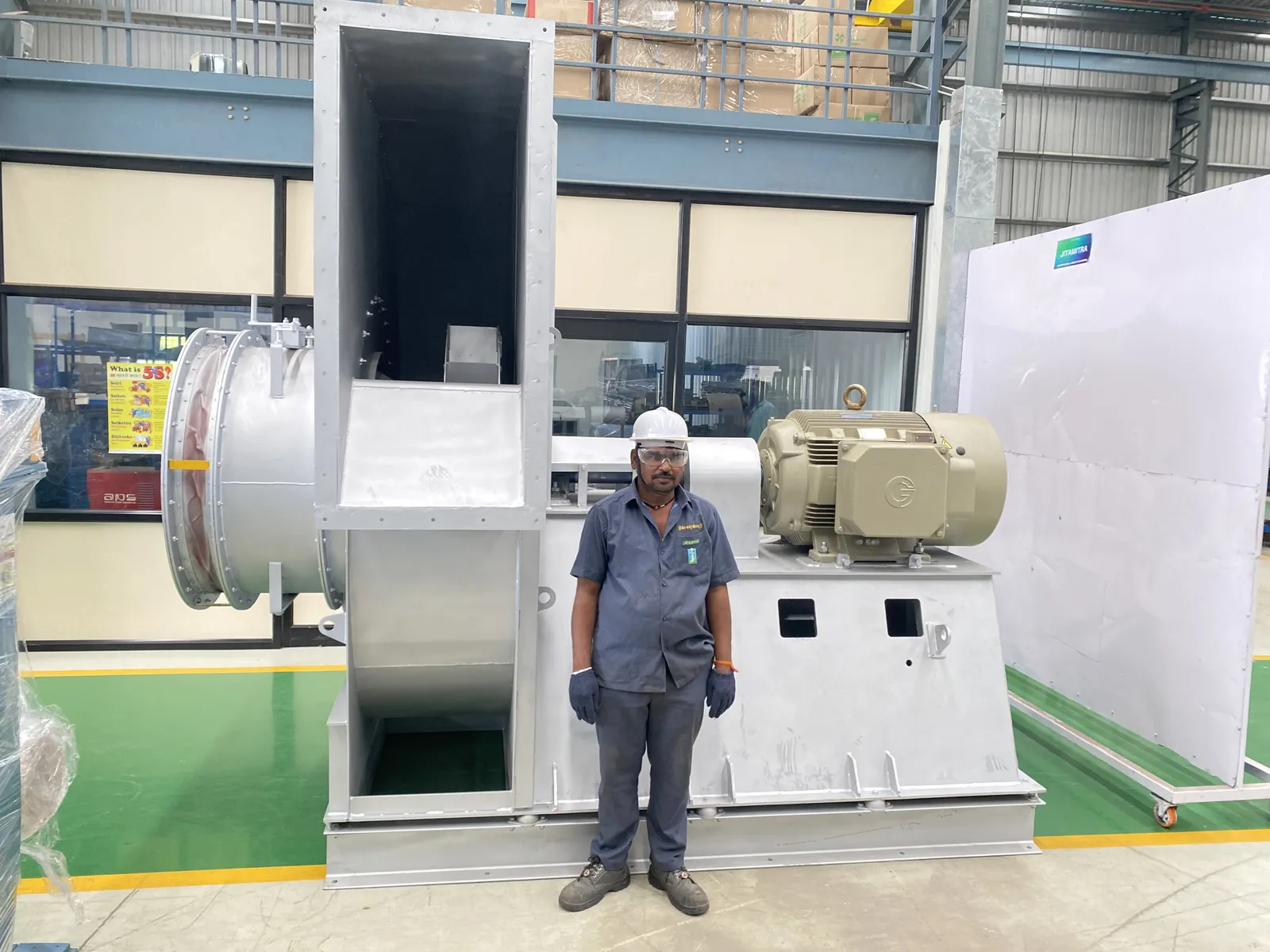
| Who | a paint-shop systems OEM in Maharashtra, serving an automotive composites plant near Pune |
| Equipment | a family of Jitamitra belt-driven centrifugal exhaust blowers — 15,000 CMH · 90 mmWC · 15 HP · 120 °C |
| Complaint | one ticket, four symptoms: blower noise, oil weeping from a plummer-block grease nipple, a slack and wearing drive belt, and rising vibration on two units |
| Service | On-site root-cause visit across the installed set — inspection-window strip, drive check, leak-path check, noise benchmarking |
| Response | Complaint logged, site visit made, corrective work done in place on the same visit; spares list raised |
| Result | Vibration traced to overspray powder caking the impeller — process fouling, not a balance or bearing defect. Belt re-tensioned, grease-nipple leak path sealed, noise identified as normal VFD/motor start-stop noise, cleaning-and-PM regime handed to the end user. No post-fix re-measurement and no signed acceptance are on record — we do not claim this one closed. |
A paint-shop systems OEM in Maharashtra had installed a set of our belt-driven centrifugal exhaust blowers into an automotive composites paint shop near Pune. The duty is a hard one and a familiar one: 15,000 CMH at 90 mmWC, 15 HP, handling 120 °C exhaust off a paint line.
The stakes on a paint shop are not subtle. Exhaust extraction holds the booth's air pattern, keeps solvent vapour below the level where it becomes a hazard, and keeps the finish clean. A noisy, leaking or shaking exhaust fan is not something the plant gets to shrug at — the booth is the bottleneck of the whole line.
The complaint arrived narrowly: "blower noise issue." By the time we were on site it had grown into four symptoms across a family of fans — noise, an oil weep at a bearing plummer-block grease nipple, a slack and wearing drive belt, and, on two units, high vibration.
Two traps sit inside that ticket. The first is the noise: the end user's real objection was that one blower sounded different from a smaller unit alongside it. That is a comparison, not a fault — and chasing it as a defect burns a visit.
The second, and the important one, is the vibration. A fan with rising vibration is very hard not to read as a bearing or a balance defect. That reflex is expensive — it points you at a balancing machine, a bearing set, or the manufacturer's rotor. On a paint-shop exhaust fan, it is usually wrong.
We worked the symptoms in order of what could be ruled out cheapest.
Noise — ruled out as a fan fault. Benchmarked against the smaller blower it was being compared to, the extra sound traced to the VFD and motor during start–stop, not the fan. Normal drive behaviour, wrongly inherited by the fan.
Belt — a drive-maintenance item. Slack, and wearing from it. Re-tensioned on the spot, and belt tension put onto the periodic checklist where it belonged in the first place.
Grease-nipple weep — a seal path, not a bearing failure. The oil was weeping at the grease nipple on the bottom-mounted plummer block, not past a bearing seal. Sealed with Teflon tape and correctly re-tightened.
Vibration — the real find. Rather than assuming imbalance, we opened the inspection window and looked at the rotor. The blades were caked: paint overspray powder had stuck and accumulated on the impeller. Powder does not deposit evenly — it builds where the flow lets it build, and an unevenly loaded rotor is, by definition, an out-of-balance rotor. The vibration was not a defect the fan arrived with. It was mass the process had added to it.
The 5-Why: Why is vibration climbing? The rotor is out of balance. → Why is it out of balance? Mass has been added to the blades. → What mass? Paint overspray powder, caked onto the impeller. → Why did it cake? The fan handles a paint-laden exhaust stream and deposits build in service. → Why was it not removed? No impeller-cleaning schedule had been handed to the end user at commissioning. → Root cause: a process-fouling duty was commissioned without a fouling-maintenance regime.
The reusable lesson: On any fan handling a loaded stream — paint, powder, resin, fume — "rising vibration" is a fouling symptom until you have proved otherwise. Open the inspection window and look at the blades before you condemn a bearing or send a rotor out for balancing. And on a fouling duty, the cleaning schedule is not an optional extra in the O&M pack — it is part of the machine.
Stated honestly — what the record supports, and what it does not.
The transferable lesson is a short one: a fan does not only wear — it also accretes. On a dirty duty the machine's mass is not a constant, and rising vibration is the process telling you it has been depositing on your rotor. Look inside before you reach for the bearing puller. A fan sold into a fouling duty without a cleaning schedule is a vibration complaint with a delay fuse on it.
We service centrifugal fans and blowers of any make — root-cause diagnosis, on-site correction, balancing, and a written maintenance regime you can actually run.
— Jitamitra Electro Engineering · Technical Services
Engineered for Every Application.
Probably neither. A fan with rising vibration is very hard not to read as a bearing or balance defect, and that reflex is expensive. On this 15,000 CMH · 90 mmWC · 15 HP · 120 °C exhaust duty, paint overspray powder had caked onto the impeller. Powder builds unevenly, and an unevenly loaded rotor is by definition out of balance.
Open the inspection window and look at the blades. On any fan handling a loaded stream — paint, powder, resin, fume — rising vibration is a fouling symptom until you have proved otherwise. Here the vibration was not a defect the fan arrived with; it was mass the process had added to it. A fan does not only wear — it also accretes.
That is a comparison, not a fault, and chasing it as a defect burns a visit. On this job the noise was benchmarked against the smaller blower it was being compared to, and the extra sound traced to the VFD and motor during start–stop — normal drive behaviour, wrongly inherited by the fan.
Check the grease nipple before you condemn the seal. On this fan the oil was weeping at the grease nipple on the bottom-mounted plummer block, not past a bearing seal — a seal path, not a bearing failure. It was sealed with Teflon tape and correctly re-tightened on the same visit, and grease-nipple sealing is now standardised at commissioning.
A cleaning schedule, treated as part of the machine rather than an optional extra in the O&M pack. What we handed over here was scheduled impeller cleaning, belt-tension checks on the periodic list, grease-nipple sealing standardised at commissioning, and PLC start/stop timing set so VFD noise is understood, not re-raised as a fan fault.
No. No post-fix vibration re-measurement was taken and no signed customer acceptance is on file, so we claim no verified close and no measured improvement. Acceptance on this class would be judged against ISO 14694 BV-3 limits — rigid: 4.5 accept / 7.1 alarm / 9.0 shutdown mm/s — with balance to ISO 21940. That measurement was not made on this visit.
Flow, static, gas temperature, application — or attach a spec, GA drawing or a multi-fan schedule. Engineer to engineer.
ISO 9001:2015 quality system · performance-tested to IS 4894 / ISO 5801 / AMCA 210 method · witnessed FAT on request.
*For our standard range. ATEX and special projects need 5 to 7 working days.
This site sets no cookies of its own. Google Analytics loads only if you accept. It sets two cookies, so we can see which fan topics people actually read. Decline and no analytics loads — the site works exactly the same. What we collect →