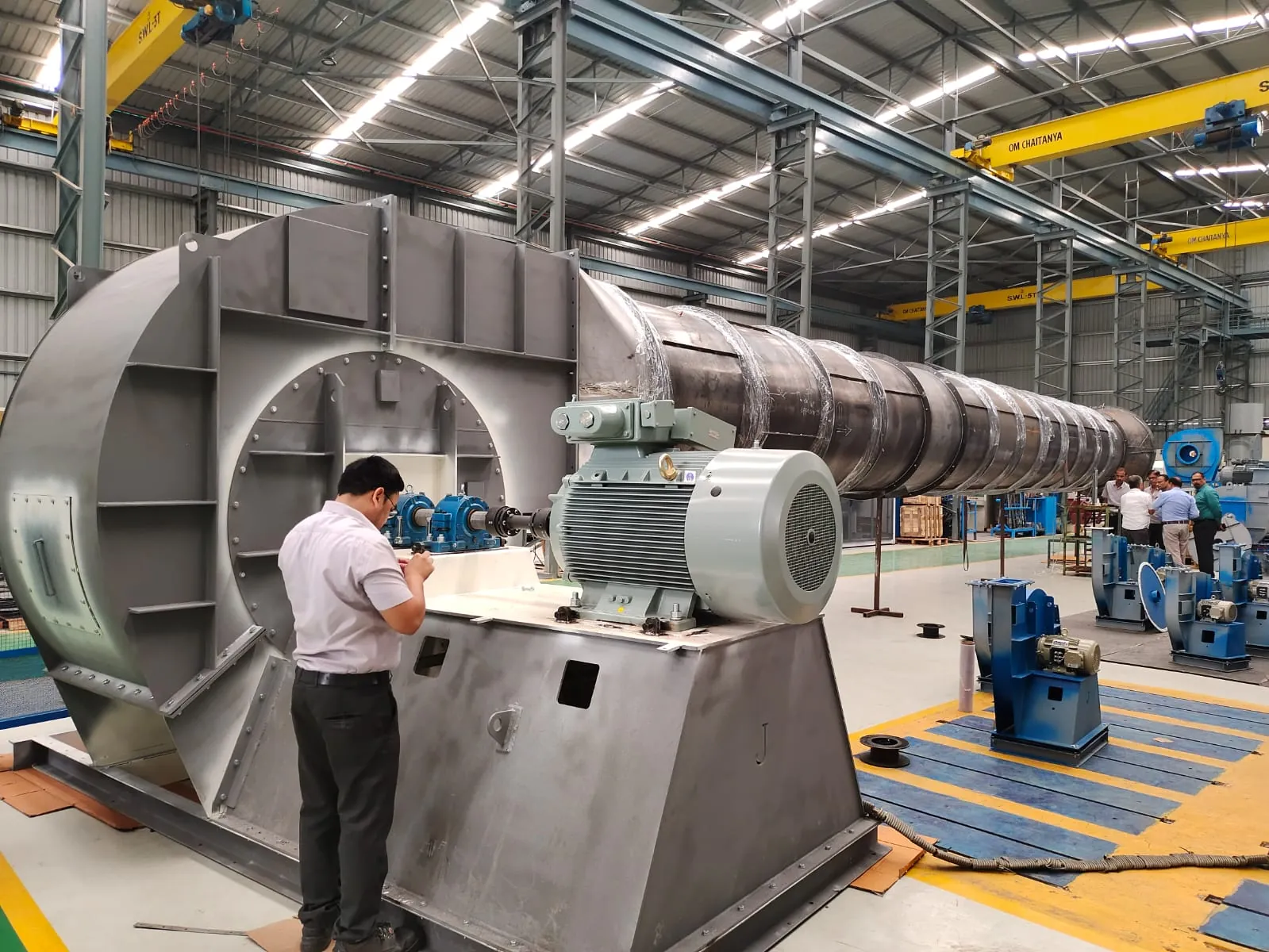
| Who | A paint-shop and pretreatment equipment OEM in Maharashtra |
| Equipment | Centrifugal blower, 30 HP — 34,000 CMH / 120 mmWC / 40 °C, on paint-shop, pretreatment and oven duty |
| Complaint | "Blower noise and vibration issue" — on the running machine at site |
| Service | Complaint registration, site evidence review, works-test data review, direct diagnosis of the mounting |
| Response | Logged and acknowledged the same working day; written corrective recommendation issued the next day |
| Result | Rotor and balance ruled out against the works vibration record (V = 2.7, H = 1.0, A = 2.0 mm/s, against an ISO 14694 BV-3 accept line of 4.5). Cause: an under-sized site support — the blower stood on a 50 mm angle. We specified a 100 mm channel support; the customer accepted it. No post-modification reading is on our record, so we claim no confirmed closure. |
The customer builds paint-shop and pretreatment equipment — coating booths, pretreatment tunnels, curing ovens. The fan was a 30 HP centrifugal blower rated 34,000 CMH at 120 mmWC, handling air up to 40 °C.
On that kind of line, airflow is not a detail; it is the process. Booth airflow governs overspray capture and film quality; pretreatment and oven airflow govern how the panel dries and cures. A blower that is unwell — or is merely believed to be unwell — puts the whole line under a question mark, and a question mark becomes a stoppage. So when the site reported the machine as noisy and shaking, it was urgent.
The complaint was specific: noise and vibration on the running blower, with photographs, a nameplate image and two short videos attached. No duty shortfall. No bearing failure. No process-air complaint. The machine was moving the air; it was simply misbehaving mechanically — or appeared to be.
The obvious suspect in any noisy, shaking fan is the rotating assembly: balance, bearings, alignment, a balance weight shifted in transit. That is where most engineers look first — and where the customer's imagination goes immediately.
But the obvious suspect had an alibi. The same machine had been dynamically tested before dispatch, and its vibration report was already in the customer's hands: V = 2.7, H = 1.0, A = 2.0 mm/s. For a rigidly-mounted fan, ISO 14694 category BV-3 puts acceptance at 4.5 mm/s, alarm at 7.1, shutdown at 9.0. Those readings do not sit near the accept line — they sit comfortably under it, on all three axes.
A machine that tests clean at works and shakes in the field is telling you that whatever changed between those two states, it is not the rotor.
We worked outward from the rotor rather than inward from the noise.
The answer was a 50 mm angle support. A 30 HP centrifugal blower is not a light dynamic load, and a light angle section under it is a low-stiffness base. A soft base need not be broken to cause trouble; it only has to flex and amplify near the running frequency. The rotor stays inside tolerance, and the structure turns a compliant machine into a noisy one.
5 Whys 1. Why noise and vibration? → The blower is vibrating on its base at site. 2. Why at site, when it tested clean at works? → The field support is not restraining the dynamic load. 3. Why not? → It sits on a light angle section, under-sized for the machine's dynamic reaction. 4. Why under-sized? → The support was executed at site with no specified minimum stiffness for the base. 5. Why did that get through? → No support/foundation stiffness spec was enforced at handover for a field-mounted heavy blower.
Our recommendation: replace the 50 mm angle with a 100 mm channel support beneath the blower, sized to carry the dynamic load and stiffen the base out of the amplifying range. No spare part was consumed. The fix was structural, and it sat on the site side of the flange.
The reusable lesson: a machine that is clean at works and shakes in the field has almost always changed its support, not its rotor. Before you condemn the fan, measure what it is standing on.
A fan is only half of a vibration system. The other half is whatever it is bolted to — and that half is usually built by someone else, on a busy site, in a hurry. If a machine left the works inside ISO 14694 BV-3 and shakes at site, the question is not "what is wrong with the fan" but "what has changed" — and the base, the frame and the duct restraints all sit ahead of the impeller on that list. Get the works test report out before you get the spanner out.
We service and diagnose industrial fans and blowers of any make, not only our own. If a machine is noisy, hot, shaking, drawing more current than it should, or simply not doing the duty it was bought for — bring it to us. We will look at the whole system, tell you what we find, and put the reasoning in writing.
— Jitamitra Electro Engineering · Technical Services
Engineered for Every Application.
The mounting, most likely. A machine that is clean at works and shakes in the field has almost always changed its support, not its rotor. A fan is only half of a vibration system; the other half is whatever it is bolted to — and that half is usually built by someone else, on a busy site, in a hurry.
Get the works test report out before you get the spanner out. On this 30 HP blower the pre-dispatch dynamic test read V = 2.7, H = 1.0, A = 2.0 mm/s. For a rigidly-mounted fan ISO 14694 category BV-3 puts acceptance at 4.5 mm/s, alarm at 7.1, shutdown at 9.0 — comfortably under, on all three axes.
Something stiff enough for the dynamic load. Here a 30 HP centrifugal blower rated 34,000 CMH at 120 mmWC stood on a 50 mm angle support. A soft base need not be broken to cause trouble; it only has to flex and amplify near the running frequency. We specified a 100 mm channel in its place.
It does. No airflow or pressure shortfall, no bearing heat, no bearing noise — and a fan fighting a duty it cannot meet usually announces itself in the ammeter first. That points you outward from the rotor, to the interface between machine and building. The question that separated the two states was simply: what is this machine standing on?
We do not know, and we will not say otherwise. The customer accepted the recommendation and undertook to strengthen the structure, but we hold no post-modification vibration reading and no written closure. The corrective action was delivered; the confirmation loop is open. We will not tell you the shaking stopped when our file does not say so.
Specify the base before the fan arrives. For field-mounted heavy blowers we now issue a minimum support-stiffness specification — channel, not light angle — with the GA package, and press for a post-installation vibration check. A works test report proves the machine, not the mounting; the base, the frame and the duct restraints all sit ahead of the impeller on that list.
Flow, static, gas temperature, application — or attach a spec, GA drawing or a multi-fan schedule. Engineer to engineer.
ISO 9001:2015 quality system · performance-tested to IS 4894 / ISO 5801 / AMCA 210 method · witnessed FAT on request.
*For our standard range. ATEX and special projects need 5 to 7 working days.
This site sets no cookies of its own. Google Analytics loads only if you accept. It sets two cookies, so we can see which fan topics people actually read. Decline and no analytics loads — the site works exactly the same. What we collect →