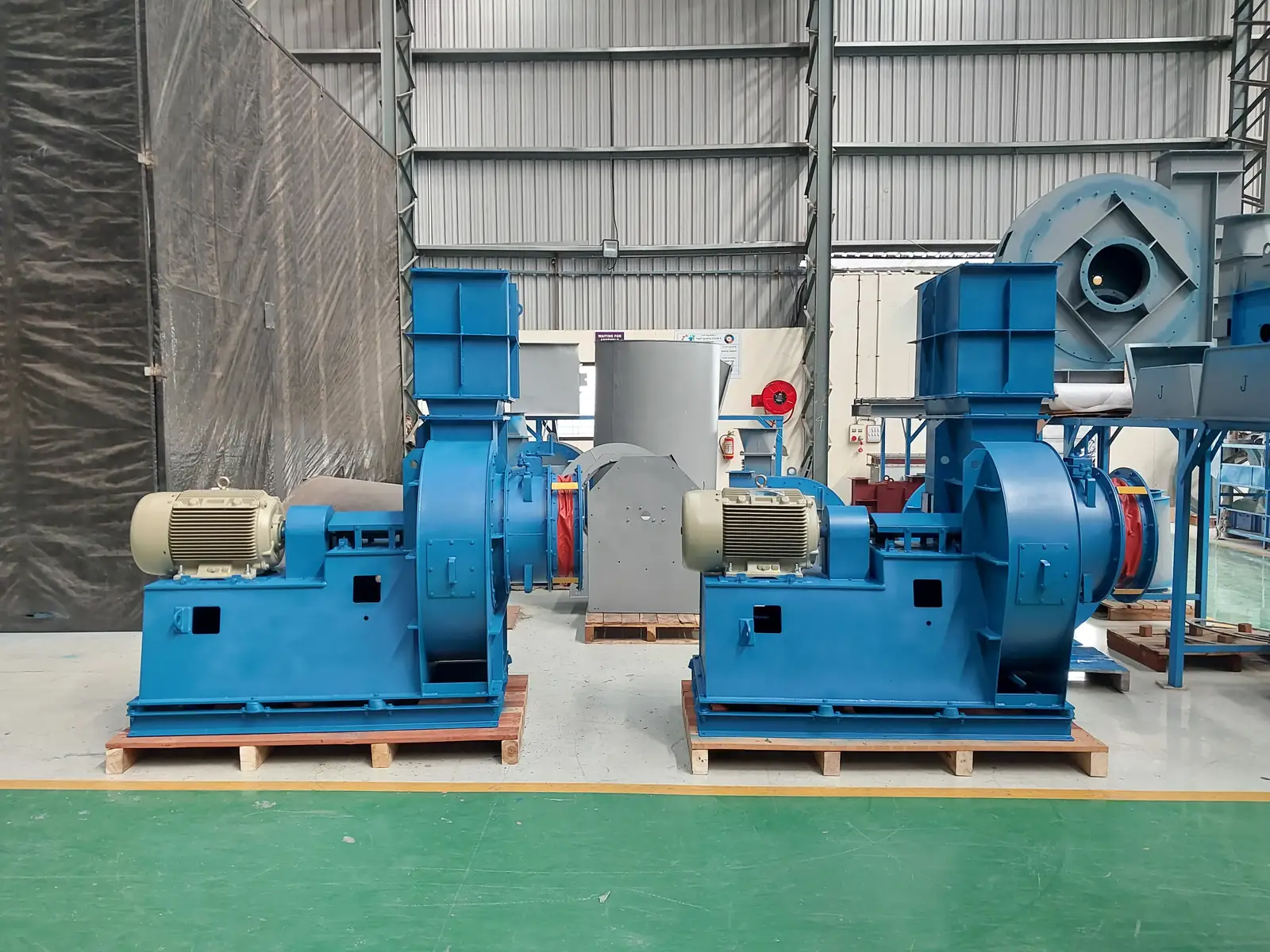
| Who | A plastics-machinery plant in Gujarat, served through an industrial equipment OEM |
| Equipment | A Jitamitra centrifugal blower, newly installed |
| Complaint | "Cone touching and vibrations" — the inlet cone rubbing the impeller, plus objectionable vibration in service |
| Service | Complaint investigation and root-cause analysis, from site photographs and the works test record |
| Response | Site advice the same working period; formal QA findings two days after the complaint was raised |
| Result | Fan proved sound at despatch (works vibration V 2.8 / H 2.4 / A 3.8 mm/s, inside the ISO 14694 rigid BV-3 acceptance limit of 4.5 mm/s). Three installation-stage faults found; corrective instructions issued to site. The record documents the diagnosis and the actions given — not a post-fix re-check, so we do not claim one. |
The fan went through an OEM partner to a plastics-machinery plant in Gujarat — a straightforward centrifugal blower on a new installation. The kind of unit nobody is supposed to think about once it is bolted down and running.
Which is why a vibration complaint on a new install carries weight out of proportion to its size. Vibration is how an installation quietly destroys itself: it walks fasteners loose, chews bearings, cracks the ductwork the fan is bolted to. And when it appears in the first weeks of life, the conclusion on the shop floor is the uncomfortable one — you sold us a bad fan. At stake was the OEM's credibility with their end customer, and ours with the OEM.
The complaint named two symptoms in one line: cone touching, and vibrations.
"Cone touching" means the inlet cone — the bellmouth feeding air into the impeller eye — was fouling the rotating shroud. A running-clearance failure: the gap between a stationary part and a spinning one had been lost.
Here is the trap. A cone rub is itself a vibration source, so the obvious path was to treat the rub as the disease: an out-of-true impeller, a fan that came out of the works wrong. That path is wrong. The rub was a symptom — something had pushed cone and impeller out of concentricity, and it had happened after the fan left our floor.
We worked it in the only order that settles an argument like this: prove or disprove the fan first, then look outward.
Step one — rule out the fan. The blower had been run and measured before despatch: V 2.8 / H 2.4 / A 3.8 mm/s. Under ISO 14694 for a rigidly-mounted fan, BV-3 accepts up to 4.5 mm/s (alarm 7.1, shutdown 9.0). Every axis sat comfortably inside acceptance. Whatever was shaking at site had been acquired after despatch.
Step two — read the site. Seven photographs came with the complaint, and they did the rest of the work. Three faults, all at the installation stage:
Cause chain: spacer left in, no foundation bolts, misalignment → running clearance lost at the cone → contact and unrestrained running forces → high vibration at site, from a fan demonstrably within tolerance at the works.
Why did the fan vibrate? The inlet cone was rubbing the impeller and the base was not restrained. Why was the cone rubbing? The assembly centreline and the fan centreline did not match. Why was the base unrestrained? No anchor bolts had been used, and a transit spacer still hard-linked the flexible flanges. Why did commissioning proceed anyway? Nothing forced foundation, alignment and clearance to be checked and signed off before the machine was energised. Root cause: the fan was commissioned without a gated pre-start check. Transport and erection artefacts were left in the machine, and nobody was required to prove otherwise before the button was pressed.
The reusable lesson: a fan is not a component you install — it is a rotating assembly you commission. Every transport restraint removed, every anchor bolt torqued, every running clearance verified, before first start, as a signed step. Anything a fan acquires between the works and the foundation will present itself as a fan defect.
Reported honestly, so it is worth something to you:
The lesson is a diagnostic discipline, not a fan fact. When a new installation vibrates, the fan is the last suspect — but only if you can prove it. That proof has to exist before the argument starts, which is why a works vibration record travelling with the machine beats any amount of debate on site. Get the certificate, then go and look at the foundation, the transit restraints and the alignment — the photographs usually give you the answer before anyone opens a casing. And if a spacer painted bright yellow can survive to first start-up, so can yours: make its removal a signed line, not a memory.
We service centrifugal fans and blowers of any make — vibration investigation, alignment and running-clearance checks, balancing to ISO 21940, and performance testing to IS 4894 / ISO 5801 / AMCA 210 method. If a fan on your plant is shaking and nobody can tell you why, we will come and find out.
— Jitamitra Electro Engineering · Technical Services
Engineered for Every Application.
Work it in the only order that settles an argument like this: prove or disprove the fan first, then look outward. On this job the works record read V 2.8 / H 2.4 / A 3.8 mm/s, inside the ISO 14694 rigid BV-3 acceptance limit of 4.5 mm/s. Whatever was shaking at site had been acquired after despatch.
Not necessarily, and that is the trap. A cone rub is itself a vibration source, so the obvious path is to treat the rub as the disease. Here it was a symptom — something had pushed cone and impeller out of concentricity, and it had happened after the fan left our floor.
Seven photographs came with the complaint and did the rest of the work. Three faults, all at the installation stage: the blower was not bolted down, anchor bolts had simply not been used; the yellow-painted C-spacer that supports the flexible flanges during transport had never been removed; and the assembly centreline and the fan centreline did not match.
Because it hard-links the fan to the very ducting it was meant to be isolated from. Combine that with an unrestrained base — which cannot absorb running forces, it amplifies them — and misalignment, and the running clearance at the cone is lost. Contact follows, and the site reads high vibration.
Our file documents the diagnosis and the instructions issued — remove the yellow C-spacer from the inlet and outlet flexible flanges, provide a properly bolted foundation, correct the alignment of the assembly to the fan centreline. It does not contain a post-fix vibration re-check or a customer closure sign-off. We will not claim an outcome we cannot evidence.
A fan is not a component you install — it is a rotating assembly you commission. Every transport restraint removed, every anchor bolt torqued, every running clearance verified, before first start, as a signed step. Anything a fan acquires between the works and the foundation will present itself as a fan defect.
Flow, static, gas temperature, application — or attach a spec, GA drawing or a multi-fan schedule. Engineer to engineer.
ISO 9001:2015 quality system · performance-tested to IS 4894 / ISO 5801 / AMCA 210 method · witnessed FAT on request.
*For our standard range. ATEX and special projects need 5 to 7 working days.
This site sets no cookies of its own. Google Analytics loads only if you accept. It sets two cookies, so we can see which fan topics people actually read. Decline and no analytics loads — the site works exactly the same. What we collect →