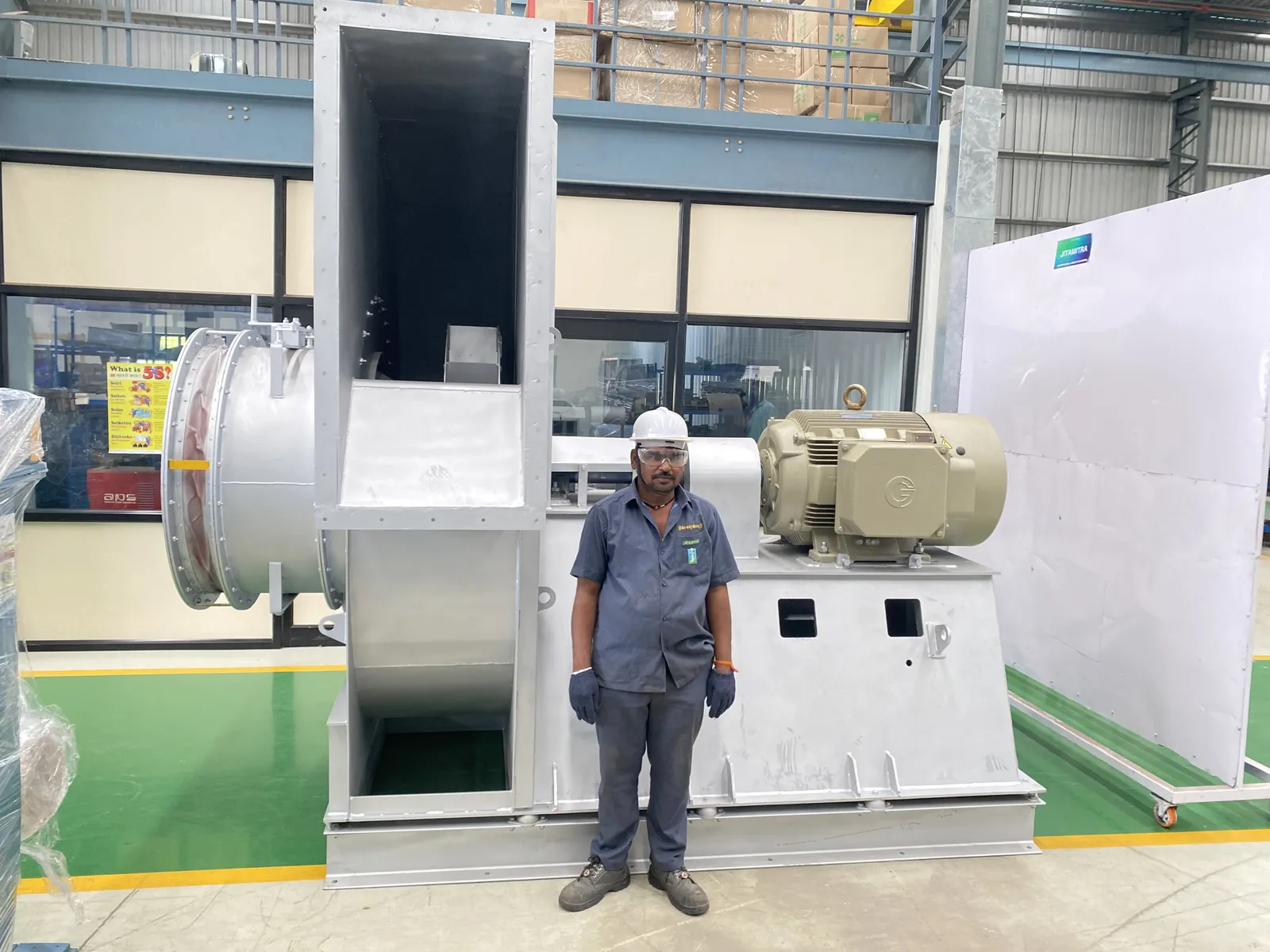
| Who | A shot-blasting equipment OEM in Karnataka; blower installed at their end-customer's surface-preparation line at a plant in Maharashtra |
| Equipment | Centrifugal blower, 6,500 CMH / 350 mmWC / 15 HP |
| Complaint | Noise and vibration at site; the OEM's commissioning certificate held by their end-customer |
| Service | Complaint-RCA — troubleshooting checklist to site, photo-based diagnosis, acceptance criterion re-based to the approved GA drawing |
| Response | Acknowledged and diagnosed the same day the complaint was raised |
| Result | Two findings delivered: the flexible-joint transit restraint links were still fitted at commissioning, and the reported sound level was inside the approved-drawing figure. Corrective instruction issued. Post-correction re-measurement is not recorded in our file — we publish what we found and what we did, not a closure we cannot evidence. |
Shot-blasting is a hard duty. The line has to move a firm, steady volume of air against real system resistance — here, 6,500 CMH at 350 mmWC on a 15 HP drive — and it has to do it inside somebody else's factory, next to people. Our customer was the equipment OEM; their customer was the plant. The blower was ours. The installation, the ductwork and the foundation were site work.
That layering is the whole story. When a fan misbehaves at a site two steps removed from the works, it is the most visible object in the room and therefore the first thing blamed. Very often it is only the messenger.
The stakes were not comfort. The end-plant was holding the OEM's commissioning certificate over the noise — so a blower already built, tested and dispatched now stood between our customer and the close of their contract.
The site's report was specific and, on its face, damning: the blower was audibly over 85 dB, where the plant expected below 75 dB "at worst case." Eleven photographs came with it. Noise plus vibration plus a held certificate is the classic signature of a fan fault — imbalance, a bearing gone, an impeller fouled or damaged in transit.
The obvious suspect was the rotating assembly, and it was wrong twice over. Nobody at site had reported a bearing failure, an impeller defect or a motor fault — noise and vibration were the symptoms, and the cause was simply being assumed. And the "<75 dB" figure the plant measured against had never been agreed with anybody: an expectation that travelled downstream, not a specification that travelled upstream.
We took the complaint the day it landed and issued our fan troubleshooting checklist to site — a structured elimination sequence rather than a guess, and the fastest containment available when the fan is a long way from the works. In parallel, we worked the photographs. The order of elimination matters:
A flexible joint exists to decouple. Leave the shipping restraints fitted and it cannot float — it becomes a rigid steel bridge from the fan into the ductwork and the building, short-circuiting the exact isolation it was installed to provide. Structure-borne vibration goes straight into the plant, and the plant gets louder. A commissioning-stage miss: nothing to do with how the blower was built or balanced.
5 Whys 1. Why is site reporting vibration and noise? Vibration is passing from the fan into the ductwork and building structure. 2. Why is it passing through? The flexible joint is not isolating. 3. Why not? Its transit restraint links are still fitted, so it cannot flex. 4. Why were they still fitted? Removing them was not a mandatory, signed-off step before energising the fan. 5. Why not? The pre-start checklist did not force a physical, photographed check of every shipping restraint before first rotation.
The reusable lesson: A fan cannot isolate through a joint that is still bolted rigid. Before you investigate the machine, prove the machine was allowed to run free — and before you accept a noise complaint, find out which number site is actually measuring against.
Stated honestly, because the record supports this much and no more:
Two cheap checks settle most "the fan is vibrating" calls before an engineer books a flight. One: walk the installation and confirm every transit restraint, bellows link and shipping bracket is off — a photograph will usually find them. Two: open the approved drawing and read what sound level was actually guaranteed. An expectation that was never agreed is not a failure; it is a communication defect, fixed at order stage, not at site.
We service centrifugal fans and blowers of any make — vibration and noise investigation, balancing to ISO 21940, performance verification tested to the IS 4894 / ISO 5801 / AMCA 210 method, bearing and impeller work, and commissioning support. If a fan on your line is being blamed for something the ductwork is doing, we will tell you so.
— Jitamitra Electro Engineering · Technical Services
Engineered for Every Application.
Start with two cheap checks before anyone books a flight. Walk the installation and confirm every transit restraint, bellows link and shipping bracket is off — a photograph will usually find them. Then open the approved drawing and read what sound level was actually guaranteed. This duty was 6,500 CMH at 350 mmWC on a 15 HP drive.
That is the classic signature, and here it was wrong twice over. Nobody at site had reported a bearing failure, an impeller defect or a motor fault, and none was visible. Noise and vibration were the symptoms; the cause was simply being assumed. Rule out the rotating assembly first, then read the installation.
Not by itself. The approved GA drawing on this job carries a stated sound level of 92 dB, and the level actually reported from site was 89 dB — inside the figure the customer had approved. Site was measuring against below 75 dB "at worst case", a number that appears nowhere in the agreed documents.
Often, yes. Eleven photographs came with this complaint, and the defect was plainly visible in the very first one: the transit restraint links on the flexible bellows joint had never been removed. They were still bolted on, with the fan running — a commissioning-stage miss, nothing to do with how the blower was built or balanced.
A flexible joint exists to decouple. Leave the shipping restraints fitted and it cannot float — it becomes a rigid steel bridge from the fan into the ductwork and the building, short-circuiting the exact isolation it was installed to provide. Structure-borne vibration goes straight into the plant, and the plant gets louder.
Not in our record. We issued the corrective action — remove the links, re-run the troubleshooting checklist, revert with feedback. There is no post-correction vibration or noise re-measurement, no re-test against ISO 14694 limits, and no written confirmation that the certificate was released. The file stands as action taken, outcome not confirmed.
Flow, static, gas temperature, application — or attach a spec, GA drawing or a multi-fan schedule. Engineer to engineer.
ISO 9001:2015 quality system · performance-tested to IS 4894 / ISO 5801 / AMCA 210 method · witnessed FAT on request.
*For our standard range. ATEX and special projects need 5 to 7 working days.
This site sets no cookies of its own. Google Analytics loads only if you accept. It sets two cookies, so we can see which fan topics people actually read. Decline and no analytics loads — the site works exactly the same. What we collect →