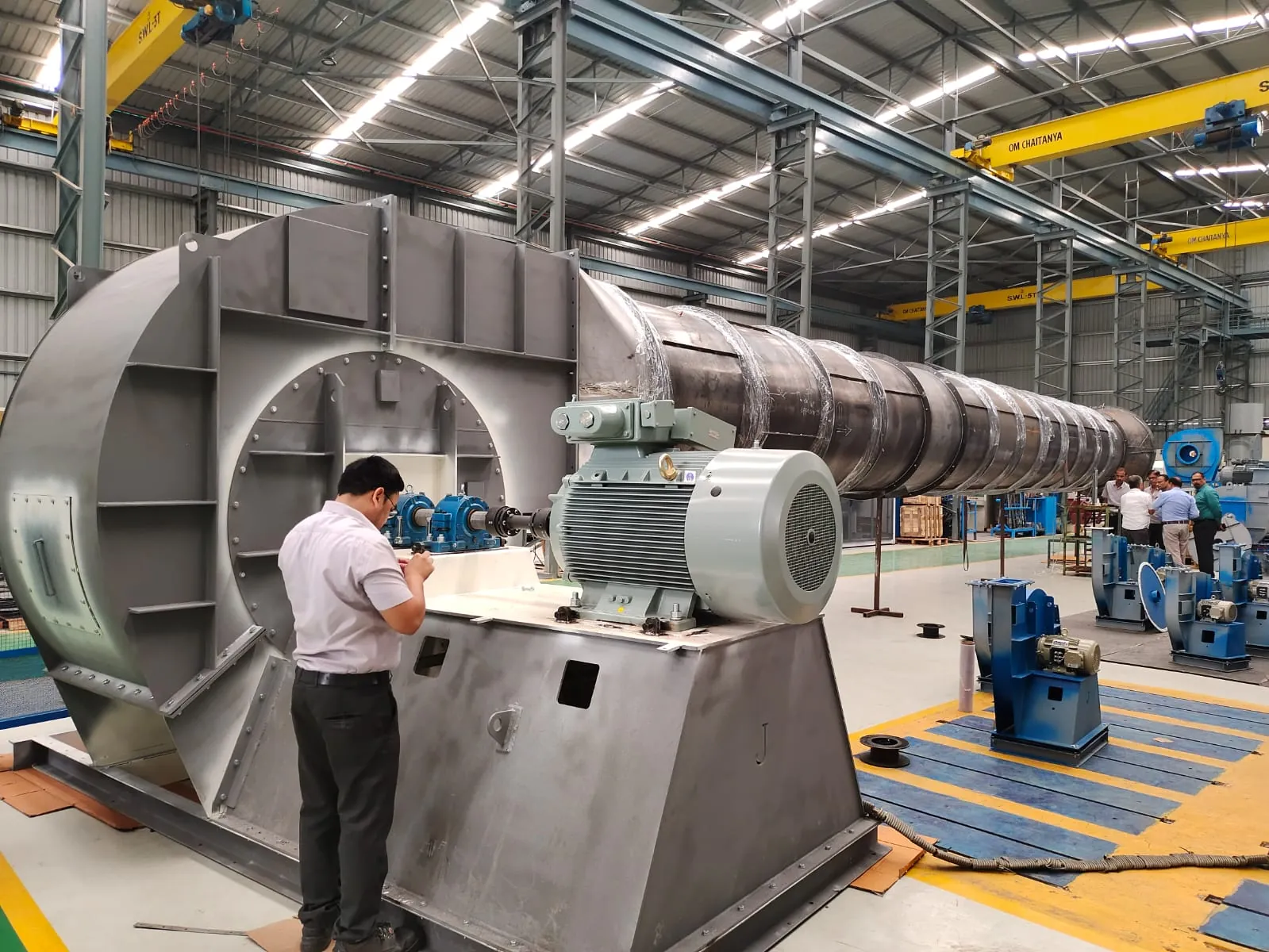
| Who | an industrial process plant in India, at start-up / commissioning stage |
| Equipment | identical 25 HP (~18.5 kW) cone-inlet centrifugal blowers, 36,000 CMH · 60 mmWC — impeller assemblies and casings shipped separately, to be married up on site |
| Complaint | high current preventing normal start-up; then vibration and noise on one machine with the inlet cone fitted, and on the other a cone fouling the impeller so hard it could not be fitted |
| Service | Root-cause investigation from site photographs and video, plus on-site field service (dynamic balancing, bearing and belt check) |
| Response | Complaint answered the same day; service engineer nominated with balancing machine, tooling, spare bearing and belt — visit charges borne by us |
| Result | Casings, impellers and rotation marking proven correct to GA; cause identified as a cross-matched casing/impeller pairing during site assembly. Correct re-location restored one machine's current to range (confirmed by the site). Field balancing and cone-clearance correction were dispatched — the record carries no final site sign-off on vibration or cone fitment. |
A process plant was commissioning identical cone-inlet centrifugal blowers on the same duty — 36,000 CMH at 60 mmWC, on 25 HP motors. Under the supply plan agreed for this order, the impeller assemblies and the casings travelled to site separately, to be married up there during erection.
That detail matters. A centrifugal fan is not a bag of interchangeable parts: each impeller is balanced inside its casing, with its inlet cone clearance set against its impeller shroud. On paper, sister machines of the same rating look identical. In the field they are not — each is a matched set, and the tolerances that keep a fan quiet live in the pairing. And these blowers sat on the critical path of a plant start-up.
The site reported the machines drawing high current on start-up and refusing to come up normally. The plant team then spotted a placement error themselves, moved a blower to its correct position — and that unit's current dropped into the desired range.
But it did not end there. On that same machine, with the inlet cone installed, the site now reported vibration and noise, with the cone-to-impeller clearance visibly tight. And on the other machine, current came into tolerance only with the cone removed — the cone rubbed hard against the impeller and physically could not be fitted. The site's own words: "the cone is having friction with impeller hence not installed."
The obvious suspect was the fan itself: a mis-built casing, an out-of-round impeller, a wrong rotation mark, an unbalanced rotor. That is the natural conclusion when sister machines misbehave in different ways on the same day. It was also wrong.
We worked it in order, ruling out the cheapest-to-check causes first.
One — were the parts built right? We went back to the manufacturing and dispatch record and compared it against the approved GA. Every casing and every impeller assembly was built correct to drawing, and the nameplate rotation arrow was correct. Critically, each casing had been marked with its own job identity before dispatch — visible in the dispatch photographs taken at our works.
Two — was it electrical? High current invites a motor, starter or supply diagnosis. But the site's own intervention had already answered that: simply re-locating a machine dropped its current into range, with no electrical component touched. A current that responds to where a fan physically sits is not an electrical fault.
Three — what did the site photographs and video actually show? The answer. The separately-shipped casings and impeller assemblies had been cross-matched during site assembly — a casing married to the impeller assembly belonging to its sister machine. That one error explains both symptoms: the wrong pairing loads the motor abnormally, and it destroys the inlet-cone-to-impeller clearance set at the works — so on one machine the cone runs tight and noisy, and on the other it fouls outright and will not go on.
5-Why Why was the current high and the cone fouling? → Because the casing and the impeller running inside it were not the matched pair. → Why were they not matched? → Because casing and impeller shipped separately and were married up on site. → Why were they married wrong? → Because the identity marking on each casing was not checked against its impeller during assembly. → Why was that not caught? → Because there was no verified marry-up check before the machine was first energised. Root cause: a cross-swapped casing/impeller assembly at site — a commissioning and site-assembly event, not a works defect.
The fix followed the cause. The plant re-located the units correctly, restoring current to range on the machine they corrected. We then sent a service engineer with an on-site dynamic balancing machine, tooling, a spare bearing and a belt, to trim the residual vibration, check bearing and drive condition, and reset the cone clearance. We carried the cost of that visit ourselves, though our standard policy is to charge for visits arising from faulty commissioning.
The reusable lesson: when a casing and an impeller ship separately, the largest field risk is not a damaged part — it is a cross-swapped pairing. Verify identity marking and rotation, and confirm inlet-cone clearance, before you energise. "High current at start-up" is very often a wrong casing/impeller marriage, not a motor fault.
Here is what the record does — and does not — show.
Sister machines, different symptoms, one cause — and the cause was in the marriage, not the metal. When a fan misbehaves at start-up, before it has run a single production hour, the odds weigh heavily toward how it was received, assembled and installed, not how it was built. The discipline that pays is boring and cheap: check the identity marking, check the rotation, check the clearance, then press start.
(Our balancing is to ISO 21940; performance is tested to IS 4894 / ISO 5801 / AMCA 210 method; vibration is judged against ISO 14694.)
Commissioning a fan of any make that pulls high current, rubs or vibrates? Call us in. You will get an ordered diagnosis and a written corrective action, not a parts quotation.
— Jitamitra Electro Engineering · Technical Services
Engineered for Every Application.
High current invites a motor, starter or supply diagnosis. On these 36,000 CMH at 60 mmWC blowers on 25 HP motors, the site simply re-located a machine and its current dropped into the desired range, with no electrical component touched. A current that responds to where a fan physically sits is not an electrical fault.
It matters completely. A centrifugal fan is not a bag of interchangeable parts: each impeller is balanced inside its casing, with its inlet cone clearance set against its impeller shroud. Sister machines of the same rating look identical on paper. In the field each is a matched set, and the tolerances that keep a fan quiet live in the pairing.
Here, neither. Every casing and every impeller assembly was built correct to the approved GA, and the nameplate rotation arrow was correct. The cone would not clear because the wrong casing/impeller pairing destroyed the clearance set at the works — on one machine the cone ran tight and noisy, on the other it fouled outright.
A verified marry-up check. Check the identity marking on each casing against its impeller, check the rotation, confirm the inlet-cone clearance, then press start. This one was not caught because there was no verified marry-up check before the machine was first energised. The discipline that pays is boring and cheap.
No. The site confirmed that re-locating the wrongly-placed machine brought its motor current back into the desired range. But there is no final customer sign-off on file closing out vibration and cone fitment after the balancing visit, and no field vibration reading against an acceptance limit was captured — so we claim neither.
Our standard policy is to charge for visits arising from faulty commissioning. On this one we carried the cost ourselves. The complaint was answered the same day and a service engineer was nominated with an on-site dynamic balancing machine, tooling, a spare bearing and a belt, to trim residual vibration and reset the cone clearance.
Flow, static, gas temperature, application — or attach a spec, GA drawing or a multi-fan schedule. Engineer to engineer.
ISO 9001:2015 quality system · performance-tested to IS 4894 / ISO 5801 / AMCA 210 method · witnessed FAT on request.
*For our standard range. ATEX and special projects need 5 to 7 working days.
This site sets no cookies of its own. Google Analytics loads only if you accept. It sets two cookies, so we can see which fan topics people actually read. Decline and no analytics loads — the site works exactly the same. What we collect →