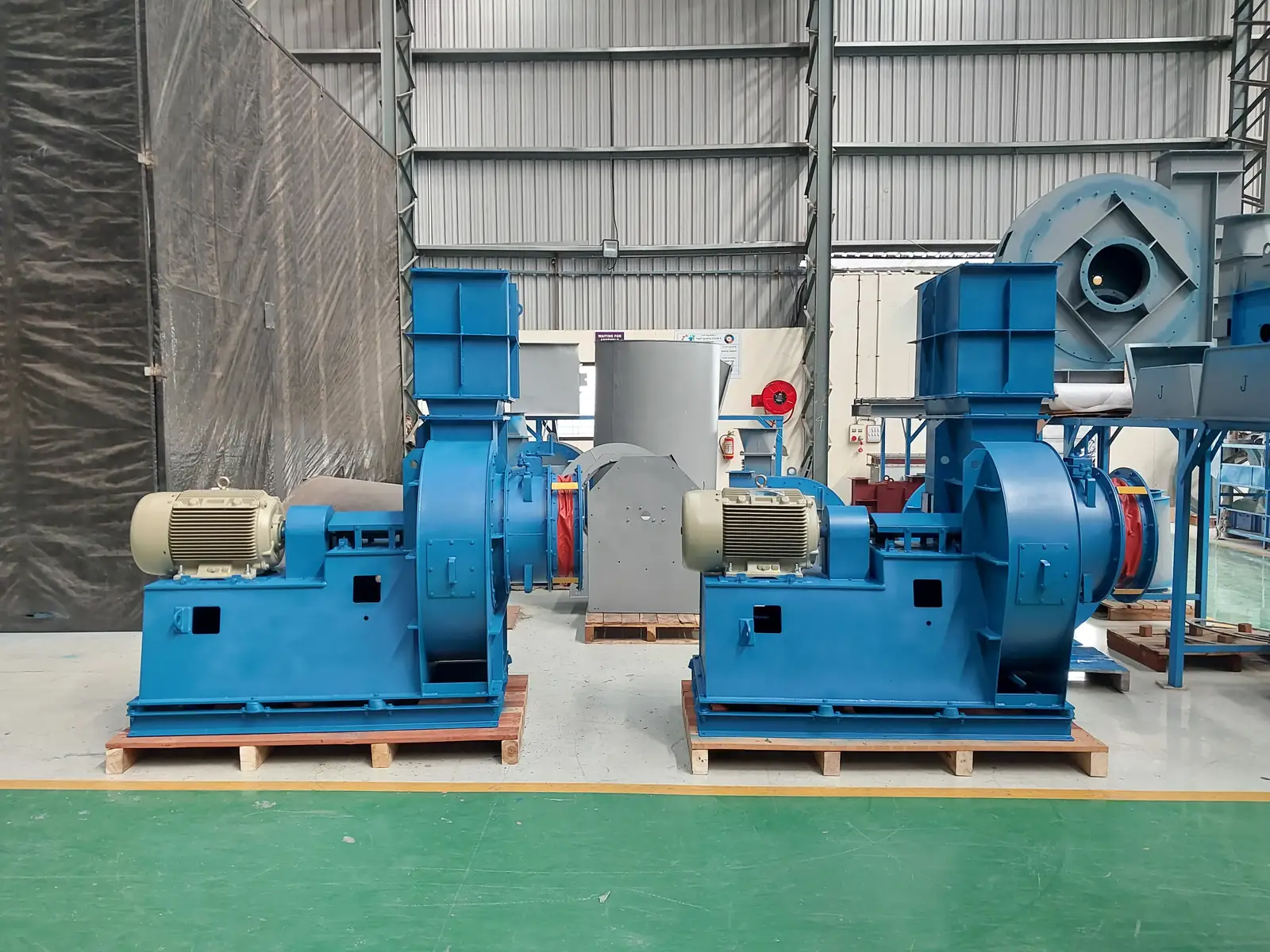
A maker of bakery and thermal-processing equipment had one of our ~20 HP class centrifugal blowers installed on a dust/air-extraction duty at one of their customer's manufacturing plants in western India. The blower draws through a pickup and discharges into a filter box — a running installation that could not simply be pulled offline for a leisurely investigation.
The site reported weak capture at the pickup and logged an "insufficient suction" complaint, asking us to attend on priority with an anemometer. The natural assumption when suction feels weak is that the fan is under-delivering — and that assumption, if accepted, would have led straight to unnecessary fan work. The honest question was not "how do we make the fan bigger?" but "is the fan actually short, or is something in the system stealing the flow?"
We did not swap parts. We cross-checked the unit against its pre-dispatch performance test, then put an engineer on site the next day to measure actual flow and pressure — the only way to separate a genuine fan shortfall from a system loss. The fan measured above its design flow. So the loss was downstream, in the way the air left the fan.
The educational root cause (generic 5-Why): Why did suction feel weak at the pickup? → Useful flow was being lost, not under-produced — the fan measured above its design curve. → Why the loss? → At the fan outlet, an obstruction sat immediately against the discharge, so high-velocity air plunged straight onto a flat wall. → Why does that matter? → An abrupt obstruction at the discharge creates heavy turbulence right where the air leaves the fan — classic system effect — and turbulence destroys useful pressure before it can do any work. → Why was it that severe? → There was no straight outlet duct or long-radius transition to let the air organise itself, and the in-line filter was due for cleaning. → Root cause: an outlet layout that induced system-effect turbulence, plus a loaded filter — a system cause, not a fan defect.**
The written corrective action gave the air a clean exit: fit a long-radius bend at the fan outlet and connect the filter box to the end of that bend (rather than hard against the discharge), and reposition the filter's air entry. The preventive step: clean the filter at regular intervals so resistance does not creep back up.
The reusable lesson: when a fan "feels weak," measure it against its own curve before you touch the fan. Nine times out of ten a suction complaint like this is a system problem at the outlet, not a fan problem — a long-radius transition where the air leaves the fan is worth more than a bigger motor.
The fan itself had been performance-tested in-house on our 200 HP VFD test rig, to the IS 4894 / AMCA 210 method before dispatch — which is exactly why we could stand behind it and look to the system with confidence.
A suction complaint is a system question before it is a fan question. Measuring the fan against its curve — and reading the first metre of ducting after the outlet — usually finds the real answer, and saves you from paying to enlarge a fan that was never short.
— Jitamitra Electro Engineering · Technical Services
Engineered for Every Application.
Measure before you assume. The natural assumption when suction feels weak is that the fan is under-delivering, and that assumption leads straight to unnecessary fan work. On this dust/air-extraction duty the fan measured above its design flow on site. The loss was downstream, in the way the air left the fan.
At this fan's outlet an obstruction sat immediately against the discharge, so high-velocity air plunged straight onto a flat wall. An abrupt obstruction at the discharge creates heavy turbulence right where the air leaves the fan — classic system effect — and turbulence destroys useful pressure before it can do any work.
We did not swap parts. We cross-checked the unit against its pre-dispatch performance test, then put an engineer on site the next day to measure actual flow and pressure — the only way to separate a genuine fan shortfall from a system loss. On-site flow came out above the design air quantity, with static pressure on target.
Give the air a clean exit. Fit a long-radius bend at the fan outlet and connect the filter box to the end of that bend, rather than hard against the discharge, and reposition the filter's air entry. The preventive step is to clean the filter at regular intervals so resistance does not creep back up.
Acknowledged the same day, engineer on site the next day, and a written root cause plus corrective action inside the 10-working-day commitment — delivered in a single working day. The complaint was closed on a signed site report in about two working days, with a measured number rather than an opinion.
Nine times out of ten a suction complaint like this is a system problem at the outlet, not a fan problem. A long-radius transition where the air leaves the fan is worth more than a bigger motor. Measure the fan against its own curve, and read the first metre of ducting after the outlet.
Flow, static, gas temperature, application — or attach a spec, GA drawing or a multi-fan schedule. Engineer to engineer.
ISO 9001:2015 quality system · performance-tested to IS 4894 / ISO 5801 / AMCA 210 method · witnessed FAT on request.
*For our standard range. ATEX and special projects need 5 to 7 working days.
This site sets no cookies of its own. Google Analytics loads only if you accept. It sets two cookies, so we can see which fan topics people actually read. Decline and no analytics loads — the site works exactly the same. What we collect →