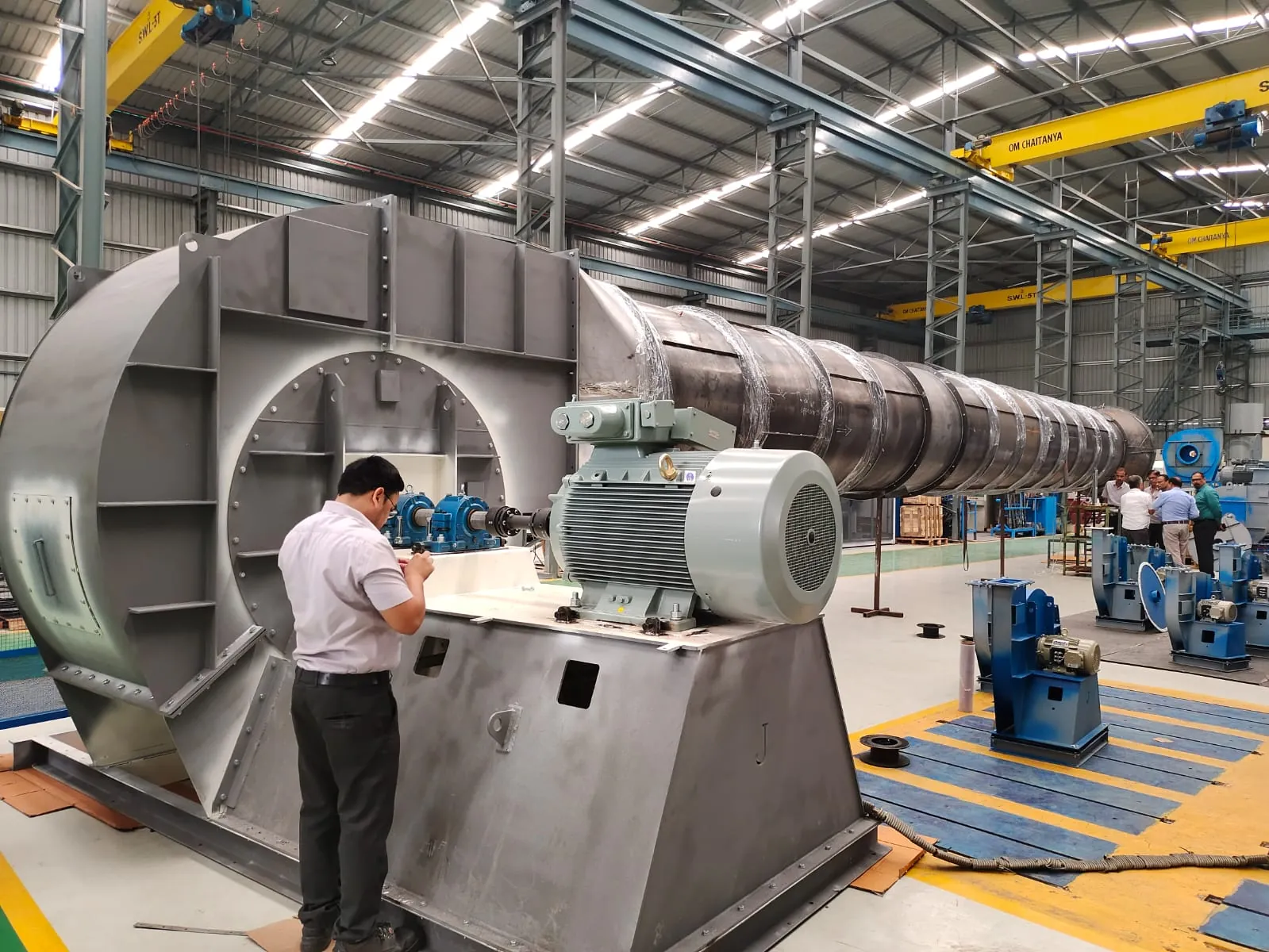
| Who | A surface-coating systems provider in western India, responsible for a blower at an engineering customer's plant |
| Equipment | Centrifugal blower — 15,500 CMH / 60 mmWC / 10 HP |
| Complaint | Abnormal vibration and noise in service, several years into operation |
| Service | Ruled out process and drive causes, then replaced bearings and balanced the rotor in situ |
| Response | Reported 29 December; offer issued next working day; technician on site 4 January |
| Result | Bearings replaced, rotor field-balanced, balancing record and site report issued. Our record documents the work performed — it carries no signed post-repair vibration figure, and that gap changed how we run these jobs. |
Surface-coating lines are unforgiving about air. This blower moved 15,500 CMH at 60 mmWC on a 10 HP motor — a modest duty by our envelope, but one the coating process depends on completely. If it stops, the line stops, and work-in-progress inside a coating booth does not wait patiently for a spare.
The unit was one of a small installed population at the same account, all supplied by us over time, all several years into operation. Our contact was the coating-systems provider, who owned the relationship with the end plant. That matters: when the end plant complained, our customer needed an answer fast enough to protect their credibility, not just their uptime.
Late December, the call came — abnormal vibration and noise.
The obvious suspect on a fan with vibration and noise is imbalance. Dust builds unevenly on the impeller, the rotor goes out of balance, the fan shakes. It is the most common story in industrial ventilation, and the site had already reached that conclusion — the order they raised was, in their words, for blower balancing. It is also the most satisfying service to sell: quick, visible, everyone goes home happy.
But balancing an imbalanced rotor and balancing a rotor with a degraded bearing produce the same immediate improvement — and only one of them lasts. Bearing degradation causes vibration too, plus the noise signature imbalance alone rarely gives you. Vibration and noise together is a different sentence to vibration on its own. Turn up with only a balancing rig and you either balance a fan whose bearings are already spalled — and it is back in a month — or it will not balance at all, and you have burned a site visit.
So we did not accept the diagnosis. We accepted the symptom.
We eliminated causes in cost order — cheapest and most reversible first, so we never dismantle anything we do not have to.
Ruled out first — process and aerodynamics. A blower detuned by a duct change, a blocked filter or a closed damper complains in flow and pressure, not primarily in bearing noise. The line was making its air; nothing indicated the duty had shifted.
Ruled out second — motor and drive. Electrical faults and drive misalignment both masquerade as fan vibration. Neither was implicated: the motor was healthy, the drive never flagged.
That left the rotating assembly — exactly what "vibration and noise, on a unit years into service" is telling you. So we went to site prepared for the answer rather than for the diagnosis: our technician attended carrying two bearings, with instructions to fit them if required — not because we had brought them.
What we found needed both halves of the job. Bearings were replaced, then the rotor balanced in situ — because a rotor you have just re-bearinged has different running characteristics, and balancing beforehand would have been balancing a fan that no longer exists. Order matters: mechanical integrity first, then balance, then measurement.
5 Whys Why vibrating and noisy? → The rotating assembly was no longer running true. Why? → Bearing condition had degraded and the rotor had drifted out of acceptable balance. Why? → Normal in-service wear: bearings age, impellers accumulate deposit and minor wear over years of duty. Why did wear reach breakdown unnoticed? → Nothing was measuring it — no condition-monitoring cadence existed on this population. Why no cadence? → The fan had run faultlessly for years, and equipment that never complains is equipment nobody schedules.
The reusable lesson: A fan that has run well for years and then develops vibration and noise is not a fan that was built wrong. It is a fan that has been worn — and wear is a maintenance-interval problem, not a fault. The corrective action is a bearing and a balance. The preventive action is a number, taken periodically, that would have told you months earlier.
Carry the spares — but bring the instrument too.
A bearing swap and a balance job are not finished when the fan sounds better. They are finished when you have an after-reading against ISO 14694, a recorded bearing failure mode, and a signature. Anything less is a repair that worked and cannot prove it. And the deeper point sits upstream: the blower that has been reliable for years is precisely the blower nobody is watching. A five-minute vibration reading on a scheduled cadence would have caught this drift months before it became a call three days after Christmas.
We service fans of any make. Field balancing to ISO 21940, vibration assessment to ISO 14694, bearing and rotating-assembly repair, and performance verification tested to IS 4894 / ISO 5801 / AMCA 210 method. If a fan has started talking to you, we would rather look at it now than after it stops.
— Jitamitra Electro Engineering · Technical Services
Engineered for Every Application.
Vibration and noise together is a different sentence to vibration on its own. Balancing an imbalanced rotor and balancing a rotor with a degraded bearing produce the same immediate improvement, and only one of them lasts. On this 15,500 CMH / 60 mmWC / 10 HP blower the job needed both a bearing change and a balance.
Turn up with only a balancing rig and you either balance a fan whose bearings are already spalled — it is back in a month — or it will not balance at all, and you have burned a site visit. Our technician attended carrying two bearings, with instructions to fit them if required, not because we had brought them.
After. A rotor you have just re-bearinged has different running characteristics, so balancing beforehand would have been balancing a fan that no longer exists. Order matters: mechanical integrity first, then balance, then measurement. Bearings were replaced here, and only then was the rotor balanced in situ.
In cost order — cheapest and most reversible first, so nothing is dismantled that need not be. A blower detuned by a duct change, a blocked filter or a closed damper complains in flow and pressure, not primarily in bearing noise. Electrical faults and drive misalignment masquerade as fan vibration; neither was implicated. That left the rotating assembly.
For this class of fan, ISO 14694, rigid mount BV-3: 4.5 mm/s accept, 7.1 alarm, 9.0 shutdown; flexible mount 6.3 / 11.8 / 12.5. Every field-balancing job we run now must capture before-and-after readings against a stated standard, with bearing designation, position and observed failure mode logged.
No. We closed the complaint on our side and the balancing sheet exists, but the file carries no signed post-repair vibration figure and no customer acceptance rating — so we claim neither. Work that isn't measured against a standard and accepted in writing cannot be defended later. That is the half of this story that changed our procedure.
Flow, static, gas temperature, application — or attach a spec, GA drawing or a multi-fan schedule. Engineer to engineer.
ISO 9001:2015 quality system · performance-tested to IS 4894 / ISO 5801 / AMCA 210 method · witnessed FAT on request.
*For our standard range. ATEX and special projects need 5 to 7 working days.
This site sets no cookies of its own. Google Analytics loads only if you accept. It sets two cookies, so we can see which fan topics people actually read. Decline and no analytics loads — the site works exactly the same. What we collect →