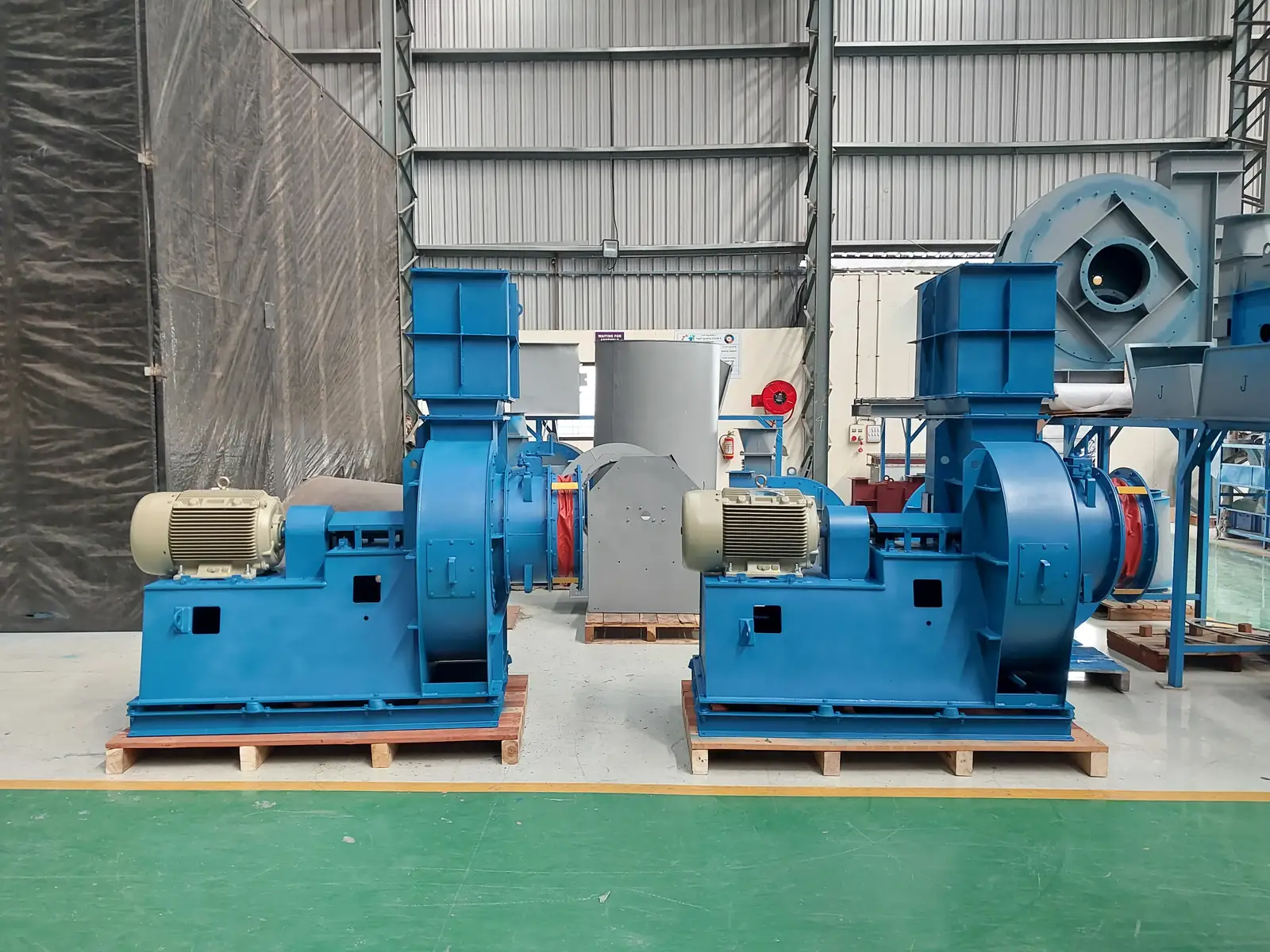
| Who | A materials-handling & pneumatic-conveying plant in Gujarat |
| Equipment | A Jitamitra direct-drive blower, rated 1,100 CMH / 300 mmWC / 3 HP on 85 °C air |
| Complaint | On receipt, the motor / fan cover — a sheet-metal guard — was found damaged. Six site photographs were attached the same day |
| Service | Complaint logged on our formal Customer Complaint Resolution Form; damage assessed on the photographic evidence; cause established; corrective action instructed |
| Response | Complaint raised on day one, diagnosis issued on day two |
| Result | Cause established as transit / handling damage, not a works defect. A replacement guard was instructed, sized off the motor nameplate frame, and the transporter put on notice for cost recovery. Our record documents the instruction; it does not record the fitment or a customer sign-off, and we are not claiming one |
This plant moves material on air. The blower is the prime mover, sized at 1,100 CMH against 300 mmWC on a 3 HP direct-drive motor, handling air at 85 °C. Direct drive is the right call at that duty — fewer wear parts, no belt to tension. The corollary is that the motor is part of the fan, with its own cooling fan and its own sheet-metal cover.
That cover is not decoration. The motor's cooling fan spins whenever the motor turns; the guard over it keeps fingers, tools and stray conveying media out, and keeps the cooling airflow where the motor designer intended. A crumpled guard is a safety item and, if it fouls the cooling fan, a thermal one. On an 85 °C duty it is not something you commission around. So the line stopped where it stood.
The site reported it plainly: motor cover damage. Photographs followed the same day.
This is where a case like this usually goes wrong. Damage found at first unpacking reads to everybody in the room as a factory escape: the purchase engineer drafts a quality complaint, the supplier drafts a defence — and the real cause, sitting in a truck somewhere on the highway, goes uninvestigated and unbilled.
The obvious suspect was wrong for a precise reason. The complaint was confined to the guard — nothing in the record touched the impeller, the shaft, the motor, the drive or the aerodynamic performance. A manufacturing fault is a systematic fault. It shows up in what was fabricated, welded, balanced or assembled, not only in the thinnest, most exposed part on the machine.
We worked the elimination in order, on the photographs and the build record:
Diagnosis, issued on day two after an internal engineering review: the cover was damaged during transportation.
Five whys 1. Why was the guard damaged? — It took a physical impact. 2. Why did it take an impact? — It was struck during handling in transit. 3. Why did handling reach it? — It is the most exposed, least protected part of the assembly. 4. Why was it exposed? — Sheet-metal guards protrude past the machine's load-bearing envelope, so they, not the frame, take the knock. 5. Why does that matter? — Because the damage a machine arrives with is usually the damage the journey did to it, not the damage the works built into it — and the two are recovered from completely different people.
The reusable lesson: damage found at first unpacking, confined to the most exposed component and functionally isolated from the machine, is a logistics event, not a quality event. Photograph it before anything is moved, put the carrier on notice in the same breath as you order the replacement, and size the replacement off the motor nameplate frame, not off a guess.
The instructed action was two-handed: procure a new cover and dispatch it to site, and show the photographs to the transport agency and recover the cost of the cover plus freight from them. Because the guard is a frame-size part, purchasing asked site for the motor nameplate photograph before sourcing — the correct step, and the one most often skipped in a hurry.
Only what the record carries:
The rule transfers to any make of fan: before you write "manufacturing defect" on the form, ask what the damage is confined to. If it sits on the most exposed, least structural component — a guard, a cowl, a terminal-box lid — and the machine behind it is untouched, you are almost certainly looking at the truck, not the workshop. That decides who pays, and whether the real cause ever gets fixed.
We service centrifugal fans and blowers of any make — diagnosis, spares, balancing, commissioning support and honest root-cause work. If a machine has arrived damaged or is not doing what its curve says it should, put it in front of us.
— Jitamitra Electro Engineering · Technical Services
Engineered for Every Application.
Probably not. Damage found at first unpacking reads to everybody in the room as a factory escape, but a manufacturing fault is a systematic fault. It shows up in what was fabricated, welded, balanced or assembled, not only in the thinnest, most exposed part on the machine. On this 1,100 CMH blower the complaint was confined to the guard alone.
That cover is not decoration. The motor's cooling fan spins whenever the motor turns; the guard over it keeps fingers, tools and stray conveying media out, and keeps the cooling airflow where the motor designer intended. A crumpled guard is a safety item and, if it fouls the cooling fan, a thermal one. On an 85 °C duty it is not something you commission around.
Ask what the damage is confined to. We worked the elimination in order: is the machine functionally affected, is it consistent with a build fault, is it consistent with handling. A thin, protruding guard is the first thing a strap, a forklift tine, a stacked load or a bad road finds. That pattern is impact, not build.
The carrier, if you move quickly. The instructed action here was two-handed: procure a new cover and dispatch it to site, and show the photographs to the transport agency and recover the cost of the cover plus freight from them. Photograph the damage before anything is moved, and put the carrier on notice in the same breath as you order the replacement.
Size it off the motor nameplate frame, not off a guess. Because the guard is a frame-size part, purchasing asked site for the motor nameplate photograph before sourcing — the correct step, and the one most often skipped in a hurry. That single photograph is what makes the replacement a frame match rather than an approximation.
Our record does not say. The file documents the instruction, not its completion — not the replacement being fitted, not a customer sign-off, not the transporter accepting the recovery. We will not write a happy ending we cannot evidence. What is documented is the diagnosis, issued on day two, and the corrective action instructed.
Flow, static, gas temperature, application — or attach a spec, GA drawing or a multi-fan schedule. Engineer to engineer.
ISO 9001:2015 quality system · performance-tested to IS 4894 / ISO 5801 / AMCA 210 method · witnessed FAT on request.
*For our standard range. ATEX and special projects need 5 to 7 working days.
This site sets no cookies of its own. Google Analytics loads only if you accept. It sets two cookies, so we can see which fan topics people actually read. Decline and no analytics loads — the site works exactly the same. What we collect →