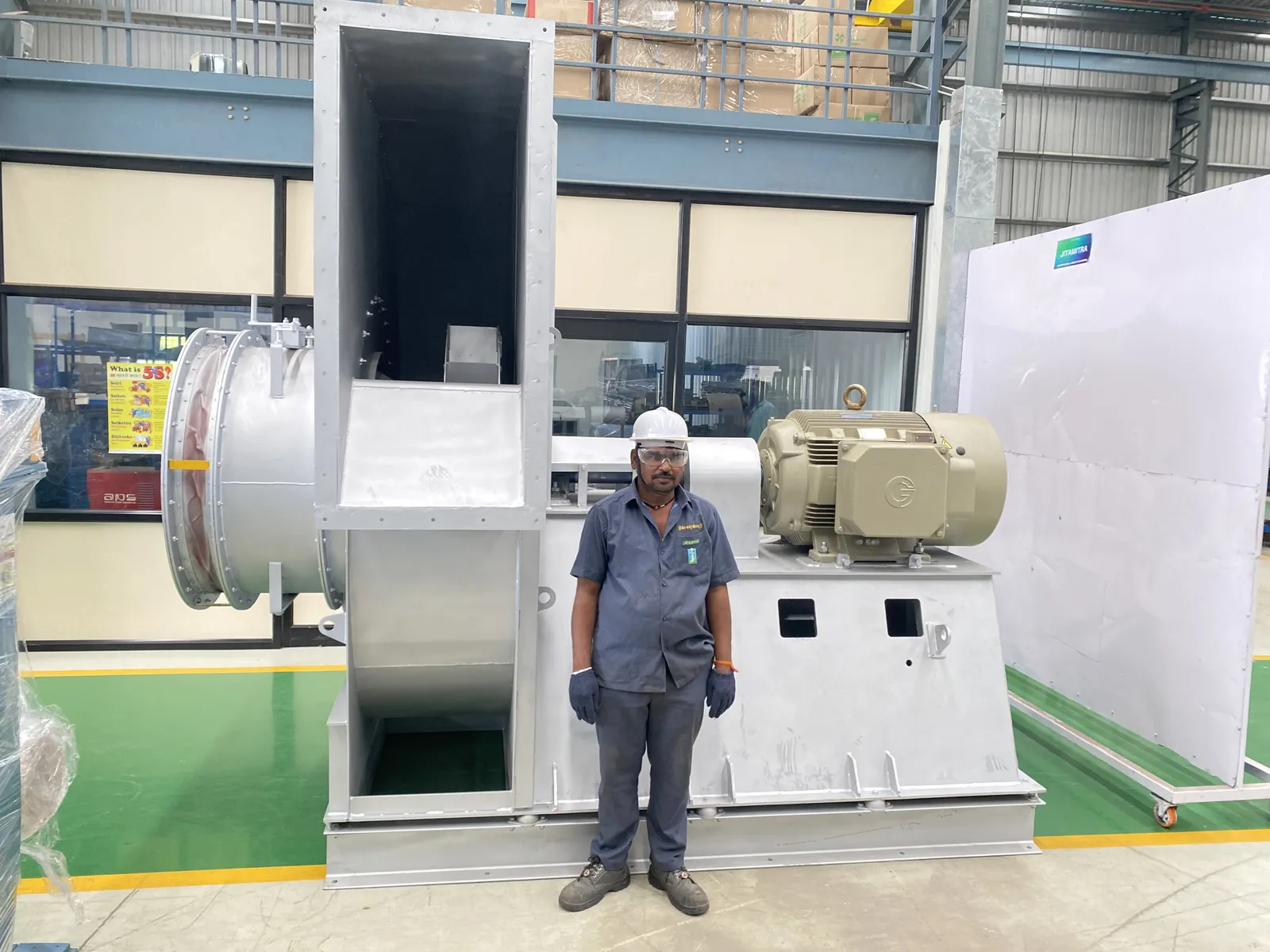
| Who | A vacuum-systems equipment OEM in Gujarat, commissioning at their end client's plant |
| Equipment | Turbine-type vacuum blower, 3 HP — 650 CMH / 210 mmWC / 80 °C |
| Complaint | Both blower motors dead during the trial run; oil separator also reported not working. The end client demanded motor replacement, same day. |
| Service | Same-day remote diagnosis from site photographs and wiring details; root-cause analysis; a two-day field recovery plus a durable re-specification |
| Response | Same day — plan issued within hours, ahead of the client's afternoon meeting |
| Result | Diagnosed as water ingress — rusted bearings, electrically failed windings. We issued a recovery (rewind, re-bearing, internal shaft seal, drain the casing) and a specification change to an IP56 motor. The record documents our diagnosis and corrective action; it does not record a completed restart, and we do not claim one. |
The customer builds vacuum and pneumatic conveying systems. The unit was a 3 HP turbine-type blower moving 650 CMH against 210 mmWC at up to 80 °C — a modest duty on paper, and exactly the kind of small machine nobody worries about until the day it stops the line.
That day had arrived. The blower was on a trial run at the end client's plant — the worst possible moment for a fault. The machine has no track record to defend it, the client is watching, and every hour of silence reads as a supplier problem rather than a plant problem. The complaint reached us flagged urgent, with a client meeting scheduled for four o'clock that afternoon.
The report was blunt: both motors were dead after the wiring had been checked, and the oil separator was not working either. The end client had already reached a conclusion — replace the motors.
Two motors failing simultaneously is the detail that should stop an engineer in their tracks. Independent motors do not fail independently on the same day; when a pair goes down together, the cause is rarely inside the motors. "Send new motors" was wrong not because motors never fail, but because this pattern does not look like motor failure. It looks like a shared environment doing the same thing to both machines at the same rate — and a like-for-like replacement is then not a repair, but a delay of about a year.
The complaint arrived with fourteen site photographs and the wiring details. We worked them the same day, in this order:
The photographs answered it. The motors had failed electrically because of water: windings gone, bearings rusted. Water had accumulated inside the blower casing and worked its way to the bearing and winding area. The failure was in service and in the environment, not in the machine as built — the units were over a year old and out of warranty.
The 5-Why 1. Why won't the motors run? → Windings failed electrically; bearings seized with rust. 2. Why did they fail? → Water reached the windings and the bearing housing. 3. Why did water reach them? → Water had accumulated inside the blower casing. 4. Why did it get into the motor? → Sealing and drainage were not adequate for a duty where water collects in the casing. 5. Why not adequate? → The unit was specified for the airflow, not for the water. A standard IP55 motor with a conventional shaft seal is correct on a dry duty and a slow death sentence on a wet one.
The recovery we issued, to run inside two days:
For the durable fix: an IP56 motor, not another IP55 — including the uncomfortable part, that even a brand-new IP55 on this duty may fail again inside a year. The IP56 carries a long lead time, which is exactly why it belongs in the specification at quotation stage, not in a recovery plan after a field failure.
The reusable lesson: When two machines fail together, stop investigating the machines and start investigating what they share. Simultaneous failure is the signature of a common environment — and on a blower, the environment that most often does the killing is water standing in the casing.
Small blowers on wet or condensing duties get specified for what they move, and almost never for what collects inside them. Water in the casing is not an incident — it is an operating condition, and it must be designed for on day one: an internally fitted shaft seal, an IP rating that matches the wetness rather than the catalogue default, a drain that exists and is actually used, and a commissioning checklist that says so. Get that wrong and the machine will tell you a year later, during someone else's trial run. And if two of anything fail on the same day, look at what they have in common — rarely a coincidence, almost never the component.
We service fans and blowers of any make. If a machine on your plant is failing repeatedly, failing in pairs, or failing in a way that "shouldn't happen," send us the photographs and the duty. We will tell you what we see — whether or not we built it.
— Jitamitra Electro Engineering · Technical Services
Engineered for Every Application.
Two motors failing simultaneously is the detail that should stop an engineer in their tracks. Independent motors do not fail independently on the same day; when a pair goes down together, the cause is rarely inside the motors. It looks like a shared environment doing the same thing to both — and a like-for-like replacement is then a delay of about a year, not a repair.
Water. On this 3 HP turbine blower the motors had failed electrically because of water: windings gone, bearings rusted. Water had accumulated inside the blower casing and worked its way to the bearing and winding area. The failure was in service and in the environment, not in the machine as built — the units were over a year old and out of warranty.
On a water-killed motor a rewind and re-bearing is a two-day recovery; a new motor is a six-to-seven-week procurement. That is why the recovery we issued was to rewind the failed motor, replace the rusted bearings, fit an aluminium shaft seal to the casing from inside, and drain the casing — all to run inside two days.
Not where water collects in the casing. A standard IP55 motor with a conventional shaft seal is correct on a dry duty and a slow death sentence on a wet one — even a brand-new IP55 on this duty may fail again inside a year. We specified IP56. It carries a long lead time, which is exactly why it belongs in the specification at quotation stage.
It was a second symptom of the same condition, not the thing that killed the motors. We ruled it out as the origin early, along with supply and wiring — the site had already checked the wiring, and a supply fault would not explain rusted internals. What the two motors shared was the casing, and what was sitting inside it.
The record does not confirm it. We cannot show that the seal was made, the rewind completed, the IP56 motor ordered, or the trial run restarted, and no customer sign-off is on file. We publish the diagnosis and the corrective action, and stop there. One loop stays open: obtaining the motor OEM's international warranty terms.
Flow, static, gas temperature, application — or attach a spec, GA drawing or a multi-fan schedule. Engineer to engineer.
ISO 9001:2015 quality system · performance-tested to IS 4894 / ISO 5801 / AMCA 210 method · witnessed FAT on request.
*For our standard range. ATEX and special projects need 5 to 7 working days.
This site sets no cookies of its own. Google Analytics loads only if you accept. It sets two cookies, so we can see which fan topics people actually read. Decline and no analytics loads — the site works exactly the same. What we collect →