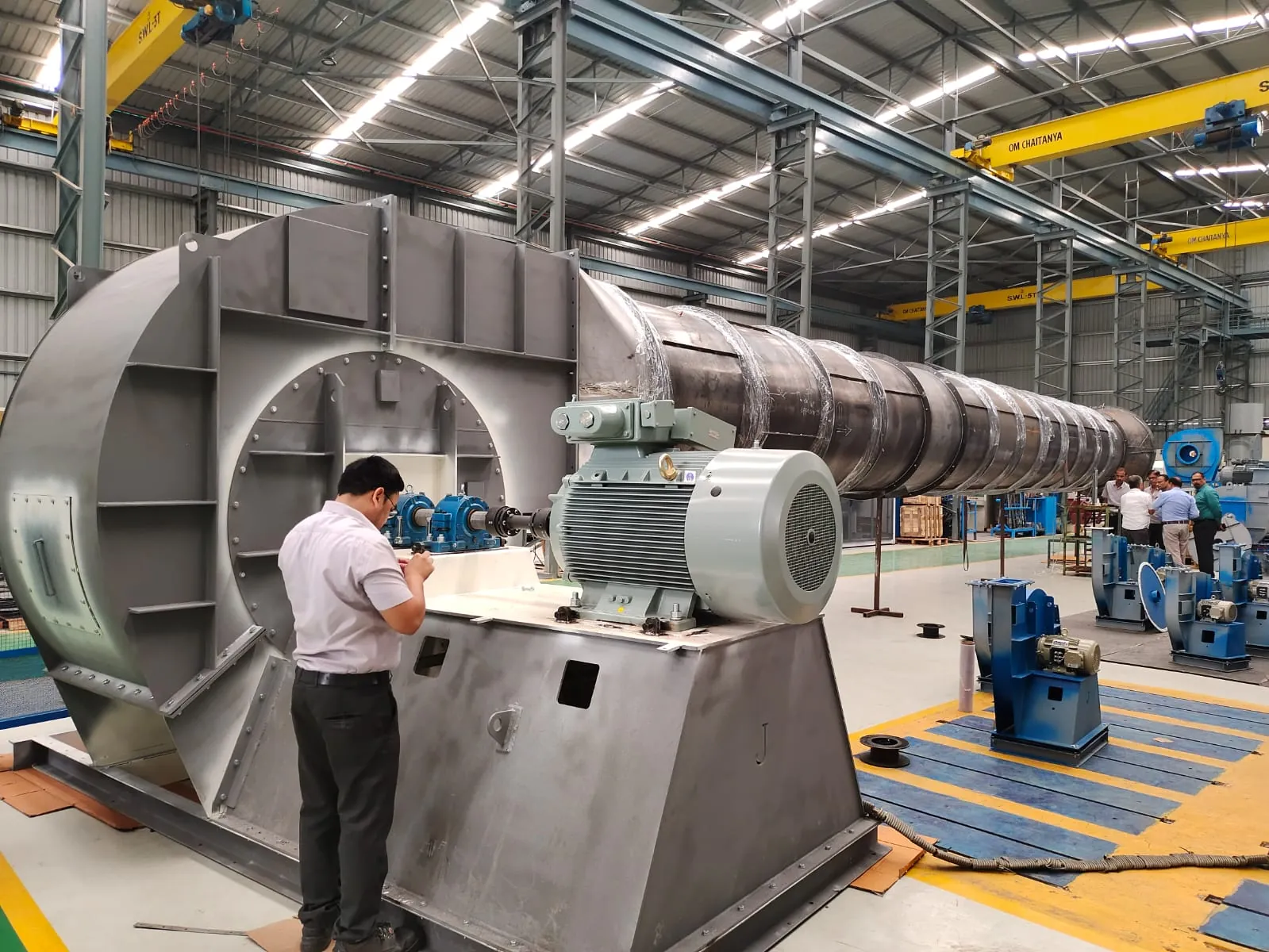
| Who | A vacuum-systems equipment OEM in India. Our blower sits inside their vacuum-department package, installed at their end-user's process plant. |
| Equipment | 3 HP direct-driven centrifugal blower, 1100 CMH / 300 mmWC, 60 Hz supply. |
| Complaint | Noise and vibration in service. The motor had already been dismantled at the end-user's site before we were called. |
| Service | Photo-led strip-down diagnosis, root-cause analysis, corrective and preventive instructions. |
| Response | Diagnosis returned within the same working week the strip-down images arrived. |
| Result | Root cause identified from the shaft evidence: a bearing seized by rust, from moisture reaching the bearing in service. Bearing replacement and a grub-screw check specified, plus a preventive rule for wet duties. The record carries no post-repair re-check or customer sign-off — we publish what we found and what we specified, not a closure we cannot evidence. |
The customer is an equipment OEM. They build a vacuum-department package — a complete skid their own end-user buys and runs inside a process plant. Our blower is one component inside that skid: a 3 HP direct-driven centrifugal fan rated 1100 CMH at 300 mmWC on a 60 Hz supply.
Being a component inside someone else's package is what makes these calls awkward. The OEM's brand is on the skid, and the blower is the loudest rotating thing in the enclosure — so the blower gets blamed. The stakes were never just a bearing. They were our customer's package, in front of their customer.
"Noise and vibration" is the least diagnostic complaint in our trade — the symptom of practically every rotating-equipment fault there is. The obvious suspect, the one most people reach for first, is imbalance: a fan that shakes must be out of balance, therefore the impeller is bad, therefore it is a manufacturing problem. That reflex is wrong more often than it is right, and it was wrong here.
The second complication was procedural. The end-user had already dismantled the motor before the complaint reached us, so there was no running machine to take a reading from — no vibration velocity in mm/s, no sound level, no record of the operating point when the noise began. Severity could not be graded against the ISO 14694 acceptance bands (rigid mount 4.5 accept / 7.1 alarm / 9.0 shutdown mm/s; flexible 6.3 / 11.8 / 12.5). We say so plainly: a case study quoting a vibration number it never measured is lying to you. What we had instead was a set of strip-down photographs. So we read the photographs.
The method on a bare "noise and vibration" complaint is to work outward from the rotating assembly, ruling out in order of how cheap the evidence is.
1. Imbalance of the impeller. The default assumption — and the only one that would have pointed back at our own works. But imbalance leaves a signature: it does not scratch a shaft, and it does not put rust anywhere. Balance is controlled to ISO 21940 at build. Nothing in the images supported it.
2. The bearing. Cheap to check on a photograph, because a bearing in distress writes on the shaft. It had. The images showed scratches on the shaft, and rust. That is not an assembly-defect signature. That is a bearing that has corroded and gripped, dragging on a shaft still turning inside it.
3. The impeller-to-hub locking. A parallel, independent vibration path: a taper-lock hub held by grub screws. If a screw backs off, the impeller vibrates however good the bearing is. We asked for photographs of the locking arrangement to judge grub-screw condition — and were explicit that this branch stayed open, not cleared.
The recorded root cause was the bearing: it had jammed due to rust — a coherent single source of both reported symptoms on a direct-driven rotor.
5 Whys 1. Why was the fan noisy and vibrating? The bearing had jammed. 2. Why did it jam? Rust had formed on the shaft and bearing — scratching and corrosion, visible at strip-down. 3. Why did rust form? Moisture reached the bearing while the fan was in service. 4. Why did moisture reach it? The bearing arrangement had no effective moisture exclusion for the environment it was actually operating in. 5. Why not? The wet character of the installed duty was never carried through into the bearing-protection specification.
Root cause (generic, reusable): a bearing sealed for a dry duty, installed into a wet one. Environmental ingress in operation — not balance, not the impeller, not the build.
The reusable lesson: on a "noise and vibration" complaint, the shaft is the witness. Rust plus scratching on the shaft is a moisture-seized bearing until proven otherwise — and the fix is not a better balance job, it is keeping water out of the bearing housing.
Corrective action specified: replace the bearing. Interim action on the open second branch: tighten the taper-lock grub screws. Preventive action, now generalised into our failure-mode library: for direct-driven fans in wet, wash-down or moisture-laden duties, specify effective bearing moisture exclusion — sealing, drain path, correct grease, correct orientation — and instruct the end-user to keep water off the bearing housing.
A fan that suddenly gets loud is usually telling you about its bearings, not its balance. Balance faults are born at build and show up on day one; bearing faults are earned in service and show up in year three. If a machine ran quietly for a season and then started shouting, look at what the environment did to it — water, dust, heat, a missing seal — before you look at what the factory did to it. And read the shaft: on a rotating assembly, it is the only component that records its own history.
We service centrifugal fans and blowers of any make — strip-down diagnosis, bearing and shaft assessment, balancing to ISO 21940, vibration assessment against ISO 14694, and performance testing to IS 4894 / ISO 5801 / AMCA 210 method. If a fan in your plant has started making a noise it did not use to make, send us the photographs before you send us the fan.
— Jitamitra Electro Engineering · Technical Services
Engineered for Every Application.
Probably not. Imbalance is the obvious suspect: a fan that shakes must be out of balance, therefore the impeller is bad, therefore it is a manufacturing problem. That reflex is wrong more often than it is right, and it was wrong here. Imbalance leaves a signature — it does not scratch a shaft, and it does not put rust anywhere.
Yes, from photographs, though you lose options. On this 3 HP direct-driven blower the end-user had dismantled the motor before the complaint reached us, so there was no running machine to take a reading from. What we had instead was a set of strip-down photographs. So we read the photographs, and returned the diagnosis within the same working week.
That the bearing corroded and gripped, dragging on a shaft still turning inside it. That is not an assembly-defect signature. On a rotating assembly the shaft is the only component that records its own history: rust plus scratching is a moisture-seized bearing until proven otherwise, and the fix is keeping water out of the bearing housing, not a better balance job.
We cannot tell you, and we will not invent it. With the machine already stripped there was no vibration velocity in mm/s, no sound level and no record of the operating point when the noise began, so severity could not be graded against the ISO 14694 acceptance bands. A case study quoting a vibration number it never measured is lying to you.
Not on its own. We specified bearing replacement, with tightening the taper-lock grub screws as an interim action on a parallel, independent vibration path we flagged but did not clear. The preventive rule matters more: on direct-driven fans in wet, wash-down or moisture-laden duties, specify effective bearing moisture exclusion — sealing, drain path, correct grease, correct orientation.
The record does not confirm it. There is no post-repair re-check, no confirmation the bearing was changed, and no customer sign-off on file. The replacement was specified, not witnessed by us. The grub-screw branch also stayed open — we asked for photographs of the locking arrangement and did not close it out.
Flow, static, gas temperature, application — or attach a spec, GA drawing or a multi-fan schedule. Engineer to engineer.
ISO 9001:2015 quality system · performance-tested to IS 4894 / ISO 5801 / AMCA 210 method · witnessed FAT on request.
*For our standard range. ATEX and special projects need 5 to 7 working days.
This site sets no cookies of its own. Google Analytics loads only if you accept. It sets two cookies, so we can see which fan topics people actually read. Decline and no analytics loads — the site works exactly the same. What we collect →