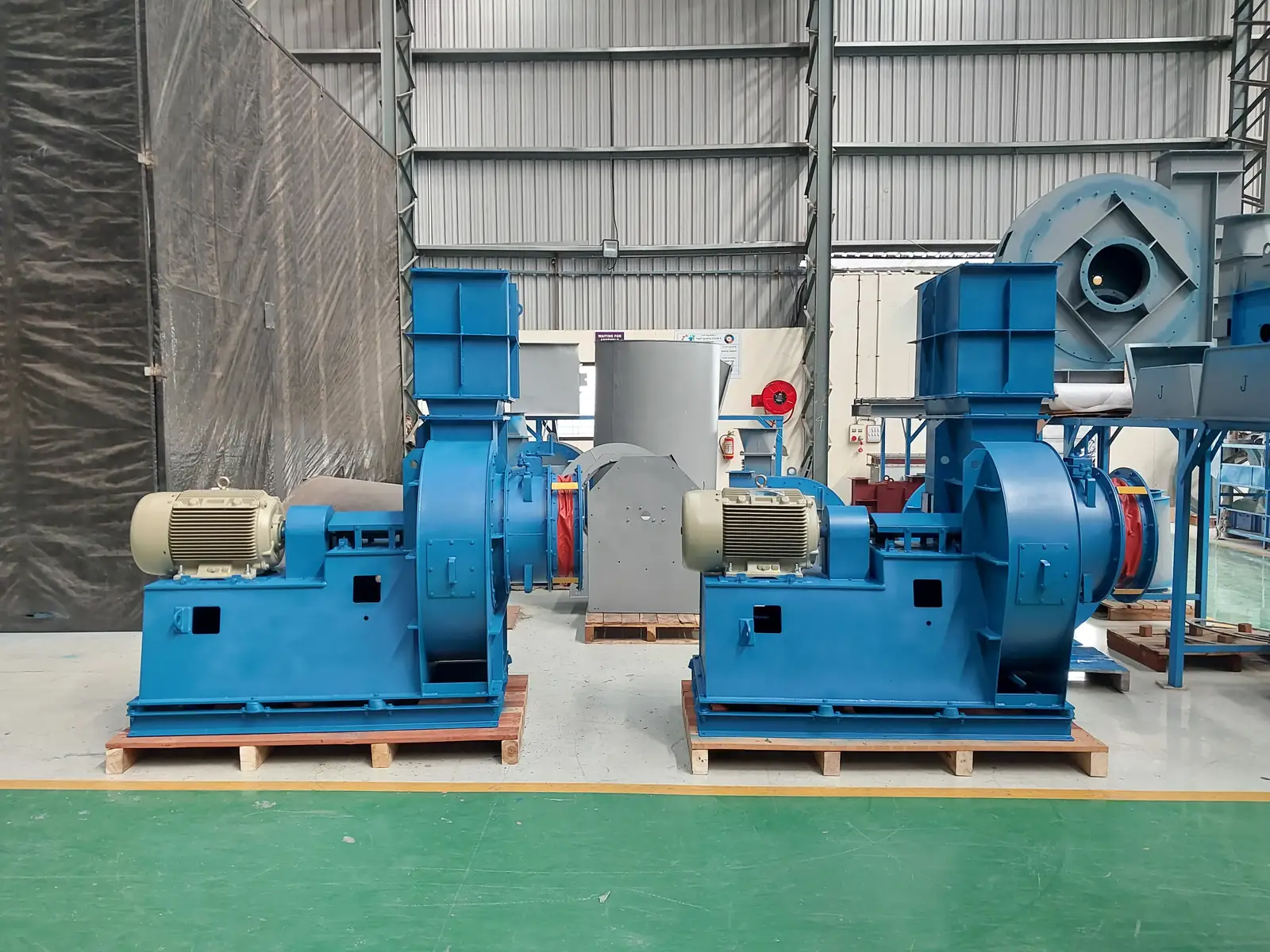
A combustion-and-thermal-systems integrator was commissioning a new furnace-air package at their end-customer's plant in western India. Two of the fans in that package — a forced-draught and an induced-draught centrifugal set — were ours. Commissioning is the worst possible time for a fan to misbehave: the whole line waits on it, a demanding end-user is watching every reading, and nothing can be handed over until the machines run clean. We'll call them the Integrator.
During commissioning, the ID and FD fans ran with more vibration than the Integrator's end-user would accept — and the two parties were even measuring against different vibration standards, so the acceptance target itself was contested. Foundation bolts had been tightened, the coupling checked, the ducting confirmed clear — the usual first moves — and vibration came down, but not all the way. Then, in the first year of operation, the ID fan developed severe vibration during routine maintenance — vertical readings around 19–20 mm/s on the fan and over 24 mm/s at the motor — and the plant shut it down. A fault that keeps coming back is not a spare-parts problem; it is a root-cause problem, and that is exactly what it turned out to be.
Rather than simply re-balance and hope, our engineers ran an as-found vibration survey — horizontal, vertical and axial readings at the motor and fan, drive and non-drive ends — and benchmarked them to the in-situ fan-vibration standard (ISO 14694, in-service limits) at balance grade G6.3. The vertical-dominant signature and a rough bearing pointed the investigation at the machine, not the aerodynamics.
Educational root-cause chain (generic):
The fix eliminated the cause on both fronts. During commissioning we added the correct pattern of structural stiffeners to the casing and base (and corrected the base-frame) so the structure no longer amplified vibration; when the bearing later failed, we replaced both bearings and the adaptor sleeve and re-commissioned with a full as-found → as-left survey. Jammed dampers were re-engineered with a wider bush tolerance and new dampers supplied.
The reusable lesson: when a fan vibrates high in the vertical direction and re-balancing doesn't hold, check the base/casing stiffness and the bearing condition before you balance a third time. A repeat vibration is telling you where to look.
(No customer quote is published — this case runs under our default anonymised consent tier.)
A fan fault that keeps returning after balancing is almost always a structural-or-bearing problem in disguise. Running an FD/ID or process fan that vibrates high and won't settle? Ask us for a root-cause vibration survey — you'll get a written corrective action benchmarked to the in-situ standard, not another balance pass.
— Jitamitra Electro Engineering · Technical Services
Engineered for Every Application.
Balance, probably not. A fan fault that keeps returning after balancing is almost always a structural-or-bearing problem in disguise. When a fan vibrates high in the vertical direction and re-balancing doesn't hold, check the base and casing stiffness and the bearing condition before you balance a third time. A repeat vibration is telling you where to look.
On this job the plant shut it down. The ID fan had developed severe vibration during routine maintenance in its first year of operation — vertical readings around 19–20 mm/s on the fan and over 24 mm/s at the motor. Only after the root cause was fixed did the readings come back within the accepted in-situ limit of ISO 14694.
Those are the usual first moves, and here they brought vibration down but not all the way. What was left was the machine itself: a vertical-dominant signature and a rough bearing. The fix was two-part — the correct pattern of structural stiffeners added to the casing and base during commissioning, then both bearings and the adaptor sleeve replaced when the bearing later failed.
An as-found survey first — horizontal, vertical and axial readings at the motor and fan, drive and non-drive ends — benchmarked to the in-situ fan-vibration standard, ISO 14694 in-service limits, at balance grade G6.3. That benchmark matters: here the two parties were measuring against different vibration standards, so the acceptance target itself was contested.
On this fan, ID vertical vibration fell about 74%, from roughly 19–20 mm/s to around 5 mm/s, with the motor peak likewise from about 24 to under 6 mm/s — back within the accepted in-situ limit of ISO 14694. We re-commissioned with a full as-found to as-left survey, so the improvement is measured rather than asserted.
No. This case runs under our default anonymised consent tier, so no customer quote is published and the plant is not named. What the file does carry is a signed on-site report: the worn bearing on an under-stiffened structure was proven on that report, not asserted, and the complaint was technically closed after the fan returned to service.
Flow, static, gas temperature, application — or attach a spec, GA drawing or a multi-fan schedule. Engineer to engineer.
ISO 9001:2015 quality system · performance-tested to IS 4894 / ISO 5801 / AMCA 210 method · witnessed FAT on request.
*For our standard range. ATEX and special projects need 5 to 7 working days.
This site sets no cookies of its own. Google Analytics loads only if you accept. It sets two cookies, so we can see which fan topics people actually read. Decline and no analytics loads — the site works exactly the same. What we collect →