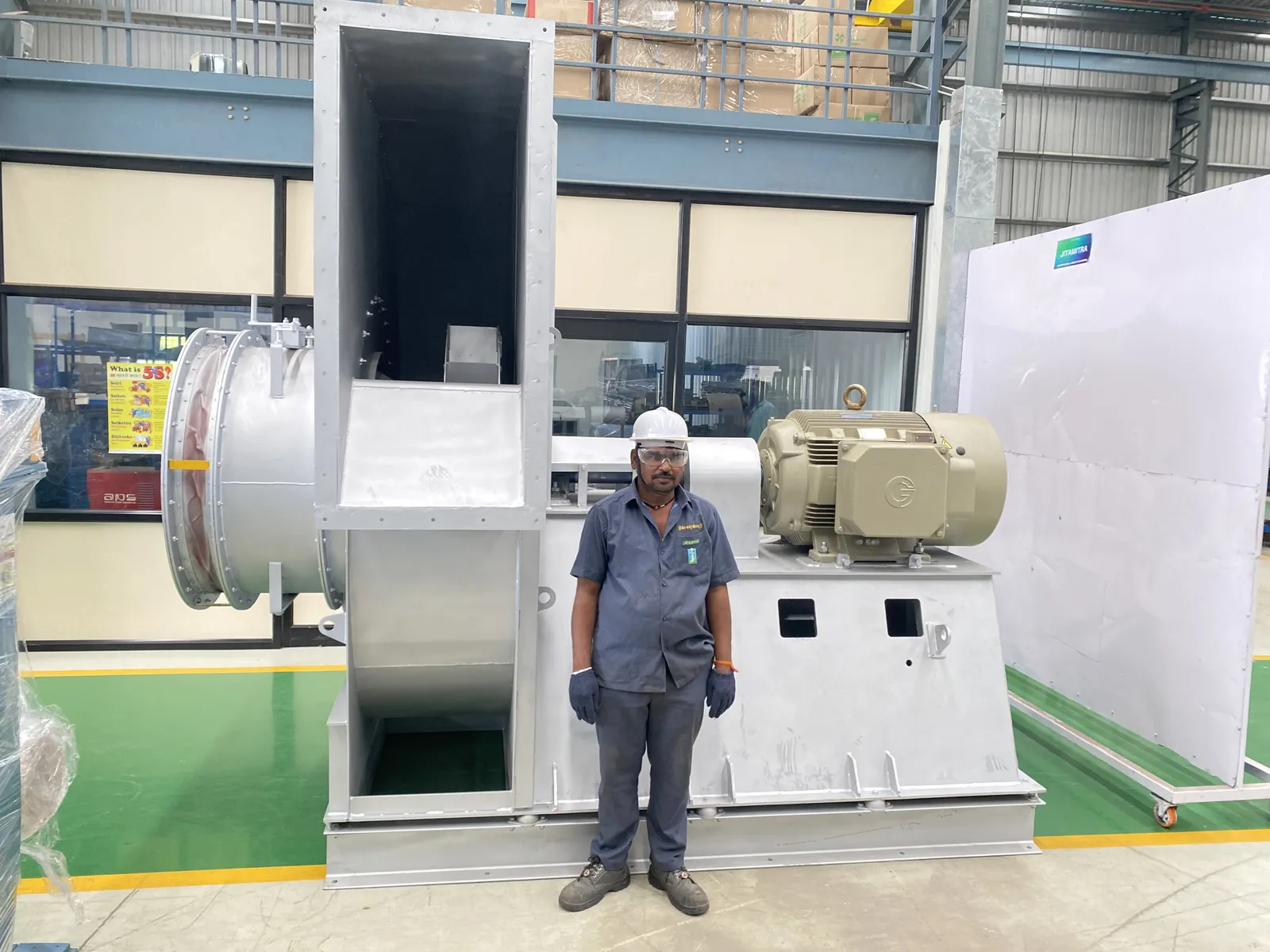
A surface-finishing and industrial-coatings manufacturer in western India was bringing a plant line back up. One of its small process blowers — a ~3 HP belt-driven centrifugal unit we had supplied — was reported as running rough, and it was flagged as a "vibration" problem. The timing was tight: the plant was due to restart within three to four days, so a machine that would not run cleanly was squarely on the critical path. An earlier visit for a separate, unrelated belt issue had left the noise question open, so the customer wanted it settled — quickly, and for good.
The blower had been logged with a vibration complaint, and the working assumption on site had been that it needed balancing. That is a reasonable first guess — but it is also a trap. Treat every rough-running fan as an imbalance problem and you reach for the balancing machine, and if the real fault lies elsewhere you spend a visit (and the customer's restart window) chasing the wrong thing. With the plant restart days away, the customer needed the actual cause, not the obvious one.
Our engineer went to site and, instead of assuming imbalance, inspected the running machine and the bearing arrangement directly. The finding was clear: the machine was not suffering a balance problem at all. It was abnormal bearing noise, and on strip-down both bearings — drive-end and non-drive-end — were physically damaged. A different failure mode entirely, needing a different fix.
Why was it running rough? Educational root cause (generic): Why the rough running? Bearing noise. → Why bearing noise? Both bearings were damaged. → Why did they fail so early? They ran at first start on old, degraded grease. → Why was the grease degraded? The fan had stood idle in storage for a long period before commissioning. → Root cause: a fan started up after long storage without the bearings being re-greased and inspected first — so the very first run wore the bearings, not a design or balance fault.
The fix matched the true cause: replace both damaged bearings, re-grease, reassemble, and trial-run the blower for 30 minutes to confirm it was running normally — bearing noise gone, running within limits — before handing it back. The failed bearings were retained and sent for supplier-side failure analysis to close the loop on the component.
The reusable lesson: If a fan has stood idle in storage for a month or more, re-grease and inspect its bearings before the first start. Old grease drains and hardens while a machine sits; running on it can chew a bearing on day one — and the symptom often reads as "vibration," sending you to the balancing machine instead of the bearings. A five-minute pre-start check saves a bearing set and a site visit.
A rough-running fan is not always a balance problem — and after a spell in storage, it is very often the bearings. The discipline that pays off is diagnosis before assumption: confirm the failure mode, then fix that.
Running a fan that has sat idle before start-up, or chasing a "vibration" you are not sure of? Ask us for an on-site root-cause diagnosis — you will get the actual cause and a written corrective action, not a guess.
— Jitamitra Electro Engineering · Technical Services
Engineered for Every Application.
Not before you confirm the failure mode. On this ~3 HP belt-driven centrifugal blower the working assumption on site was that it needed balancing. That is a reasonable first guess, but it is also a trap: treat every rough-running fan as imbalance and you reach for the balancing machine while the real fault sits elsewhere. It was abnormal bearing noise.
Re-grease and inspect its bearings. Old grease drains and hardens while a machine sits, and running on it can chew a bearing on day one. On this job both bearings, drive-end and non-drive-end, were physically damaged because the very first run happened on old, degraded grease. A five-minute pre-start check saves a bearing set and a site visit.
Not on this evidence. The chain ran: rough running to bearing noise, bearing noise to both bearings damaged, the damage to a first start on old, degraded grease, the degraded grease to a long idle period in storage. Root cause was a fan started after long storage without re-greasing and inspection — not a design or balance fault.
It did here. The plant was due to restart within three to four days, so the complaint was acknowledged the same day, an engineer was on site in about two days, and the complaint was re-characterised from "vibration" to a bearing failure and resolved on the first site visit — root cause and written corrective action inside the 10-working-day commitment.
Yes, on the spot. Both bearings were replaced, re-greased and reassembled, and the blower was trial-run for 30 minutes to confirm it was running normally — bearing noise gone, running within limits — before being handed back and signed off by the customer, who rated the service "Good."
They were retained and sent for supplier-side failure analysis, to close the loop on the component rather than just the machine. The pre-start re-greasing procedure was reinforced at the same time, so the same start-up mistake need not repeat. That is the part of a service call that stops the fault coming back on the next unit.
Flow, static, gas temperature, application — or attach a spec, GA drawing or a multi-fan schedule. Engineer to engineer.
ISO 9001:2015 quality system · performance-tested to IS 4894 / ISO 5801 / AMCA 210 method · witnessed FAT on request.
*For our standard range. ATEX and special projects need 5 to 7 working days.
This site sets no cookies of its own. Google Analytics loads only if you accept. It sets two cookies, so we can see which fan topics people actually read. Decline and no analytics loads — the site works exactly the same. What we collect →