A real air-pollution-control fan, fully anonymised — wheel choice, spark-resistant construction, and the P-Q curve that holds capture velocity through a baghouse cleaning pulse.
Reviewed by Jitamitra application engineering
Share on LinkedInA well-built dust-extraction fan sits on the clean side of the filter and is made of four decisions: a wheel form that tolerates whatever gets past the bags, wear protection where the grit lands, spark-resistant construction where the dust is combustible, and a pressure curve steep enough that capture velocity at the hood holds through the pulse-jet cleaning cycle. The last one is what most specifications leave out.
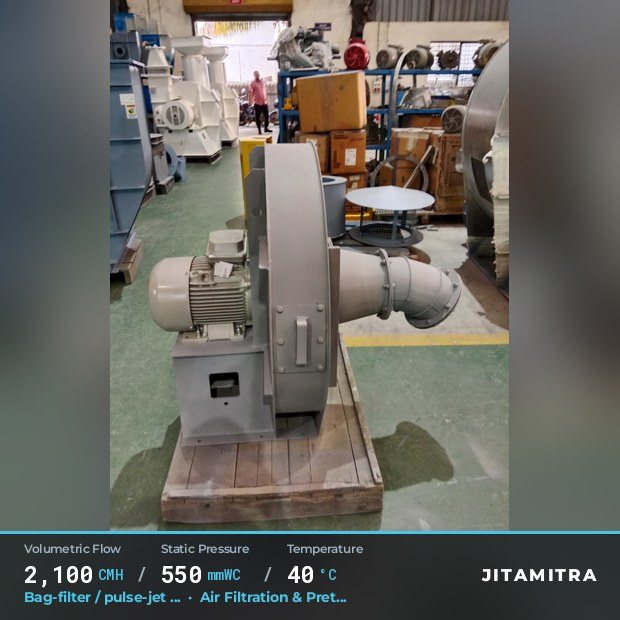
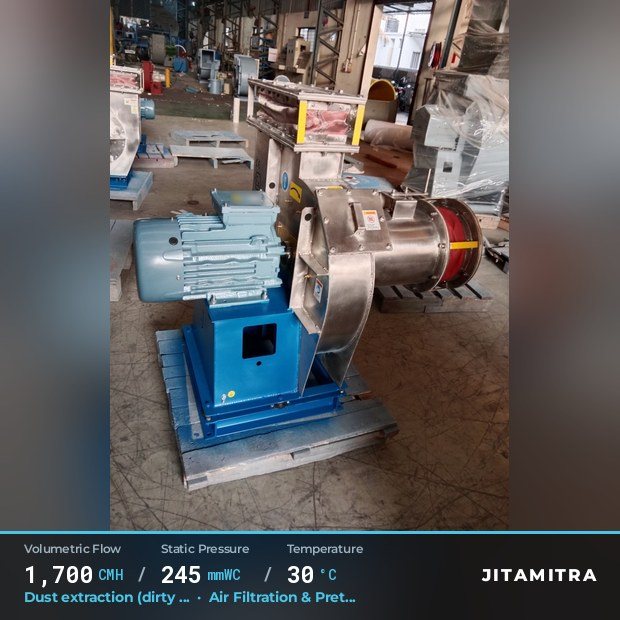
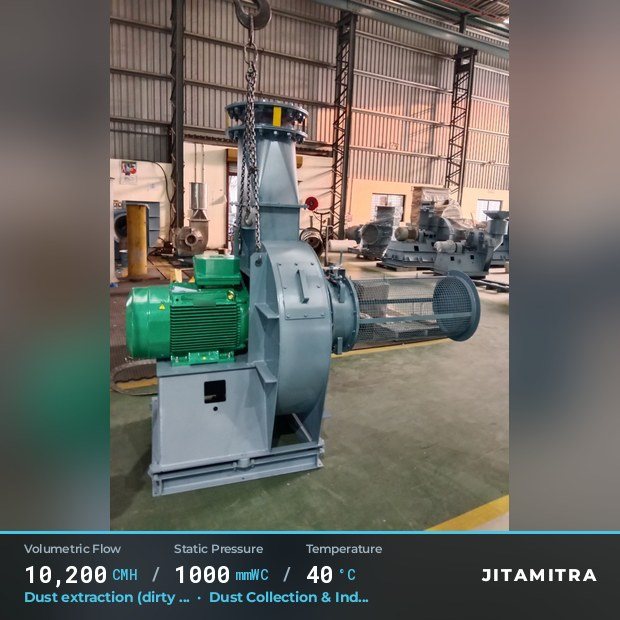
Representative builds from our own floor — illustrative, not the customer’s own unit.
A dust-extraction fan looks simple from across the shop floor — a scroll, a wheel, a motor. Open the general-arrangement drawing and it stops being simple. Here is a real machine we built for an air-pollution-control OEM: roughly 44,600 m³/hr at ~475 mmWC on a 120 HP flame-proof motor, a mid-range dust fan in our served range. Every choice on that drawing — a coupled backward-curved aluminium wheel, a brass spark ring, silicon-glass bellows — answers a specific question about the air it moves and where it sits in the system.
This is the one decision that drives everything else. In a pulse-jet baghouse the fan almost always mounts on the clean side — it pulls filtered air out through the outlet plenum rather than pushing raw process air into the bags. By the time the airstream reaches the wheel, the bags have already caught the dust, so grain loading at the impeller is low. That is what lets us use a high-efficiency backward-curved wheel here (total fan efficiency around 75%) instead of a rugged paddle. Put the same fan on the dirty side, ahead of the filter, and the wheel would see the full abrasive, grain-laden airstream — a different machine entirely.
| Parameter | This fan |
| Flow | ~44,600 m³/hr |
| Static pressure | ~475 mmWC |
| Operating temperature | 50 °C |
| Wheel | Backward-curved, aluminium |
| Total fan efficiency | ~75% |
| Drive | Coupled, 120 HP flame-proof, VFD-rated |
| Speed | 1,480 rpm |
| Spark-resistance | AMCA Type B construction |
The wheel is the fan: put four different impellers in the same scroll and you get four different machines. On the clean side, a backward-curved wheel wins on efficiency and gives a non-overloading power curve — power peaks and then falls, so the motor cannot be overloaded by a duct change. But it is the wrong wheel for raw abrasive dust: the thin sections erode. The moment a fan has to breathe coarse, abrasive or sticky dust — coal dust, fly ash, foundry or grinding fines, or a dirty-side duty — a heavy radial paddle becomes mandatory. Wide-spaced radial blades are self-cleaning and shrug off wear at the cost of efficiency, usually backed with bolt-on wear plates. Match the wheel to the airstream first, the duty point second — more on that in choosing the fan wheel and, for the abrasive case, wear protection and hard-facing.
Combustible dust means an ignition source is the thing you engineer out. If a rotating and a stationary steel part ever touch, they can throw a spark — so this fan is built to the AMCA spark-resistance classes, Type B here: a non-ferrous aluminium impeller plus a brass spark ring at the shaft opening, so any rub is non-ferrous against non-ferrous. The motor is flame-proof (FLP), IP-65, IE3 and VFD-rated. Be precise about what this is: spark-resistant construction matched to the area classification the OEM specified — not a certificate. No fan carries an AMCA product stamp, and the motor plus every accessory must be rated to the same zone for the protection to mean anything.
The flexible connectors at inlet and outlet are non-metallic silicon-glass-fabric bellows — they absorb thermal movement and break the vibration path into the ducting so the fan does not shake the plant. Anti-vibration pads under the base and an outlet silencer finish the isolation. The rotating assembly is balanced to the ISO 21940 method at grade G6.3, vibration is held to the ISO 14694 BV-3 band, and performance is proven on the IS 4894 test method — methods we test to, stated honestly rather than dressed up as third-party stamps.
Here is the part buyers miss. A baghouse cleans itself: dust cake builds on the bags, the pressure drop across them rises, then a reverse pulse of compressed air knocks the cake off and the drop falls again. System resistance cycles between freshly-pulsed and loaded bags, and the fan rides its pressure-flow curve as that resistance swings. If the curve is flat, a small change in resistance produces a big change in flow — so when the bags load up, flow sags and capture velocity at the hoods collapses, letting dust escape at source. A steep backward-curved P-Q curve holds flow nearly constant through the same swing, keeping capture velocity up across the whole cleaning cycle. This is the heart of dust extraction — and of what some OEMs call circulaire fan dust prevention: keep the air fast enough to carry particulate all the way to the filter, pulse after pulse. It is also why the duty point has to be specified as a band, not a single number — see specifying the duty point.
Ask your fan vendor two questions: which side of the filter does this wheel see, and is the curve steep enough to hold capture velocity when the bags are dirty? If the answer is a shrug, keep looking.
Talk to us about a dust-extraction fan →
Jitamitra Electro Engineering · Fan-engineering notes, written for the engineer.
Sources & basis. Every engineering fact — duty ~44,600 m3/hr at ~475 mmWC, 50 C, 120 HP flame-proof VFD motor, 1,480 rpm, coupled backward-curved aluminium wheel at ~75% total efficiency, brass spark ring, AMCA Type B spark-resistant construction, silicon-glass-fabric inlet/outlet bellows, outlet silencer and anti-vibration pads, ISO 21940 grade G6.3 balancing, ISO 14694 BV-3 vibration and IS 4894 test method — is read directly from the general-arrangement drawing of one dust-extraction fan we built for an air-pollution-control OEM. Customer, job, drawing, part and type-code details are withheld for confidentiality, and duties are presented as a served range within our published envelope.
After it, on the clean side — that one decision drives everything else. In a pulse-jet baghouse the fan pulls filtered air out through the outlet plenum rather than pushing raw process air into the bags, so grain loading at the impeller is low. Put the same fan on the dirty side and it is a different machine entirely.
More likely the curve is too flat. System resistance cycles as cake builds and each reverse pulse knocks it off, and the fan rides its pressure-flow curve through that swing. A flat curve turns a small resistance change into a big flow change, so flow sags and capture velocity at the hoods collapses. A steep backward-curved P-Q curve holds flow nearly constant.
Material pairing at the rub. If a rotating and a stationary steel part touch they can throw a spark, so this fan is AMCA Type B: a non-ferrous aluminium impeller plus a brass spark ring at the shaft opening, and a flame-proof motor. That is spark-resistant construction, not a certificate — no fan carries an AMCA product stamp, and every accessory must be rated to the same zone.
No. On the clean side a backward-curved wheel wins on efficiency and gives a non-overloading power curve, but it is the wrong wheel for raw abrasive dust — the thin sections erode. For coarse, abrasive or sticky dust, or any dirty-side duty, a heavy radial paddle becomes mandatory: wide-spaced, self-cleaning blades, usually backed with bolt-on wear plates.
On this build the rotating assembly is balanced to the ISO 21940 method at grade G6.3, vibration is held to the ISO 14694 BV-3 band, and performance is proven on the IS 4894 test method. Those are methods we test to, stated honestly rather than dressed up as third-party stamps. Silicon-glass-fabric bellows and anti-vibration pads keep the vibration path out of the ducting.
It is real, and the limits are stated plainly. Every figure — ~44,600 m³/hr at ~475 mmWC, 50 °C, 1,480 rpm, ~75% total efficiency — is read directly from the general-arrangement drawing of one fan built for an air-pollution-control OEM. Customer, job, drawing and part details are withheld, and the photographs are representative builds, not the customer's own unit.
Flow, static, gas temperature, application — or attach a spec, GA drawing or a multi-fan schedule. Engineer to engineer.
ISO 9001:2015 quality system · performance-tested to IS 4894 / ISO 5801 / AMCA 210 method · witnessed FAT on request.
*For our standard range. ATEX and special projects need 5 to 7 working days.
This site sets no cookies of its own. Google Analytics loads only if you accept. It sets two cookies, so we can see which fan topics people actually read. Decline and no analytics loads — the site works exactly the same. What we collect →