Single-inlet high-static selection, hygienic construction, and the one datasheet line that sizes the machine — read from a real selection report.
Reviewed by Jitamitra application engineering
Share on LinkedIn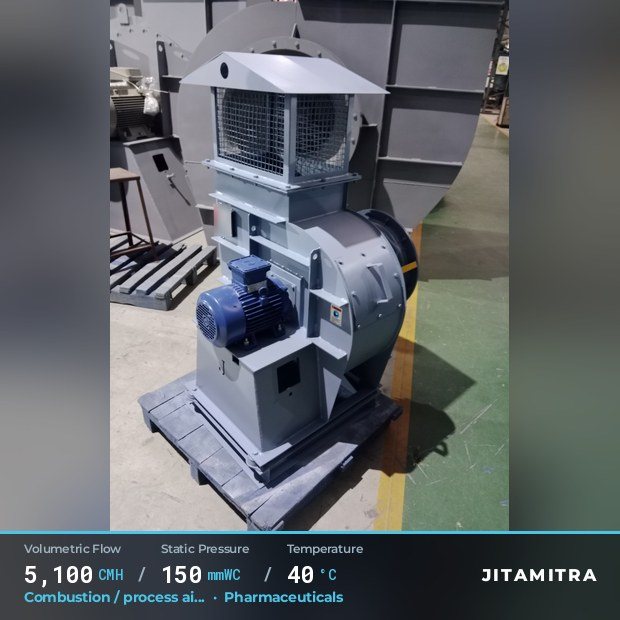
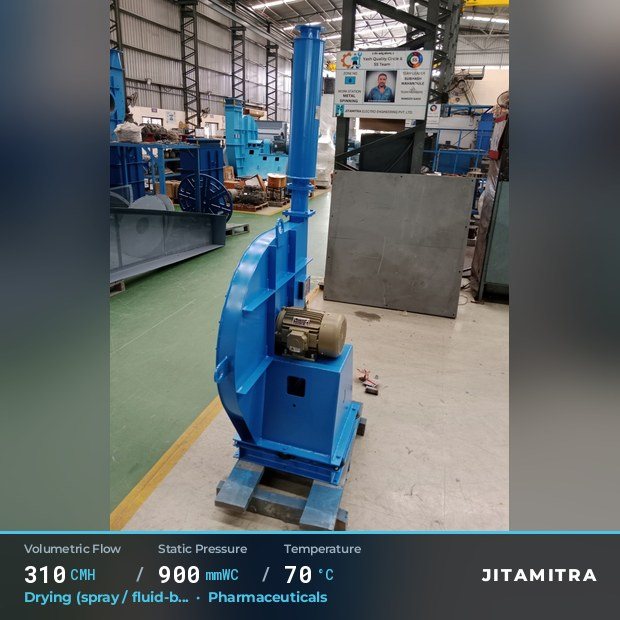
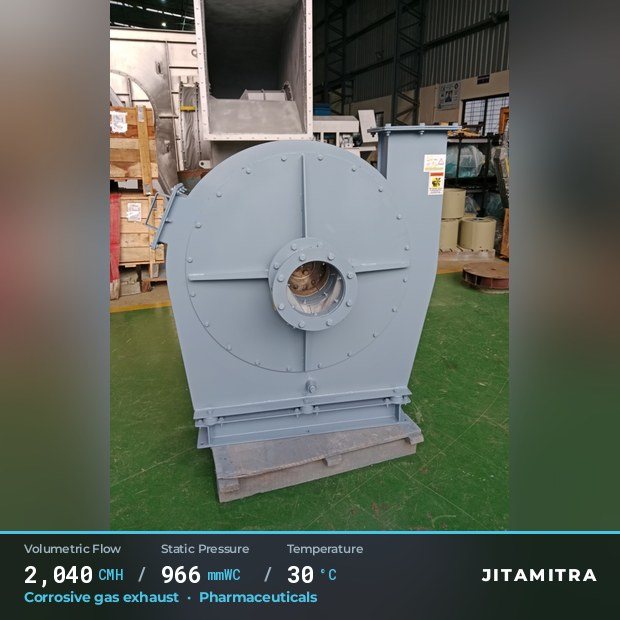
Representative builds from our own floor — illustrative, not the customer’s own unit.
The line on a pharma process-blower RFQ that actually sizes the machine is not the airflow — it is the static pressure, and only if it is stated at the fan outlet and labelled as static. We recently built a direct-driven process blower for a pharma-equipment customer at roughly 11,050 m³/hr and 610 mmWG fan static pressure. The flow is unremarkable. The 610 mmWG is what decided the wheel, the speed and the motor. Here is how that selection reads, anonymised from the real summary report and data sheet.
A centrifugal fan develops pressure from tip speed — and fan pressure rises with roughly the square of that tip speed. So the static duty you write down sets the tip speed the wheel must reach; tip speed then sets the combination of diameter and rpm; and that combination sets absorbed power and therefore motor rating. At this duty the wheel runs at about 101 m/s tip speed to make 610 mmWG, drawing roughly 24.8 kW at the duty point behind a 40 HP motor.
Flow does matter — it sets the inlet area and wheel width — but two fans at the same 11,050 m³/hr can be entirely different machines once one is asked for 150 mmWG and the other for 610. That is why a quotation only means something when it says which pressure it states. Fan static pressure (FSP) excludes the velocity pressure at the outlet; fan total pressure (FTP) includes it, and at real outlet velocities the gap is not rounding error. If your consultant's schedule gives total pressure, pass it on as total — do not relabel it. We convert it and show the conversion.
The instinct on anything near a cleanroom or pharma AHU is a double-inlet (DWDI) wheel — and for AHU supply and return duty that instinct is right: DWDI moves high volume at lower pressure and packs into a shorter plenum. But a 610 mmWG scrubber or process blower is a different animal. High static at modest flow is single-inlet (SWSI) territory: one impeller, one clean inlet approach, bearings out of the airstream. We selected a single-width backward-inclined wheel of about 665 mm here for exactly that reason. Get the width question answered by the duty, not by habit — see our backward-curved fan range.
| Parameter | Value (served) |
| Volume flow | ~11,050 m³/hr |
| Fan static pressure (at outlet) | 610 mmWG |
| Operating temperature | 30 °C |
| Gas density | 1.157 kg/m³ |
| Wheel | single-inlet, backward-inclined, ~665 mm |
| Speed · tip speed | 2,890 rpm · ~101 m/s |
| Absorbed power at duty | ~24.8 kW |
| Motor · drive | 40 HP · direct-driven |
Every figure traces to the selection report and data sheet for this job; all of it sits well inside our served envelope. Temperature rise across the fan works out to under 7 °C, which matters when the discharge feeds back toward conditioned space.
Two construction decisions follow the pharma setting. First, direct drive: no belts means no belt-dust shedding and one fewer wear item to service near a clean process — but it fixes the fan close to motor speed (about 2,890 rpm on a 2-pole), so the wheel diameter has to do all the work of hitting 610 mmWG. Lose the belt-ratio freedom and diameter becomes the tuning knob. Second, wetted parts in stainless: the impeller and hub are SS304 for a cleanable, corrosion-resistant gas path, on an epoxy-coated 4 mm mild-steel casing. The build also carried a silicone inlet flexible connector to isolate vibration, an outlet silencer, a drain plug, an aluminium spark-proof ring at the inlet, and anti-vibration mounts. One honest limit worth stating up front: a gland/plate shaft seal reduces but does not achieve 100% sealing.
The rotor was balanced to the ISO 1940 G2.5 grade and the fan tested to the IS 4894 method, with the test record naming its setup — no fan carries an AMCA product stamp, so the honest claim is always the method, not a certificate. Pushing rpm to chase static is expensive because power climbs with the cube of speed (the cube law), which is one more reason to fix the static number precisely before selecting.
Do that and the machine gets sized by engineering. See also seven mistakes when buying an industrial fan.
Talk to us about pharma process blowers →
Jitamitra Electro Engineering · Fan-engineering notes, written for the engineer.
Sources & basis. Figures are anonymised from a real direct-driven single-inlet pharma process blower we supplied - its fan selection summary report and technical data sheet (~11,050 m3/hr, 610 mmWG fan static pressure, 30 degC, ~665 mm backward-inclined wheel at 2,890 rpm, ~24.8 kW at duty, 40 HP direct drive, SS304 wetted parts, ISO 1940 G2.5 balance, tested to the IS 4894 method). Engineering framing on single-inlet vs double-inlet construction and on static, velocity and total pressure reflects established fan-engineering principles. Customer identity, order and job references are withheld; values are given as served-range, not absolute ratings.
The static — stated at the fan outlet and labelled as static. A centrifugal fan develops pressure from tip speed, and pressure rises with roughly the square of it. On this blower the flow of ~11,050 m³/hr is unremarkable; 610 mmWG is what decided the wheel, the speed and the motor — about 101 m/s tip speed, roughly 24.8 kW at duty behind a 40 HP motor.
Because they were not quoting the same pressure. Two fans at the same 11,050 m³/hr can be entirely different machines once one is asked for 150 mmWG and the other for 610. Fan static pressure excludes the velocity pressure at the outlet; fan total pressure includes it. If your schedule gives total, pass it on as total — do not relabel it; we convert it and show the conversion.
For AHU supply and return duty that instinct is right — a double-inlet wheel moves high volume at lower pressure and packs into a shorter plenum. But a 610 mmWG scrubber or process blower is a different animal. High static at modest flow is single-inlet territory: one impeller, one clean inlet approach, bearings out of the airstream. Let the duty answer the width question, not habit.
The belt-ratio freedom. Direct drive means no belts, so no belt-dust shedding and one fewer wear item to service near a clean process — but it fixes the fan close to motor speed, about 2,890 rpm on a 2-pole. The wheel diameter then has to do all the work of hitting 610 mmWG; here that meant a single-width backward-inclined wheel of about 665 mm.
The wetted parts are stainless: impeller and hub in SS304 for a cleanable, corrosion-resistant gas path, on an epoxy-coated 4 mm mild-steel casing, with a silicone inlet flexible connector, an outlet silencer, a drain plug, an aluminium spark-proof inlet ring and anti-vibration mounts. One honest limit stated up front: a gland or plate shaft seal reduces but does not achieve 100% sealing.
Every figure traces to the selection report and data sheet for the job. Customer identity, order and job references are withheld, and values are given as served-range, not absolute ratings. The rotor was balanced to the ISO 1940 G2.5 grade and the fan tested to the IS 4894 method. No fan carries an AMCA product stamp, so the honest claim is the method, not a certificate.
Flow, static, gas temperature, application — or attach a spec, GA drawing or a multi-fan schedule. Engineer to engineer.
ISO 9001:2015 quality system · performance-tested to IS 4894 / ISO 5801 / AMCA 210 method · witnessed FAT on request.
*For our standard range. ATEX and special projects need 5 to 7 working days.
This site sets no cookies of its own. Google Analytics loads only if you accept. It sets two cookies, so we can see which fan topics people actually read. Decline and no analytics loads — the site works exactly the same. What we collect →