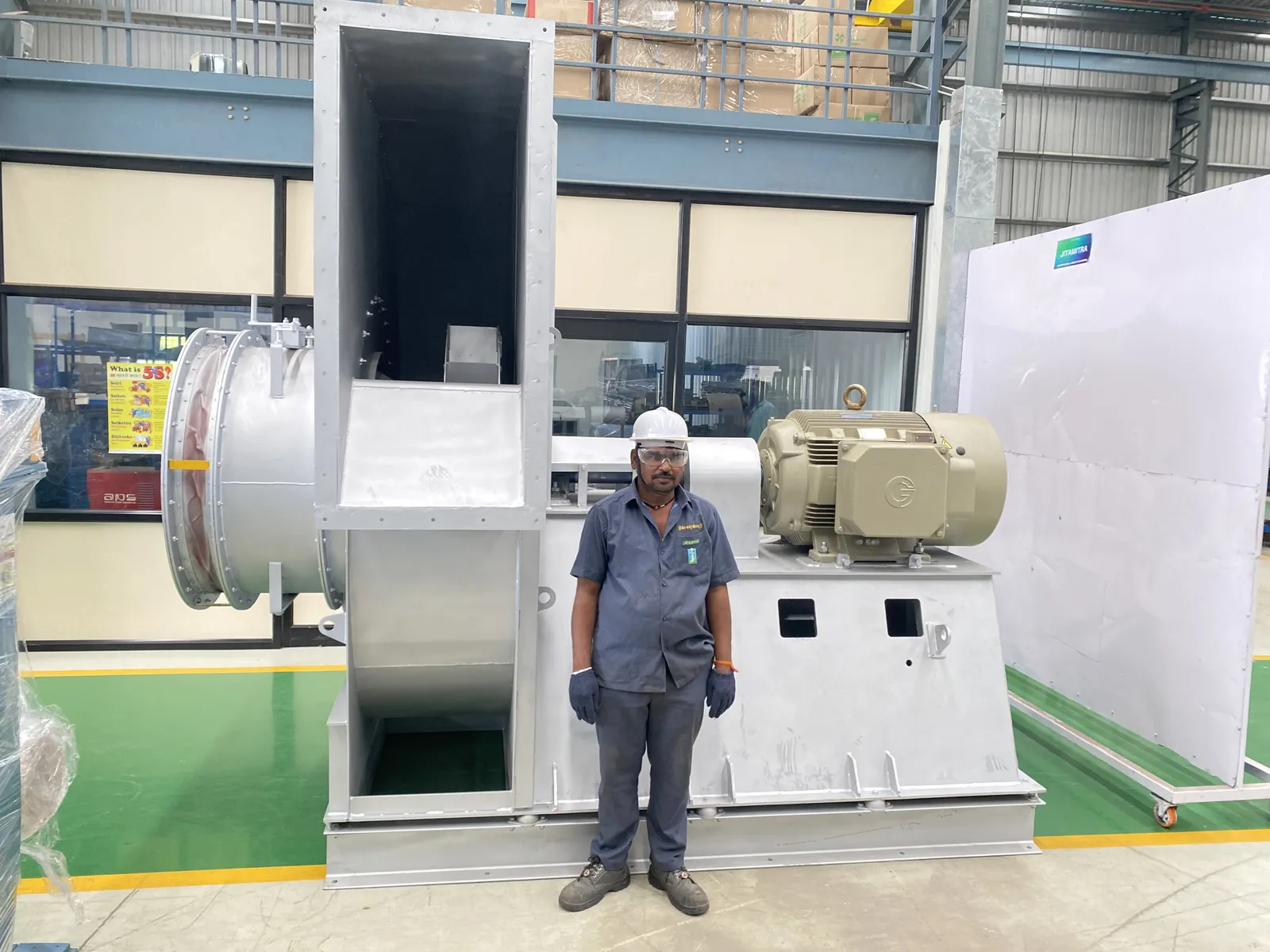
Noise that is there from the first run is almost always a fitment fault, not a defective bearing. The usual causes are internal clearance set wrong at assembly, an interference fit driven too far up a tapered sleeve, a housing bored out of tolerance, or a locating and floating pair both locked so the shaft cannot grow. A bearing that was wrong at fitment does not bed in - it gets worse.
Most bearing complaints arrive after years of service. This one doesn't. This is the fan that was noisy the week it was commissioned, and the reason is almost always that the bearing's internal clearance was set wrong when it was mounted.
Plummer-block fans in this class typically run taper-bore spherical-roller bearings on an adapter sleeve, C3 clearance, locked with a KM nut and a lock washer. The bearing does not arrive with its running clearance fixed — the fitter sets it, by how far the sleeve is driven up the taper. Drive it too far and the inner ring expands, C3 collapses into negative clearance: preload. Leave it short and the inner ring is loose on its seat. Both are wrong from the first revolution, and neither is cured by grease.
Vibration thresholds — state the mounting. Under ISO 14694 (fan application categories, e.g. BV-3), on a rigid mount the commissioning-acceptance limit is ≤ 4.5 mm/s r.m.s., alarm 7.1, shutdown 9.0. On a flexible mount: 6.3 / 11.8 / 12.5. A number quoted without the mounting condition is meaningless. Keep this separate from ISO 10816/20816, which grades overall velocity into evaluation zones A–D for machines generally — different standard, different basis. Don't mix the two on one report line.
Ranked by the honest prior:
A fan leaves works run-tested, so causes downstream of dispatch — transport, installation, commissioning, operation, wear, or a bought-out component — carry the higher prior. That is a statement about where the clearance is physically set, not a way of pushing the problem across the fence: specifying the setting method and handing it over is the manufacturer's job.
First: isolate. Lock out and tag out, prove dead, and confirm the impeller has coasted to a full stop — a large rotor freewheels for minutes.
Decision point. Hot + stiff + both ends → preload; re-set the clearance looser. Play + knock + fretting → looseness; re-seat and re-lock. Evenly-pitched raceway marks with near-zero run time → brinelling; replace the bearing.
Transport & handling. Static brinelling — shipping shock on a non-rotating shaft skids the rollers and indents the raceway. Confirm: marks at roller pitch, present before any meaningful run time.
Installation & commissioning (the primary stage). - Sleeve over-driven. Taper drive-up radially expands the inner ring; C3 goes negative. Confirm: both ends hot, stiff by hand, unimproved by correct greasing. - Sleeve under-driven / locknut loose. Inner ring loose on the seat → micro-motion, fretting, walk-out. Confirm: hand-felt play, fretting corrosion on the seat, backed-off nut. - Lock stack not set. Nut not torqued, or the tab never bent into a slot, so it walks loose in service. Confirm: straight tab, slack nut. - Impeller central bolt or key not torqued. Confirm: measurable shaft-to-impeller play. - Over-tightening at fitment. Excess clamp load can crack an adjacent part such as a cooling ring or heat slinger. Confirm: visible crack at strip-down.
Operation & process. Long idle before start-up — bearings sit statically loaded, grease drains or rusts. Confirm: delay beyond ~2 months; inspect grease for rust and raceways for brinelling.
Maintenance & wear. - Grease over-pack or wrong grade. Churning heat with no mechanical play. Confirm: over-full housing, high temperature, shaft turns freely. - Clearance re-set wrong at a field bearing change. The same over/under-drive error, repeated. Confirm: the noise dates from the change, not before it.
Two misdiagnoses waste the most field time. "Just re-grease it" — grease will not open a clearance that a taper closed. "Bad bearing, replace it" — fit a new bearing, drive the sleeve wrong again, and you have faithfully reproduced the failure. The setting is the fault far more often than the part.
Jitamitra manufactures centrifugal fans and blowers and services fans of any make — on-site vibration diagnosis, in-situ and workshop balancing, bearing and coupling replacement, adapter-sleeve clearance setting, and re-rating where the duty has drifted away from the fan. If you have a day-one bearing noise you cannot close out, our service desk can take it.
sales@jitamitrablowers.com · Jitamitra Help Desk +91 8329172325
Jitamitra Electro Engineering Private Limited is ISO 9001:2015 certified (third party). Fan performance is tested to IS 4894 / ISO 5801 / AMCA 210 method. CE and ATEX (Zone 2/22) conformity is self-declared.
— Jitamitra Electro Engineering · Technical Services
Engineered for Every Application.
Flow, static, gas temperature, application — or attach a spec, GA drawing or a multi-fan schedule. Engineer to engineer.
ISO 9001:2015 quality system · performance-tested to IS 4894 / ISO 5801 / AMCA 210 method · witnessed FAT on request.
*For our standard range. ATEX and special projects need 5 to 7 working days.
This site sets no cookies of its own. Google Analytics loads only if you accept. It sets two cookies, so we can see which fan topics people actually read. Decline and no analytics loads — the site works exactly the same. What we collect →