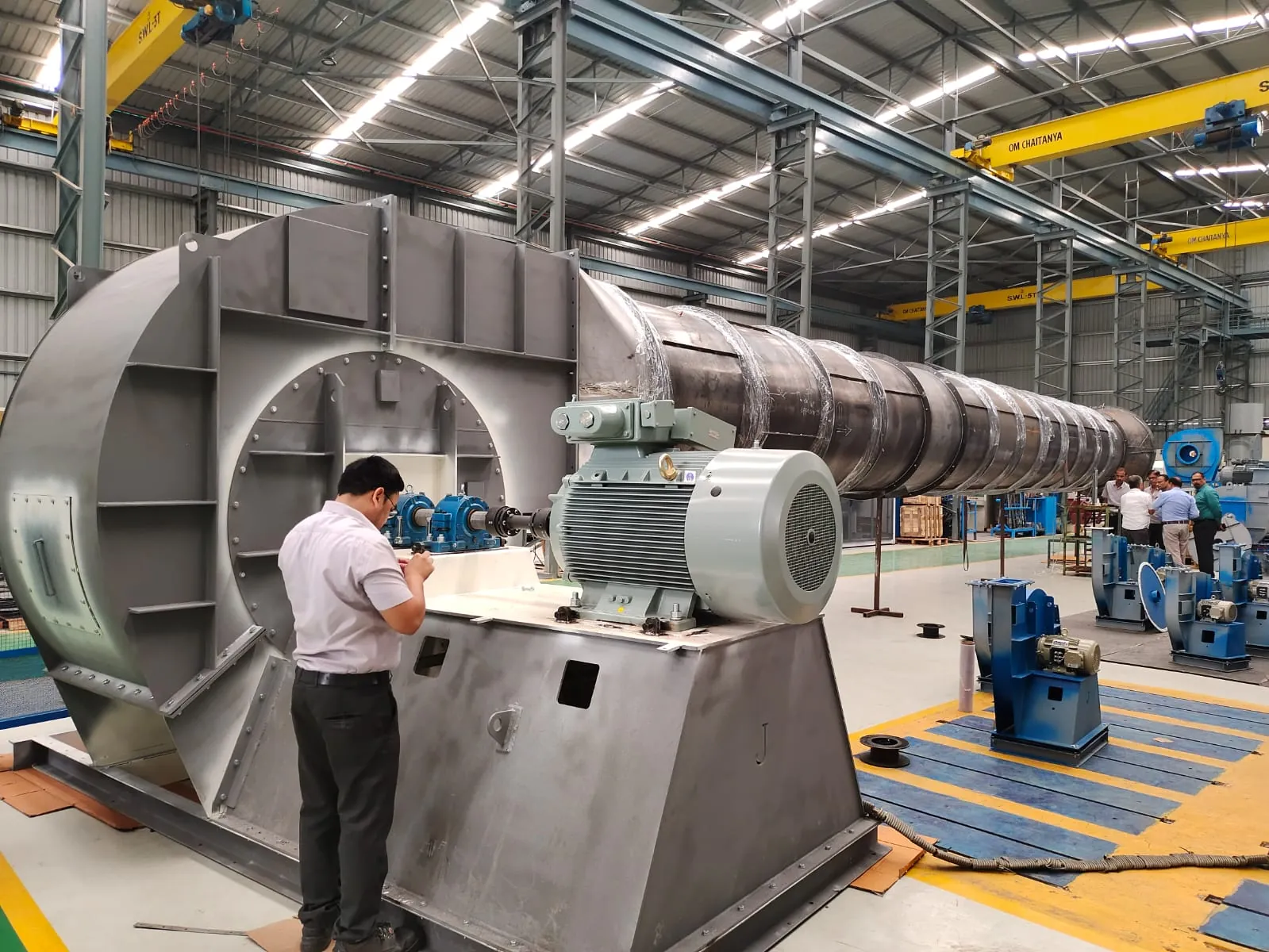
Sometimes, but test it before you re-grease. Too little grease gives metal-to-metal contact, heat and spalling; too much gives churning, heat, seal blow-by and leakage - so over-greasing is as common a cause as under-greasing. The decisive test is simple: if the noise does not clear after a correct top-up with the right grease, the race is already damaged and grease will not save it.
A hot or noisy fan bearing is the most common service call we get — on our own fans and on fans of every other make we're asked to look at. It's also the most commonly misdiagnosed, because the bearing is where the pain shows, not usually where the problem started.
Sound. An abnormal note from the plummer block — growl, rumble, or a periodic knock. Character matters: a dry or spalled bearing gives a high hissing or grinding note; an over-packed or brinelled bearing gives a lower rumble. The single most diagnostic observation available to you: does the noise clear after a correct grease top-up? If it doesn't, the raceway is already damaged and more grease will not fix it.
Vibration. Rising broadband velocity at the bearing caps. Grade against ISO 14694 — and state the mounting, because the numbers differ:
| BV-3 (common industrial) | Commissioning acceptance | Alarm | Shutdown |
|---|---|---|---|
| Rigid mount | 4.5 mm/s r.m.s. | 7.1 | 9.0 |
| Flexible mount | 6.3 mm/s r.m.s. | 11.8 | 12.5 |
Use the flexible band for spring-isolated, soft-mounted or elevated installs, or you'll over-diagnose a healthy fan. These are ISO 14694 fan limits — don't mix them with ISO 10816 / 20816 machine-zone boundaries.
One trap: bearing-defect energy sits at high frequency. A velocity meter can read comfortably inside limits while the raceway is disintegrating. Take an acceleration or envelope (gE) reading at the cap as well.
Temperature. A stabilised rise of more than 40 °C over ambient, or an absolute cap temperature above 70–80 °C, is abnormal. Over-greasing has a signature: temperature climbs first, then grease weeps past the seals.
Visual. Grease or oil weeping at the nipple or seal. Discoloured (blued) grease. Perished coupling rubbers. A torn expansion bellow with oil tracks below it.
Motor current. Creeping up as drag increases; tripping in the terminal stage.
Ranked by how often we find it, once a fan is in service:
A fan leaves works run-tested and balanced, so for a bearing that has been in service the higher prior sits in the field — transport, installation, commissioning, operation, wear, or a bought-out component. That's where the evidence points; it isn't a way to end the conversation. Where a bearing goes noisy within days of first run, keep a bearing-supply or assembly cause open until a teardown confirms or clears it.
Work in this order. Skipping to step 4 with a vibration meter in hand is how bearings get replaced twice.
0. Isolate. Lock out, tag out. Confirm zero energy at the motor terminals and the impeller at rest, and shut any damper or process line that could motor the fan backwards. A fan will windmill in a live duct.
1. Interview. Running hours. Commissioning status — properly commissioned, or run in bursts? Last greasing: who, what grade, how much, when? Any trips or restarts? This step reframes more failures than any instrument. A fan that has run 10–12 hours in intermittent commissioning bursts and is already noisy is telling you something very different from one at 8,000 hours.
2. Stopped inspection. Rotate the impeller by hand — feel for roughness, notchiness, axial and radial play. Inspect nipple and seals for weeping, the coupling pin-bush set, belt condition and tension, and the impeller for build-up.
3. Mounting and structure. Firm grouted foundation, hold-down bolts torqued, and soft-foot checked with a feeler gauge (target < 0.05 mm). Confirm the fan sits on the structural support it was designed for — on an export project we found a 91,800 CMH induced-draught fan that had run about a year without its designed support, ending in plummer-block leakage and a torn bellow. Check alignment (laser or dial) and coupling gap.
4. Vibration — baseline vs running. Velocity (mm/s) and acceleration (gE) at drive-end and non-drive-end caps, horizontal / vertical / axial. Compare against the handover or test-bed record if one exists — this is precisely why a baseline is worth taking. Grade against the ISO 14694 band matching the actual mounting.
5. Thermal. IR or contact temperature at both caps after 30–60 minutes of steady running. Log the rise over ambient, not just the absolute.
6. Decision points. - Grease top-up cures the noise → it was under-greased. Set the interval, close out. - Noise or vibration persists after correct greasing → the bearing is damaged. Replace it; stop topping up. - Weeping at the nipple with an otherwise sound bearing → over-greasing or an unsealed nipple, not a failed bearing. - Vibration that tracks with fouling → clean the impeller and re-measure before condemning anything. - Sanity-check the ticket before ordering spares. "Blower problem" complaints are frequently misfiled under bearings. A low-airflow complaint on a 15,000 CMH dryer-plant fan turned out to be pure system resistance — undersized ducting and a cyclone running well above its design pressure drop. The bearings were fine.
| Stage | Cause & mechanism | Confirm on site |
|---|---|---|
| Transport & handling | False brinelling — micro-movement marks the raceways in transit, with no rotation to restore the film. | Regularly spaced raceway marks; noise present from the very first run. |
| Installation | Missing support, soft-foot, misalignment — casing distortion and dynamic load pass into bearings and seals, giving leakage and eventually a torn bellow. | Soft-foot gauge; alignment check; audit the actual support against the GA. |
| Installation | Resonant elevated platform — a flexible high structure amplifies vibration at running speed. Fans on a 32 m elevated outdoor platform went noisy a month after commissioning. | Bump test: structural natural frequency vs run speed. |
| Commissioning | Shortcuts, irregular running-in — a bearing loaded hard before proper lubrication and bedding-in takes early damage. | The commissioning log — or its absence. |
| Operation & process | Over-greasing — an over-packed housing churns, heats, forces grease past the seals. | Weeping at the nipple, with a bearing that still feels sound. |
| Operation & process | Process fouling — powder builds on the impeller, shifts the centre of mass, drives a 1× unbalance force into the bearings. On a 15,000 CMH paint-shop exhaust fan, paint-powder accumulation alone raised vibration to complaint level. | Inspection hatch; vibration falls after cleaning. |
| Operation & process | Belt tension out of spec — side load on the drive-end bearing accelerates wear. | Tension gauge; belt wear pattern. |
| Maintenance & wear | Coupling pin-bush degradation — worn elastomer lets the coupling transmit shock into the shaft. On a 30 HP high-pressure fan in a steel plant, perished coupling rubbers took out both bearings. | Strip and inspect the pin-and-bush set. |
| Maintenance & wear | Bearing already spalled — raceway damage. | Noise persists after correct lubrication. |
| Maintenance & wear | Contaminated / wrong-grade / dried-out grease — loss of the EHL film, metal-to-metal contact. | Grease sample; discolouration. |
The physics under all of it. A rolling bearing needs a thin, continuous film. Too little grease → metal contact, heat, spalling. Too much → churning, heat, seal blow-by, leakage. Misalignment, soft-foot and coupling wear add a rotating side load, and bearing life is brutally sensitive to load: L10 = (C/P)³ for ball bearings, so doubling the load cuts life to roughly an eighth (exponent 10/3 for rollers — about a tenth). That's why 0.1 mm of soft-foot is not cosmetic.
| Finding | Corrective action |
|---|---|
| Noise persists after correct greasing | Replace the bearing — and the matched pair if both are affected. Flush and repack with the correct grade and quantity. |
| Weeping at the grease nipple | Clean, apply PTFE tape to the nipple and torque it, then reset fill to about ⅓–½ of the free space. Don't condemn the bearing first. |
| Worn coupling pin-bush | Fit the correct pin-and-bush set, then re-check alignment and coupling gap. |
| No support / soft-foot / misalignment | Install or repair the support, shim out the soft-foot, re-align, then re-baseline the vibration. |
| Process fouling | Clean the impeller, re-measure, and set a cleaning interval matched to the duty. |
| Belt out of spec | Re-tension to the stated deflection; replace worn belts as a set. |
| Torn bellow / plummer leakage | Replace the bellow, reseal the plummer block — and correct the support problem that caused it, or you'll be back. |
Jitamitra services fans of any make, not only our own — on-site vibration diagnosis, in-situ and workshop balancing, bearing and coupling replacement, alignment and structural correction, and re-rating where the duty has drifted from the original selection. If you have a bearing that won't stay quiet, or vibration numbers you can't explain, send us the readings and the mounting condition and we'll tell you what we think before anyone opens anything.
sales@jitamitrablowers.com · Jitamitra Help Desk +91 8329172325
Jitamitra Electro Engineering is ISO 9001:2015 certified (third party). CE and ATEX (Zone 2/22) conformity is self-declared.
— Jitamitra Electro Engineering · Technical Services
Engineered for Every Application.
Flow, static, gas temperature, application — or attach a spec, GA drawing or a multi-fan schedule. Engineer to engineer.
ISO 9001:2015 quality system · performance-tested to IS 4894 / ISO 5801 / AMCA 210 method · witnessed FAT on request.
*For our standard range. ATEX and special projects need 5 to 7 working days.
This site sets no cookies of its own. Google Analytics loads only if you accept. It sets two cookies, so we can see which fan topics people actually read. Decline and no analytics loads — the site works exactly the same. What we collect →