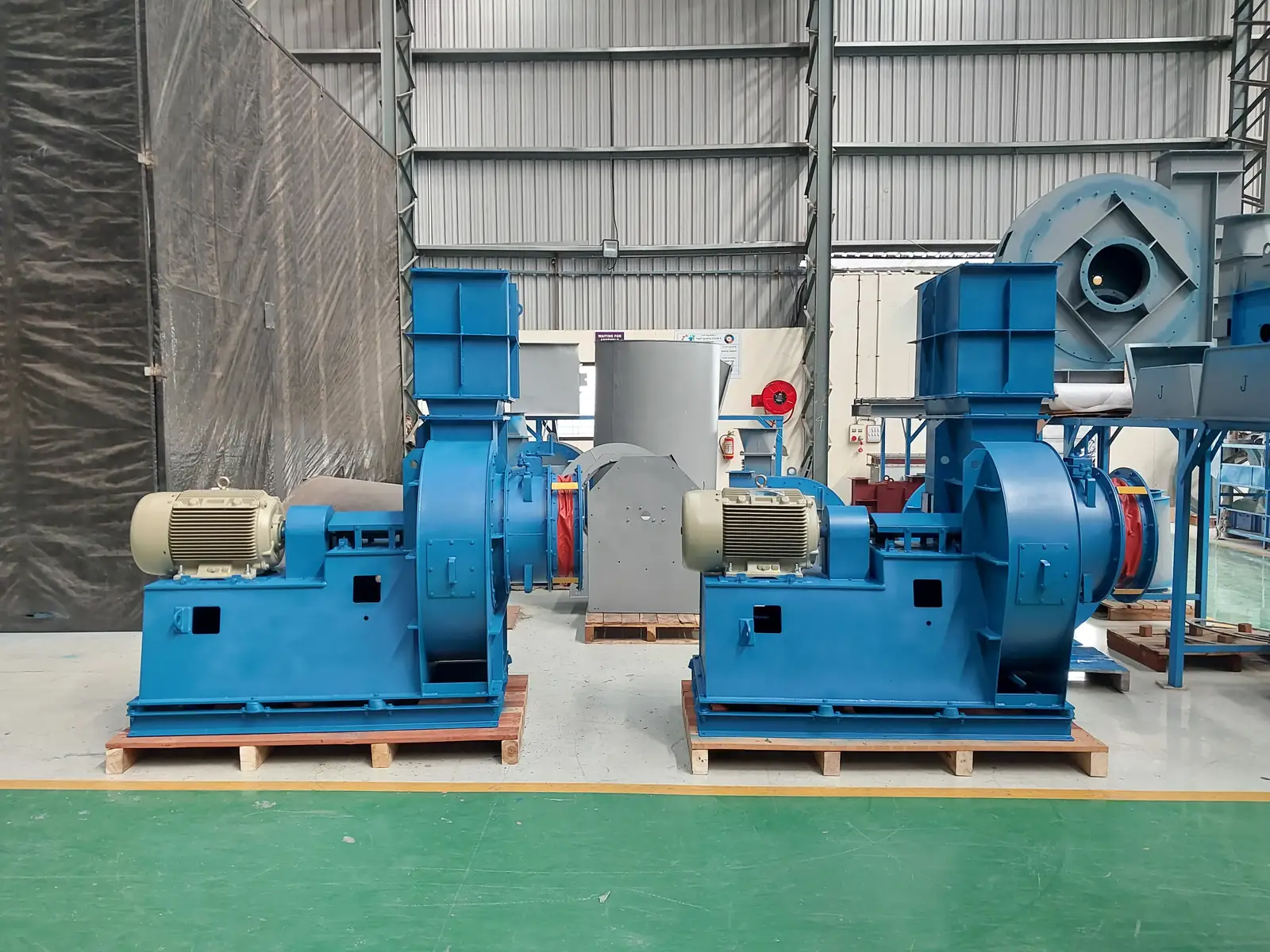
In our own service records the bearing is usually the symptom carrier, not the root cause. The recurring causes are lubrication faults, contamination past a worn or missing shaft seal, misalignment or soft foot adding a rotating side load, and residual unbalance or impeller fouling driving a once-per-revolution force straight into the housing. Replacing the bearing without finding which one it was buys you a few months.
Bearings are the largest single bucket in industrial fan service work — fan-side plummer blocks, motor bearings on bought-out motors, and the parts that fail around a distressed bearing (oil seals, heat slingers). Little of it is random. A bearing that dies early almost always has a traceable cause: something got in, something was missing, something was misaligned, or something was greased wrongly. This is the field procedure we use to find which.
The complaint arrives as "abnormal sound" or "vibration". Take the reading, not the adjective.
A fan leaves a competent works run-tested and vibration-checked, which makes the field causes the higher prior — roughly in this order:
Note what is not on that list: "noise and vibration" is not automatically a bearing. A rubbing inlet cone and a cracked heat slinger both arrive as bearing complaints. Confirm the source before you order a bearing.
Ordered, on site. Each step confirms or eliminates.
Transport and handling. False brinelling from transit vibration on a stationary bearing — micro-fretting of the races, confirmed by regular indentations at ball spacing on the stripped race. Long storage without shaft rotation drains the grease film and corrodes the lower race; look for rust staining and a dry bottom half.
Installation. Misalignment and soft foot load the bearing continuously. Bearing L10 life falls with the cube of dynamic load — a modest alignment error is not a modest life penalty. Confirm with 1×/2× vibration and a laser alignment check.
Commissioning. Residual unbalance kills bearings fast: a hot-gas induced-draught fan on a food/pharma process lost its plummer block within 10–12 hours of first run. Mounting or removing a bearing without a puller brinells the new one immediately. And a grease top-up mistaken for a fix — on a 15,000 CMH dryer fan both bearings sounded wrong at commissioning, grease was added, the noise stayed; the races were already damaged.
Operation and process. Fine process dust migrates through the motor-shaft-entry gap, cuts the oil-seal lip, then destroys the bearing over a few months. The tell is an impeller that is clean — no build-up to explain the vibration — with contaminated grease behind a damaged seal. High-temperature duty (300 °C and above) cooks ordinary grease and thermally loads the heat slinger; a cracked slinger lets heat walk straight into the bearing. Running above the alarm level spalls the race progressively — a 19,000 CMH dust-extraction fan reached around 40 mm/s with the shaft floating axially; nothing on it was salvageable by then.
Maintenance and wear. Wrong grade, wrong interval, wrong quantity. Uniform race wear after years of running is honest end-of-life — replace and reset the clock. And check which bearing: on a small pneumatic-conveying blower the "fan noise" was the bought-out motor's own bearing, out of warranty. Establish fan-side versus motor-side before anyone quotes.
Jitamitra services fans of any make, not only our own — on-site vibration diagnosis and balancing, bearing and coupling replacement, seal retrofits, and re-rating where the duty has moved away from the fan. If a machine is above its alarm level, still noisy after a grease change, or eating bearings repeatedly and you don't yet know why, a site visit costs less than the next failure.
Contact: sales@jitamitrablowers.com · Jitamitra Help Desk +91 8329172325
Jitamitra Electro Engineering Private Limited. Fans are tested to IS 4894 / ISO 5801 / AMCA 210 method; balance to ISO 21940; vibration acceptance to ISO 14694. Quality system ISO 9001:2015 certified; CE and ATEX (Zone 2/22) self-declared.
— Jitamitra Electro Engineering · Technical Services
Engineered for Every Application.
Flow, static, gas temperature, application — or attach a spec, GA drawing or a multi-fan schedule. Engineer to engineer.
ISO 9001:2015 quality system · performance-tested to IS 4894 / ISO 5801 / AMCA 210 method · witnessed FAT on request.
*For our standard range. ATEX and special projects need 5 to 7 working days.
This site sets no cookies of its own. Google Analytics loads only if you accept. It sets two cookies, so we can see which fan topics people actually read. Decline and no analytics loads — the site works exactly the same. What we collect →