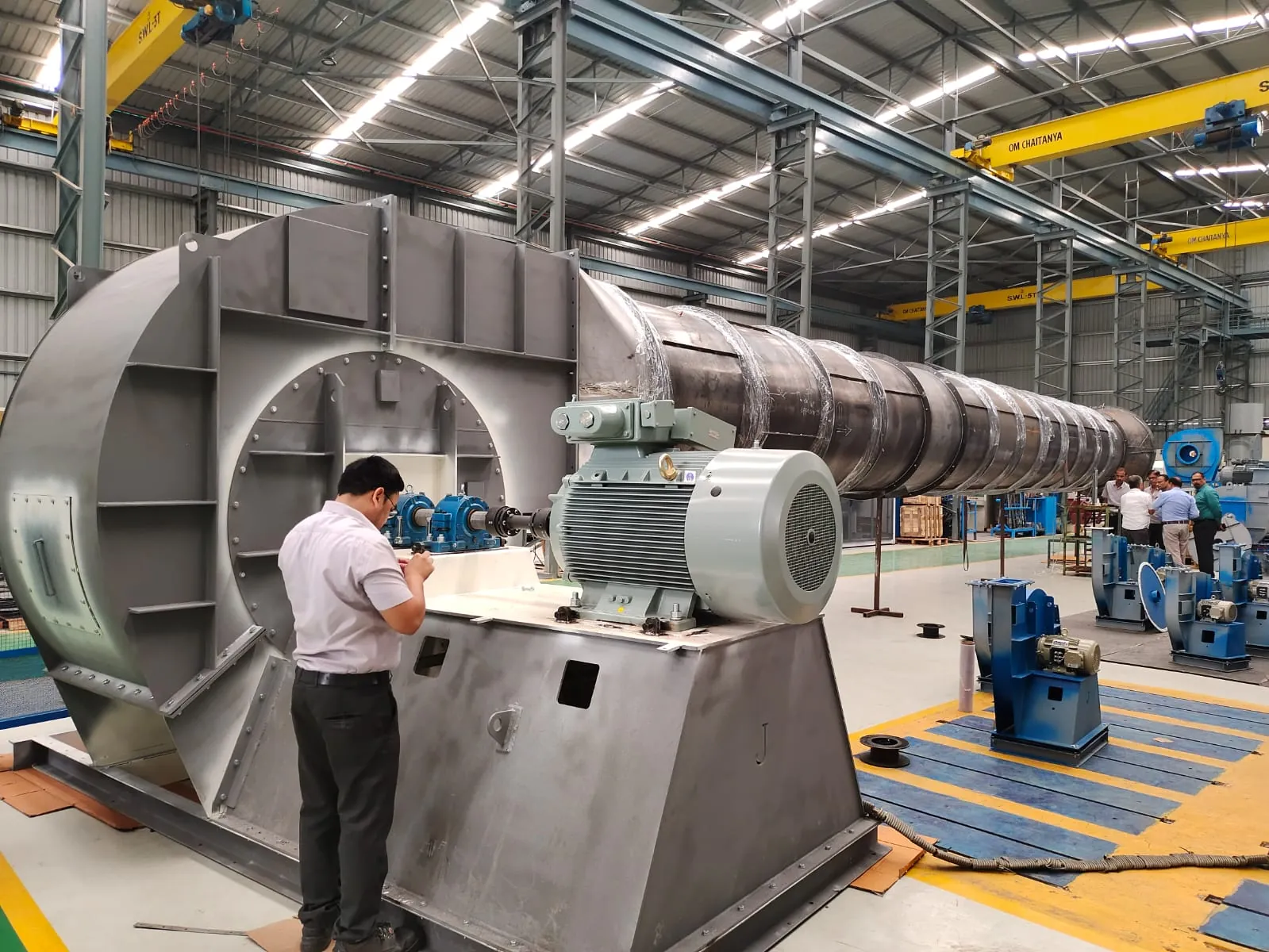
Slip is tension, alignment or the wrong section - in that order. Under-tensioned belts slip and polish the groove; over-tensioned belts load the bearings and shorten them. Misaligned sheaves throw the belt onto its flank, which is the usual cause of a squeal and of one-sided wear. And a belt that smokes is already glazed, so it must be replaced as a matched set, not topped up with one new belt.
A belt-driven centrifugal fan depends on three variables set after the fan leaves the works — sheave alignment, belt tension, taper-bush torque — and all three are set on a foundation, often in a hurry. Get them right and the drive runs for years; get one wrong and the belt tells you within hours. That is why belt drives are the largest single family of fan complaints we see. This procedure works on any belt-driven fan, whatever the make.
Ranked by what we actually find on site: sheave misalignment first, by a distance; then incorrect tension, almost always set by feel rather than by gauge; then a taper-lock bush or grub screws not torqued to the table; then groove contamination on dusty duties; then ordinary wear and elongation; and last, the belt as victim rather than culprit, shredded by impeller imbalance or a rub upstream of it.
A V-belt grips by wedging friction, and grip scales with effective tension × wrap angle × groove friction. Misalignment cuts contact, contamination and glaze cut friction, under-tension cuts normal force; the lost torque becomes heat, heat glazes, glaze accelerates slip. Over-tension does the opposite harm, dumping radial load into shaft and bearings. Getting tension into the narrow correct band is the whole game.
One honest word on priors. A fan leaves the works run-tested, so on a belt failure in service the higher prior is a field cause — transport, installation, commissioning, operation, wear, or a bought-out component. That is a statement about where the loose variables live, not a way of dodging responsibility: a geometry dimension set wrong on a drawing can foul an impeller and load the drive. When the checks below all come back in spec, works and design go back on the table.
Isolate and lock out the motor before any hands-on step. Never open a guard on a coasting fan.
Transport and handling. Shock in transit loosens a taper bush or nudges alignment; belts left tensioned through long storage take a set. Confirm: a bush loose out of the box, no operating hours behind it.
Installation. Misalignment introduced while mounting the motor — edge-loading, belt roll-off. Confirm: straight-edge or laser.
Commissioning. Tension set by feel, not gauge — signature is smoke during the first trial. Bush or grub screws never torqued — signature is a pulley walking along the shaft over the first weeks. Confirm: tension gauge, torque wrench.
Operation and process. Powder or paint-dust ingress into the guard on coating booths and oven blowers, packing grooves until grip collapses; process heat (oven duties well above 100 °C) hardening and glazing standard belts; sustained overload pushing torque past the drive rating. Confirm: look at the deposit in the guard; check running duty against drive rating.
Maintenance and wear. Fatigue, glazing and stretch with hours; grooves wearing; no re-tension after run-in; belt sets of different vintage sharing load unevenly. Confirm: belt age and hours, and whether the set is matched.
Design for the duty. On powder, paint and oven blowers, specify the spare groove, the extra belt and anti-static / oil-resistant belts up front. Size the drive with margin, avoid single-belt drives on dusty service, and specify guards with an inspection window and dust venting so the drive can be seen without a shutdown.
Commissioning discipline. Make alignment, gauge-set tension and bush torque three signed-off line items on the commissioning checklist — not three things someone remembers. Book and log the re-tension visit after run-in. Record the commissioning vibration figure against the ISO 14694 acceptance limit for the actual mounting; that number is the baseline for every later argument.
Maintenance intervals. Tension and belt condition monthly for the first quarter, quarterly thereafter. Replace belts as a matched set, never one at a time. Gauge sheave grooves annually. Keep guard and grooves clear of process deposit.
Hand-over. The operating crew needs one page: how to check tension, why over-tensioning is not "extra safe", keep the guard clear of powder, replace belts as a set, and report squeal or smoke immediately — slip destroys a belt fast.
If the drive checks out and the vibration will not clear, the fault is upstream and you need instruments rather than spanners. Jitamitra services fans of any make: on-site balancing, vibration diagnosis, bearing and coupling replacement, drive re-selection and re-rating. Send us the vibration readings, the duty and a photo of the guard, and we will tell you what we think it is.
Contact: sales@jitamitrablowers.com · Jitamitra Help Desk +91 8329172325
— Jitamitra Electro Engineering · Technical Services
Engineered for Every Application.
Flow, static, gas temperature, application — or attach a spec, GA drawing or a multi-fan schedule. Engineer to engineer.
ISO 9001:2015 quality system · performance-tested to IS 4894 / ISO 5801 / AMCA 210 method · witnessed FAT on request.
*For our standard range. ATEX and special projects need 5 to 7 working days.
This site sets no cookies of its own. Google Analytics loads only if you accept. It sets two cookies, so we can see which fan topics people actually read. Decline and no analytics loads — the site works exactly the same. What we collect →