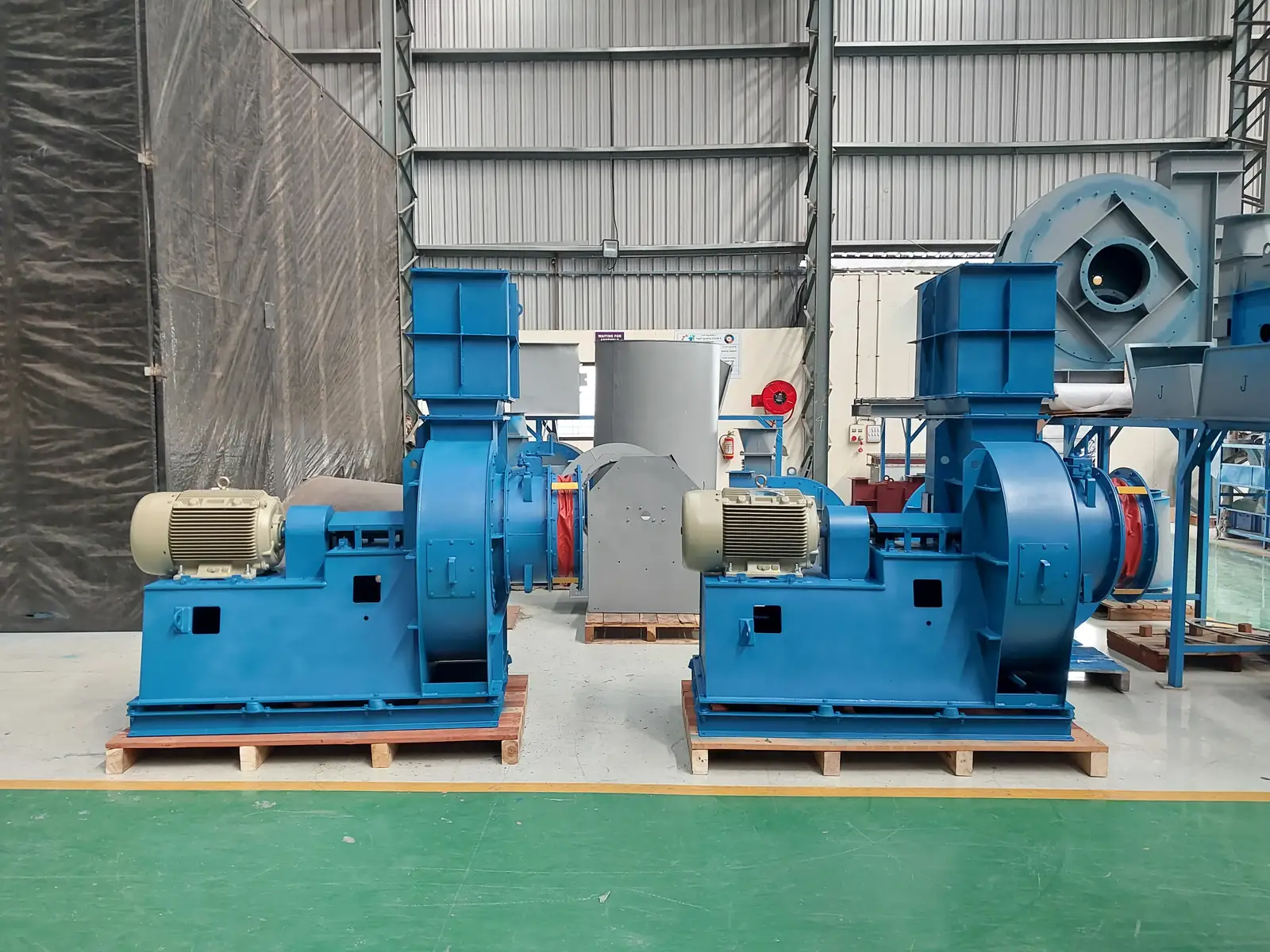
A leak is the loss of process air — or, on the suction side, the ingress of water and dirt — across a joint that should be airtight: the scroll weld seams, the flange gaskets, the shaft penetration, the plummer-block grease path, or a bolt-on such as a damper, inspection door or flexible connector. It is among the most misdiagnosed faults we see, because the joint that leaks is very often not the joint at fault.
What you're seeing
- Audible. A steady hiss or whistle from a seam or flange under running pressure — joint-specific, localisable with a stethoscope. Broadband aero or bearing noise does not localise to a joint line.
- Visual. Dust streaking or powder "comet tails" downstream of a seam; a torn or bulging bellows; an oil film at the greasing nipple; water pooling in the scroll or at the drain. A tissue held at the joint will move.
- Pressure. Static at the fan outlet below GA duty; the system will not hold set point; on a sealed test, pressure decays. A few percent of flow lost trips nothing — but it fails a trial run.
- Motor current. Usually unremarkable; a leak alone does not load the motor. If current is abnormal too, you have two faults — treat them separately.
- Vibration. Leakage is not a vibration mode, but an unsupported casing that leaks also runs rough, so vibration cross-checks the mounting behind the leak. Measure against ISO 14694 fan-application categories and state the mounting condition: for the common BV-3 category, rigidly mounted 4.5 mm/s r.m.s. commissioning acceptance, 7.1 alarm, 9.0 shutdown; flexibly mounted 6.3 / 11.8 / 12.5. Elevated readings alongside a leak point at strain, not at a hole.
- Temperature. Not a primary tell. A gasket that has taken a compression set weeps only once the line is hot — that timing is the diagnosis.
What it usually means
Ranked by what we actually find on site:
- Mounting and support — the casing or flexible connector carrying duct weight it was never designed to carry. The most common finding, by a distance.
- Bolting and gasket — under-torqued, uneven or incomplete bolting; a mis-cut or compression-set gasket.
- Drive-side seal path — weeping at the nipple threads or the lip/labyrinth seal. A drive leak, not a casing leak.
- Accessories — damper seals, drain plugs, doors, instrument tappings.
- Weather and drainage — outdoor units drawing water in through a suction-side joint.
- Weld seam — porosity or a cracked run. Real, but the lowest prior, and only callable after a scoped leak test with mounting and bolting already proven.
The honest frame: a fan leaves the works run-tested, so the higher prior sits with what happened afterwards — transport, installation, commissioning, operation, wear, or a bought-out component. That is a base-rate statement, not an argument. If a scoped leak test says the seam is bad, the seam is bad. Do the test.
How to diagnose it
Safety first. Lock out and tag out the drive, prove zero energy, let the impeller coast to a full visual stop. On hot service, let the casing cool. On dust or solvent duty, ventilate and gas-test before opening a door. The running checks below are done under permit, outside the guard line — never with a hand near a joint.
- Confirm it is a leak, not aero noise. At duty, trace the joint lines with a stethoscope. A leak gives a steady jet you can feel. Chalk-mark every leaking point before touching anything.
- Establish the pressure sign. Discharge side or suction side? Positive blows dust out; negative draws air, water and dirt in. This one question decides whether you chase a gasket or a rain path — and it is the step most often skipped.
- Check the mounting before you touch the casing. Verify the unit sits on its designed structural support and that the flexible connector is not carrying duct weight. Straightedge across the flange face; compare with the support GA. A distorted flange plane creates leaks in perfectly good joints.
- Bolting and gasket. Torque-check cross-pattern against the schedule. Look for a gasket mis-cut, blown out, or hard and cracked from compression set.
- Weld seams. Soap-solution the suspect seam under pressure and watch for bubbles; if a leak test is contractually scoped, run it to that class. Check first whether a leak test was ever in scope — a seam weep on a machine that never carried the requirement is a scope question as much as a metallurgy one.
- Separate the drive leak from the casing leak. Oil at the greasing nipple is a thread and seal path: inspect the nipple threads and the lip or labyrinth seal. Do not re-weld a scroll because a bearing housing is weeping.
- Isolate the accessories. Blank off or re-seal dampers, doors, drains and tappings one at a time. A damper spindle seal is a very common "casing leak".
- Decide. Attribute to a lifecycle stage below. Escalate to a seam defect only when mounting and bolting are proven and a scoped test fails.
The usual root causes
Transport & handling. Flange edge dinged or gasket dislodged in transit — confirm with a straightedge and fresh, bright dents. A bellows chafed or torn before installation: tear edges clean, not weathered.
Installation & commissioning — the primary cluster.
- No or incorrect structural support. The casing and flexible connector take load they were never sized for; the flange plane opens, the bellows tears, the drive seals weep in sympathy. We have seen this on a 100 HP induced-draught fan of roughly 90,000 CMH on a project-export site that stood about a year without its support steel. Confirm against the support GA.
- Under-torqued or incomplete bolting. The gasket never reaches sealing compression — the classic install-stage cause.
- Leak test never scoped. A trial run becomes the first leak test the machine has ever had — a governance failure wherever the fault finally lands.
- Duct strain or misalignment pulling on the outlet flange. Disconnect the duct and re-check: if the leak vanishes, the duct is your answer.
Operation & process. Positive-pressure dust escape through a marginal seam, seen as streaking — common on paint-shop and dust-collection extraction. Water ingress into a negative-pressure or outdoor casing through a missing cowl or blocked drain. Thermal cycling relaxing a gasket on hot exhaust duty.
Maintenance & wear. Grease-nipple weep from over-greasing or loose threads — on a 15,000 CMH paint-shop exhaust fan handling air at about 120 °C, a complaint logged as noise proved on site to be an oil weep at the nipple, plus a slack belt and a fouled impeller. Also aged gaskets, perished bellows, and damper seal wear.
How to fix it
- Unsupported casing / torn bellows: install the correct support per the GA, relieve the duct load, replace the bellows, re-seal and re-test. Fix the support first, or you will replace the bellows twice.
- Flange or gasket leak: new gasket in the correct material and cut for the service temperature; torque cross-pattern to the schedule; re-check flatness.
- Seam weep, leak-test-scoped job: grind out and re-weld the porous run, dye-penetrant or soap-test, then leak-test to the contractual class. Correct that specific GA — do not propagate a copied GA across the family.
- Grease-nipple weep: PTFE tape on the thread, re-tighten, correct the greasing quantity and interval. Over-greasing is a cause, not a cure.
- Damper leak: re-seal or replace spindle and blade seals; re-check the linkage.
- Water ingress: weather cowl, sealed shaft penetration, a cleared or newly fitted drain, and a re-route so the joint is not a rain path.
- Close with a signed record of what was found and done. An undocumented fix is a repeat visit.
How to stop it coming back
- Leak-test governance. Decide at GA approval whether the job needs a leak test and to what class — and record it in writing. Never let a trial run be the first leak test a machine sees.
- Mounting spec. Issue a supported-mounting drawing and a flexible-connector requirement with every project fan; make "do not commission without structural support" a hard gate on the commissioning checklist.
- Bolting discipline. Publish a flange-bolt torque and gasket schedule; verify at commissioning and again after the first thermal cycles.
- Seal detailing. PTFE-tape grease-nipple threads at build; specify gaskets rated for the actual service temperature, not the nominal one.
- Weatherproofing. For outdoor and washdown duty, treat cowl, casing drain and upgraded shaft seal as standard fit, not options.
- Commissioning baseline. Record vibration at handover against ISO 14694 for the stated mounting condition, rotor balanced to ISO 21940 (G6.3 is typical for this class). A baseline taken on day one is what proves, two years later, what actually changed.
When to call a specialist
Jitamitra services fans of any make, not only our own — on-site vibration diagnosis and balancing, bearing and coupling replacement, seal and bellows work, casing repair, and re-rating when the duty has drifted away from the machine. If you have a leak you cannot pin to a lifecycle cause, or you want an independent read before a warranty conversation with any supplier, we are glad to look. Contact: sales@jitamitrablowers.com · Jitamitra Help Desk +91 8329172325.
On our own credentials, since engineers ask: our quality system is ISO 9001:2015 certified (third-party). Our CE and ATEX (Zone 2/22) conformity is self-declared. Fan performance is tested to IS 4894 / ISO 5801 / AMCA 210 method in our own works.
— Jitamitra Electro Engineering · Technical Services
Engineered for Every Application.